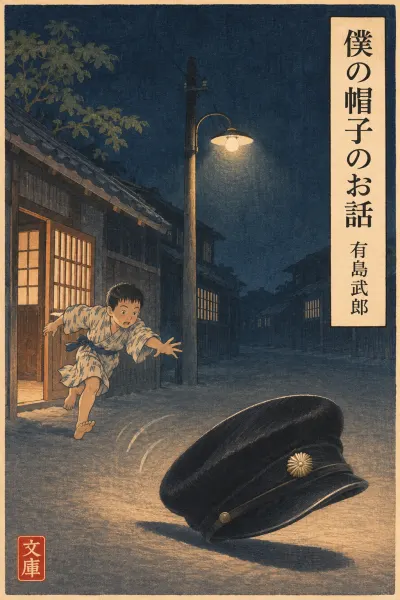
Part 3 of 4 · JLPT N3
僕の帽子のお話 Boku no Bōshi no Ohanashi, part 3: The Cap Becomes a Black Moon
In this part
In class the boy suddenly realises his cap has vanished. He runs out onto a dark, empty plain and finds it hanging in the sky like a black moon, ignoring him. He starts to fear that a shape-shifting tanuki is behind it all. When his weeping parents appear in their nightclothes calling his name, he stops himself from running to them because he suspects they may be tanuki too.
AI translation · independently checked
「これを何枚呑むとお腹の痛みがなおりますか」"How many of these must one swallow for a stomach ache to get better?"
とお聞きになりました。he asked.
「一枚呑むとなおります」"If you swallow one, it gets better."
とすぐ答えたのはあばれ坊主の栗原です。The one who answered at once was Kurihara, the rowdy boy.
先生が頭を振られました。The teacher shook his head.
「二枚です」と今度はおとなしい伊藤が手を挙げながらいいました。"Two," said quiet Itō this time, raising his hand.
「よろしい、その通り」"Very good, that is right."
僕は伊藤はやはりよく出来るのだなと感心しました。I was impressed, and thought that Itō really was clever after all.
おや、僕の帽子はどうしたろうと、今まで先生の手にある銅貨にばかり気を取られていた僕は、不意に気がつくと、大急ぎでそこらを見廻わしました。"Oh, what has become of my cap?" Until then I had been preoccupied with nothing but the copper coins in the teacher's hand, but when it suddenly struck me, I hurriedly looked all around.
どこで見失ったか、そこいらに帽子はいませんでした。I didn't know where I had lost sight of it, but my cap was nowhere about.
僕は慌てて教室を飛び出しました。In a panic I rushed out of the classroom.
広い野原に来ていました。I found I had come to a wide plain.
どっちを見ても短い草ばかり生えた広い野です。It was a broad field where, whichever way you looked, nothing grew but short grass.
真暗に曇った空に僕の帽子が黒い月のように高くぶら下がっています。In the pitch-dark, clouded sky my cap was hanging high up, like a black moon.
とても手も何も届きはしません。I could never reach it, not with my hands or anything else.
飛行機に乗って追いかけてもそこまでは行けそうにありません。Even if I chased it in an aeroplane, it did not seem I could get up that far.
僕は声も出なくなって恨めしくそれを見つめながら地だんだを踏むばかりでした。I could not even make a sound; all I could do was stare at it bitterly and stamp my feet.
けれどもいくら地だんだを踏んで睨みつけても、帽子の方は平気な顔をして、そっぽを向いているばかりです。But however much I stamped and glared at it, the cap just kept a calm face and looked the other way.
こっちから何かいいかけても返事もしてやらないぞというような意地悪な顔をしています。It wore a spiteful face, as if to say, "Even if you start saying something to me, I shan't answer you."
おとうさんに、帽子が逃げ出して天に登って真黒なお月様になりましたといったところが、とても信じて下さりそうはありませんし、明日からは、帽子なしで学校にも通わなければならないのです。If I told Father that my cap had run away and climbed up into the heavens and become a pitch-black moon, he would never believe me, and from tomorrow I would have to go to school without a cap.
こんな馬鹿げたことがあるものでしょうか。Could anything so silly really happen?
あれほど大事に可愛がってやっていたのに、帽子はどうして僕をこんなに困らせなければいられないのでしょう。I had loved it and taken such good care of it, so why must my cap trouble me like this?
僕はなおなお口惜しくなりました。I grew more and more vexed.
そうしたら、また涙という厄介ものが両方の眼からぽたぽたと流れ出して来ました。And then that nuisance called tears came trickling, drip, drip, out of both my eyes again.
野原はだんだん暗くなって行きます。The plain was growing darker and darker.
どちらを見ても人っ子一人いませんし、人の家らしい灯の光も見えません。Whichever way I looked there was not a living soul, and I could not see a single light that might come from someone's house.
どういう風にして家に帰れるのか、それさえ分らなくなってしまいました。I no longer even knew how I could get back home.
今までそれは考えてはいないことでした。That was something I had not thought about until then.
ひょっとしたら狸が帽子に化けて僕をいじめるのではないかしら。Could it be that a tanuki had turned itself into my cap to torment me?
狸が化けるなんて、大うそだと思っていたのですが、その時ばかりはどうもそうらしい気がしてしかたがなくなりはじめました。I had always thought that tanuki changing their shape was a great big lie, but just that once I began to feel, and could not help feeling, that it really must be so.
帽子を売っていた東京の店が狸の巣で、おとうさんがばかされていたんだ。The shop in Tōkyō that sold the cap was a tanuki's den, and Father had been tricked!
狸が僕を山の中に連れこんで行くために第一におとうさんをばかしたんだ。The tanuki had fooled Father first of all, so that it could lead me off into the mountains!
そういえばあの帽子はあんまり僕の気にいるように出来ていました。Come to think of it, that cap had been made all too much to my liking.
僕はだんだん気味が悪くなってそっと帽子を見上げて見ました。Feeling more and more uneasy, I quietly looked up at the cap.
そうしたら真黒なお月様のような帽子が小さく丸まった狸のようにも見えました。And then the cap, like a pitch-black moon, looked like a small, curled-up tanuki as well.
そうかと思うとやはり僕の大事な帽子でした。But the next moment it was my precious cap after all.
その時遠くの方で僕の名前を呼ぶ声が聞こえはじめました。Just then, far away, I began to hear voices calling my name.
泣くような声もしました。There was a voice that sounded like crying, too.
いよいよ狸の親方が来たのかなと思うと、僕は恐ろしさに脊骨がぎゅっと縮み上がりました。When I thought that the chief of the tanuki had come at last, my backbone shrank up tight with fright.
ふと僕の眼の前に僕のおとうさんとおかあさんとが寝衣のままで、眼を泣きはらしながら、大騒ぎをして僕の名を呼びながら探しものをしていらっしゃいます。Suddenly, right before my eyes, there were my father and mother, still in their nightclothes, their eyes swollen from crying, searching about in a great commotion and calling my name.
それを見ると僕は悲しさと嬉しさとが一緒になって、いきなり飛びつこうとしましたが、やはりおとうさんもおかあさんも狸の化けたのではないかと、ふと気が付くと、何んだか薄気味が悪くなって飛びつくのをやめました。When I saw them, sadness and happiness came over me together, and I was about to throw myself at them; but then it suddenly struck me that Father and Mother might be tanuki in disguise as well, and I felt somehow creepy and stopped myself from running to them.
そしてよく二人を見ていました。And I watched the two of them carefully.
Vocabulary
| Word | Meaning | JLPT |
|---|---|---|
| 銅貨どうか | copper coin銅 = copper, 貨 = money/goods. | — |
| 気を取られていたきをとられる | to have one's attention taken up (by something)dictionary form: 気を取られるUsually implies being distracted from something else. | — |
| 見失ったみうしなう | to lose sight ofdictionary form: 見失う | — |
| 恨めしくうらめしい | bitter, reproachful, resentfuldictionary form: 恨めしいFeeling wronged by someone or something. | — |
| 地だんだを踏むじだんだをふむ | to stamp one's feet (in frustration)dictionary form: 地団駄を踏むUsually written 地団駄; here partly in kana. | — |
| 睨みつけてもにらみつける | to glare atdictionary form: 睨みつける | — |
| そっぽを向いてそっぽをむく | to look away, turn one's face away (pointedly ignoring someone)dictionary form: そっぽを向く | — |
| 意地悪いじわる | spiteful, mean | N2 |
| 厄介ものやっかいもの | nuisance, troublesome thingdictionary form: 厄介者Normally used for people; here playfully for tears. | — |
| 狸たぬき | tanuki (raccoon dog)A wild animal which, in Japanese folklore, can change its shape and play tricks on people. Kept as 'tanuki' in the translation because English has no real equivalent. | — |
| 化けてばける | to take the form of, disguise oneself asdictionary form: 化けるUsed of foxes, tanuki and ghosts transforming. | N1 |
| ばかされていたばかす | to bewitch, trick (as a fox or tanuki does)dictionary form: 化かすTransitive partner of 化ける; passive 化かされる = to be bewitched. | — |
| 気味が悪くきみがわるい | creepy, eerie, uneasydictionary form: 気味が悪い薄気味悪い in a later sentence means 'somewhat creepy'. | — |
| 泣きはらしなきはらす | to have one's eyes swollen from cryingdictionary form: 泣き腫らす | — |
Grammar
〜ばかりだ N3 do nothing but ~; only ~
After a verb in the dictionary form, ばかり says that this is the only thing happening or possible. Here the boy can do nothing except stamp his feet.
恨めしくそれを見つめながら地だんだを踏むばかりでした
all I could do was stare at it bitterly and stamp my feet
〜たところが N2 even if / when (one did ~), as it turned out
Past form + ところが normally means 'when I did ~, (unexpectedly) ...', with a result contrary to expectation. Here, in an older style, it works like 〜たところで: 'even if I said ~, it would be no use'. The hypothetical telling (telling Father it became a pitch-black moon) is followed by a negative result: he would hardly believe me.
真黒なお月様になりましたといったところが、とても信じて下さりそうはありません
even if I said it had become a pitch-black moon, he would never believe me
〜ものでしょうか N2 can it really be that ~? (rhetorical)
A rhetorical question that expects the answer 'no', expressing disbelief or indignation.
こんな馬鹿げたことがあるものでしょうか。
Could anything so silly really happen?
〜なければいられない N2 cannot help but ~; must ~
Literally 'cannot be without doing ~': a compulsion one cannot resist. The boy asks why the cap simply must trouble him.
帽子はどうして僕をこんなに困らせなければいられないのでしょう
why must my cap trouble me like this?
〜てしかたがない N3 can't help ~; extremely ~
After the te-form of a feeling or sensation, it shows the feeling is too strong to control. Here 気がしてしかたがない means he cannot shake off the feeling.
どうもそうらしい気がしてしかたがなくなりはじめました
I began to feel, and could not help feeling, that it really must be so
〜のではないかしら N3 I wonder if perhaps ~
のではないか expresses a suspicion, and かしら adds 'I wonder'. Together they voice a worried guess.
狸が帽子に化けて僕をいじめるのではないかしら。
Could it be that a tanuki had turned itself into my cap to torment me?