Intermediate · JLPT N3
僕の帽子のお話Boku no Bōshi no Ohanashi — The Tale of My School Cap
- JLPT N3
- 6,071 characters
- 4 parts
- about 51 minutes
- 2 easier versions
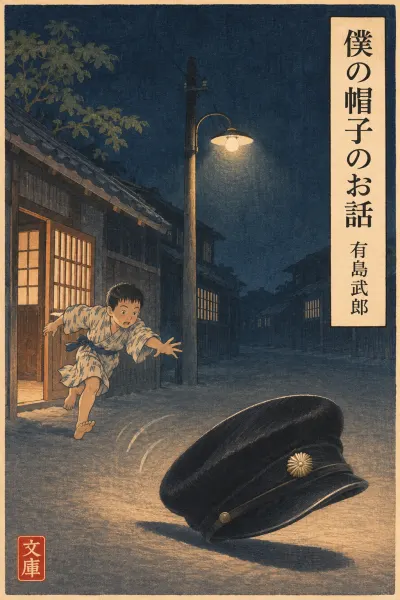
This is a children's story told by a young schoolboy who is very proud of the fine school cap his father bought him in Tōkyō. He is so fond of it that he writes in a composition that he sleeps holding it, and his teacher and classmates laugh. Then, one night, the cap is gone. What begins as an ordinary worry about a lost possession turns into a strange, dreamlike chase through dark streets, a classroom and a wide empty plain, where nothing behaves quite as it should. The tone moves from gentle humour to real unease, and the boy starts to wonder whether a shape-shifting tanuki is playing tricks on him. The story is told entirely in the boy's own voice: polite です/ます sentences, respectful verbs for his parents and teacher, and lively sound-words. For learners, the vocabulary is mostly everyday and the plot is easy to follow, but the text has some old-fashioned kanji spellings and kana usage. It also uses many expressions of guessing, worry and determination, such as 〜に違いない, 〜かも知れない and 〜なければいけない, which follow the boy's changing feelings closely.
Contents
Easier versions
This story is also retold in simpler Japanese. Reading an easier version first makes the original much more approachable.
Before you read
- Learn the guessing and worrying patterns first: 〜に違いない (it must be), 〜かも知れない (it might be) and 〜はずなのに (it should be, and yet). They show how the boy's reasoning shifts from certainty to doubt and fear.
- Watch for honorific verbs such as 仰有る (おっしゃる), いらっしゃる and お〜になる. The boy uses them for his father, mother and teacher, and they often tell you who is speaking or acting even when no name is given.
- Expect older spellings: 仰有る for おっしゃる, 中 read as うち in 〜ない中に (before ~), and 知れない written in kanji. If a word looks unfamiliar, try reading it aloud, because it is often a common word in older dress.
- Useful nouns to know before starting: 帽子 (cap), 綴り方 (school composition), 格子戸 (lattice door), 門 (gate), 原っぱ (grassy plain), 狸 (tanuki, a shape-shifting raccoon dog in folklore) and 一銭 (a one-sen coin).
- The story moves into a dream without warning, and the boy narrates impossible events in the same calm, polite style as ordinary ones. Read for the sequence of events rather than looking for logic, and enjoy the onomatopoeia that shows how the cap moves.
Words to know
The most useful words from the notes across the story.
| Word | Meaning | JLPT |
|---|---|---|
| 夢中むちゅう | frantic, absorbed; 夢中になって = without thinkingLiterally 'in a dream'. Also used for being crazy about a hobby. | N3 |
| 雨戸あまど | storm shutters (wooden shutters closed at night)雨 is read あま here, as in 雨具 (あまぐ). | N2 |
| 化けてばける | to take the form of, disguise oneself asdictionary form: 化けるUsed of foxes, tanuki and ghosts transforming. | N1 |
| 情けなくなさけない | miserable, pathetic, wretcheddictionary form: 情けない | — |
| 銅貨どうか | copper coin一銭 = one sen, a hundredth of a yen; 銭 (せん) has no English equivalent. | — |
| 狸たぬき | tanuki (raccoon dog)A wild animal which, in Japanese folklore, can change its shape and play tricks on people. Kept as 'tanuki' in the translation because English has no real equivalent. | — |
| 字引きじびき | dictionaryOld-fashioned, everyday word for 辞書. | N5 |
| 仰有いおっしゃる | to say (honorific)dictionary form: 仰有るRespectful equivalent of 言う; today usually written 仰る or おっしゃる. | N4 |
| 襖ふすま | sliding paper door between rooms | N2 |
| 挟まってはさまる | to be caught or wedged (between things)dictionary form: 挟まるIntransitive; the transitive partner is 挟む (to put between, to pinch). | N2 |
| からかうからかう | to tease, to make fun of | N2 |
| 口惜しくくやしい | frustrated, vexed, chagrineddictionary form: 口惜しいOld spelling of 悔しい. | N2 |
| 意地悪いじわる | spiteful, mean | N2 |
| 呶鳴りどなる | to shout, to bellowdictionary form: 怒鳴るToday written 怒鳴る; 呶鳴る is an older spelling. | N2 |
| 白状はくじょう | confession白状させる = to make someone confess. | N1 |
Plot summary
Show the full summary (contains spoilers)
A schoolboy treasures the cap his father bought him in Tōkyō and writes that he sleeps holding it. His teacher reads the composition aloud and the class laughs. One night he wakes and the cap is missing. He finds it caught in the lattice door, but it rolls away down the dark street and keeps escaping him all the way to school. At the gate it dares him to catch it, and suddenly he is in his classroom. The cap vanishes again, and he runs onto a dark plain where it hangs in the sky like a black moon. His weeping parents appear calling his name, but he fears they are tanuki. They cannot see or hear him, and his hands pass through them. He leaps, grabs the cap and falls towards a sea of fire. Then he wakes up. It was a dream, his mother is beside him, and the cap is in his hand.
About the author
Arishima Takeo was a Japanese novelist and essayist associated with the Shirakaba (White Birch) literary group. He studied at Sapporo Agricultural College and later in the United States, and for a time he was a committed Christian. His best-known works include the novel 或る女 (A Certain Woman) and the stories カインの末裔 and 生れ出づる悩み. Troubled by his inherited wealth, he gave his family's farm in Hokkaido to the tenant farmers who worked it.