Part 4 of 4 · JLPT N3
僕の帽子のお話 Boku no Bōshi no Ohanashi, part 4: Catching the Cap, and Waking Up
In this part
The boy watches his weeping parents search for him, but they cannot see or hear him, and his hands pass straight through them like air. Deciding that the raccoon-dog cap hanging in the sky is to blame, he leaps up, grabs it, and falls endlessly towards a blazing sea of fire. He wakes to find it was a dream, with his mother beside him and his shiny-peaked cap still clutched in his hand.
AI translation · independently checked
おとうさんもおかあさんも僕がついそばにいるのに少しも気がつかないらしく、おかあさんは僕の名を呼びつづけながら、箪笥の引出しを一生懸命に尋ねていらっしゃるし、おとうさんは涙で曇る眼鏡を拭きながら、本棚の本を片端から取り出して見ていらっしゃいます。Father and Mother did not seem to notice at all that I was right there beside them. Mother kept calling my name as she searched the drawers of the chest with all her might, and Father, wiping his spectacles as they clouded with tears, was taking the books out of the bookcase one after another and looking through them.
そうです、そこには家にある通りの本棚と箪笥とが来ていたのです。Yes, the very same bookcase and chest of drawers that we have at home had come to that place.
僕はいくらそんな所を探したって僕はいるものかと思いながら、暫くは見つけられないのをいい事にして黙って見ていました。I thought, "However much they search in places like that, I'm not going to be there!" and for a while, glad that they could not find me, I watched them without saying a word.
「どうもあれがこの本の中にいないはずはないのだがな」"Well, I really can't see how he could fail to be inside one of these books."
とやがておとうさんがおかあさんに仰有います。That is what Father said to Mother after a while.
「いいえそんな所にはいません。またこの箪笥の引出しに隠れたなりで、いつの間にか寝込んだに違いありません。月の光が暗いのでちっとも見つかりはしない」"No, he's not in a place like that. He must have hidden in this drawer again and fallen fast asleep before he knew it. The moonlight is so dim that I can't find him at all."
とおかあさんはいらいらするように泣きながらおとうさんに返事をしていられます。Mother was answering Father like this, crying as though she were on edge.
やはりそれは本当のおとうさんとおかあさんでした。So they really were my own father and mother after all.
それに違いありませんでした。There was no doubt about it.
あんなに僕のことを思ってくれるおとうさんやおかあさんが外にあるはずはないのですもの。For there could not be any other father and mother anywhere who cared about me as much as that.
僕は急に勇気が出て来て顔中がにこにこ笑いになりかけて来ました。Suddenly I felt my courage well up, and my whole face began to break into a smile.
「わっ」といって二人を驚かして上げようと思って、いきなり大きな声を出して二人の方に走り寄りました。Meaning to give them both a fright by shouting "Boo!", I let out a loud cry all at once and ran up to them.
ところがどうしたことでしょう。But what do you think happened?
僕の体は学校の鉄の扉を何の苦もなく通りぬけたように、おとうさんとおかあさんとを空気のように通りぬけてしまいました。Just as my body had slipped through the iron gate of the school without any trouble, it passed right through Father and Mother as if they were air.
僕は驚いて振り返って見ました。I was startled and turned round to look.
おとうさんとおかあさんとは、そんなことがあったのは少しも知らないように相変らず本棚と箪笥とをいじくっていらっしゃいました。Father and Mother went on fiddling with the bookcase and the chest of drawers just as before, as though they knew nothing at all of what had happened.
僕はもう一度二人の方に進み寄って、二人に手をかけて見ました。I stepped up to them once more and tried laying my hands on them.
そうしたら、二人ばかりではなく、本棚までも箪笥まで空気と同じように触ることが出来ません。And then I found that not only the two of them, but even the bookcase and the chest of drawers, were just like air, and I could not touch them.
それを知ってか知らないでか、二人は前の通り一生懸命に、泣きながら、しきりと僕の名を呼んで僕を探していらっしゃいます。Whether they knew it or not, the two of them, crying as before and searching with all their might, kept calling my name over and over as they looked for me.
僕も声を立てました。I raised my voice too.
だんだん大きく声を立てました。I called louder and louder.
「おとうさん、おかあさん、僕ここにいるんですよ。おとうさん、おかあさん」"Father, Mother, I'm right here, you know! Father, Mother!"
けれども駄目でした。But it was no use.
おとうさんもおかあさんも、僕のそこにいることは少しも気付かないで、夢中になって僕のいもしない所を探していらっしゃるんです。Father and Mother did not notice at all that I was there; they were completely absorbed in searching places where I was not even to be found.
僕は情けなくなって本当においおい声を出して泣いてやろうかと思う位でした。I felt so miserable that I almost thought I would really start bawling out loud.
そうしたら、僕の心にえらい智慧が湧いて来ました。Just then a splendid idea came welling up in my mind.
あの狸帽子が天の所でいたずらをしているので、おとうさんやおかあさんは僕のいるのがお分かりにならないんだ。It's because that raccoon-dog cap is up there in the sky playing its tricks that Father and Mother can't tell I'm here!
そうだ、あの帽子に化けている狸おやじを征伐するより外はない。Yes, there's nothing for it but to defeat that old raccoon dog who has turned himself into the cap.
そう思いました。That is what I thought.
で、僕は空中にぶら下がっている帽子を眼がけて飛びついて、それをいじめて白状させてやろうと思いました。So I decided to make a leap at the cap dangling in mid-air, and give it a hard time until it confessed.
僕は高飛びの身構えをしました。I took up my stance for the high jump.
「レデー・オン・ゼ・マーク……ゲッセット……ゴー」"Ready, on the mark… get set… go!"
力一杯跳ね上がったと思うと、僕の体はどこまでもどこまでも上の方へと登って行きます。The moment I sprang up with all my strength, my body went climbing on and on, higher and higher.
面白いように登って行きます。Up I went, so easily that it was fun.
とうとう帽子の所に来ました。At last I reached the cap.
僕は力みかえって帽子をうんと掴みました。Straining with all my might, I grabbed hold of the cap tight.
帽子が「痛い」といいました。The cap said, "Ouch!"
その拍子に帽子が天の釘から外れでもしたのか僕は帽子を掴んだまま、まっさかさまに下の方へと落ちはじめました。At that moment, perhaps because the cap had come loose from the nail in the sky, I began to fall headlong downwards, still holding on to the cap.
どこまでもどこまでも。Down and down and down.
もう草原に足がつきそうだと思うのに、そんなこともなく、際限もなく落ちて行きました。I kept thinking my feet must be about to touch the grassy plain, but they never did, and I went on falling without end.
だんだんそこいらが明るくなり、神鳴りが鳴り、しまいには眼も明けていられないほど、まぶしい火の海の中にはいりこんで行こうとするのです。Little by little everything around grew brighter, thunder rumbled, and in the end I was about to plunge into a sea of fire so dazzling that I could not even keep my eyes open.
そこまで落ちたら焼け死ぬ外はありません。If I fell that far, there would be nothing for it but to be burnt to death.
帽子が大きな声を立てて、The cap raised a loud voice
「助けてくれえ」"Help meee!"
と呶鳴りました。it bellowed.
僕は恐ろしくて唯うなりました。I was so frightened that all I could do was groan.
僕は誰れかに身をゆすぶられました。Somebody was shaking me.
びっくらして眼を開いたら夢でした。I opened my eyes with a start, and it had been a dream.
雨戸を半分開けかけたおかあさんが、僕のそばに来ていらっしゃいました。Mother, who had half opened the storm shutters, had come over to my side.
「あなたどうかおしかえ、大変にうなされて……お寝ぼけさんね、もう学校に行く時間が来ますよ」"What's the matter with you? You were having such a bad dream… What a sleepyhead you are! It's almost time to go to school."
と仰有いました。That is what she said.
そんなことはどうでもいい。That did not matter in the least.
僕はいきなり枕もとを見ました。At once I looked by my pillow.
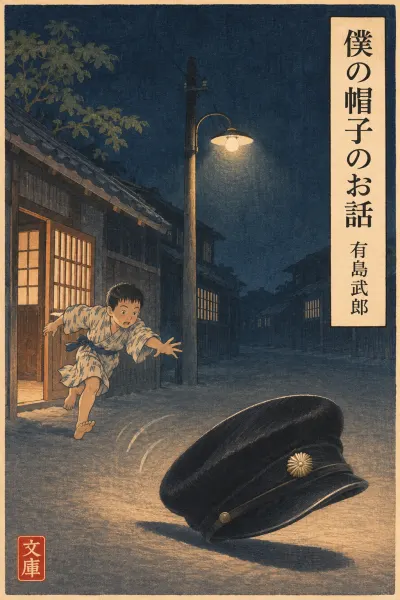
そうしたら僕はやはり後生大事に庇のぴかぴか光る二円八十銭の帽子を右手で握っていました。And there I was, just as I had thought, holding tight in my right hand, as if it were the most precious thing in the world, my two-yen-eighty-sen cap with the shiny peak.
僕は随分うれしくなって、それからにこにことおかあさんの顔を見て笑いました。I felt so very happy, and then I looked up at Mother's face and smiled and smiled.
Vocabulary
| Word | Meaning | JLPT |
|---|---|---|
| 片端からかたっぱしから | one after another, every single oneDescribes going through things in order without missing any. | — |
| 夢中むちゅう | completely absorbed, lost in something夢中になる = to become absorbed in something. | N3 |
| 情けなくなさけない | miserable, wretched, pitifuldictionary form: 情けないExpresses helpless sadness or shame about one's situation. | — |
| 狸たぬき | tanuki, raccoon dogAn East Asian wild animal that in Japanese folklore tricks people by changing its shape. 狸おやじ means 'old tanuki', often used of a crafty old man. | — |
| 化けてばける | to transform oneself into, to disguise oneself asdictionary form: 化けるUsed of foxes, tanuki and ghosts taking another shape: 〜に化ける. | N1 |
| 征伐せいばつ | subduing, conquering (an enemy or monster)A grand, old-fashioned word, as in folk tales of defeating demons (鬼征伐). | — |
| 白状はくじょう | confession白状させる = to make someone confess. | N1 |
| 拍子ひょうし | the moment, the instant (when something happens)その拍子に = at that very moment, as a result of that. | — |
| 際限さいげん | limit, endUsually negative: 際限もなく / 際限なく = endlessly. | — |
| 呶鳴りどなる | to shout, to bellowdictionary form: 怒鳴るToday written 怒鳴る; 呶鳴る is an older spelling. | N2 |
| 雨戸あまど | storm shuttersWooden sliding shutters closed over the windows of a Japanese house at night. | N2 |
| うなされてうなされる | to groan or moan in a nightmaredictionary form: うなされるAlways about bad dreams: 悪い夢にうなされる. | — |
| 後生大事ごしょうだいじ | treasuring something with great careOriginally Buddhist (caring for one's next life); now 'holding on to something as if it were very precious'. | — |
Grammar
〜たって/〜ものか N2 even if…; there is no way…!
〜たって is a casual form of 〜ても, 'however much / even if'. 〜ものか at the end of a clause is an emphatic denial: 'as if…!' or 'certainly not'.
いくらそんな所を探したって僕はいるものか
however much they search in places like that, I'm not going to be there!
〜はずはない N3 there is no way that…; it cannot be that…
〜はずはない means 'there is no way that…; it cannot be that…', a judgement that something is impossible on the grounds of reason. After a negative, as in the father's いないはずはない, the two negatives cancel and the sense is 'he must be there'. Example: あんなに僕のことを思ってくれるおとうさんやおかあさんが外にあるはずはないのですもの。
あんなに僕のことを思ってくれるおとうさんやおかあさんが外にあるはずはないのですもの。
For there could not be any other father and mother anywhere who cared about me as much as that.
〜に違いない N3 must be…; surely…
Expresses a strong conviction. The polite form here is 〜に違いありません.
いつの間にか寝込んだに違いありません。
He must have fallen fast asleep before he knew it.
〜たなり(で) N1 just as…, still in the state of having done…
なり after the past tense means that a state continued with nothing following it. Here the boy hid and stayed that way: 'having hidden, and just as he was'.
この箪笥の引出しに隠れたなりで
having hidden in this drawer and staying there
〜より外(ほか)はない N2 there is nothing to do but…
With a dictionary-form verb, it means this is the only option left. Sentence 42 has the same idea in 焼け死ぬ外はありません.
あの帽子に化けている狸おやじを征伐するより外はない。
There's nothing for it but to defeat that old raccoon dog who has turned himself into the cap.
〜てか〜ないでか N1 whether … or not
It sets two opposite possibilities side by side and leaves open which one is true. Today 知ってか知らずか is more common.
それを知ってか知らないでか
Whether they knew it or not