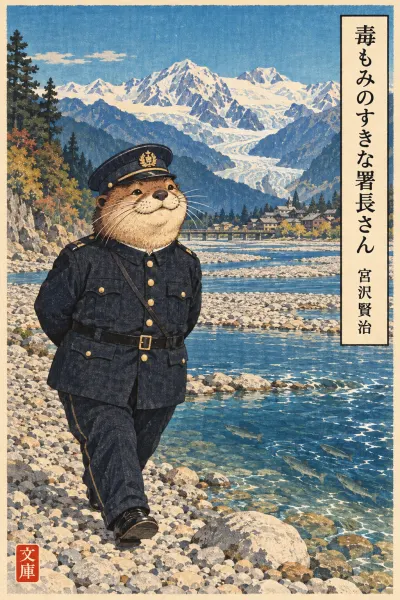
 N3 · easy
Simplified retelling · JLPT N3
毒もみのすきな署長さん Dokumomi no Sukina Shochōsan in easy Japanese (N3)
This is our own simplified retelling of The Police Chief and His Favourite Pastime, written for N3 learners and checked word by word against the N3 vocabulary list. A few story words and grammar patterns go beyond N3; the notes below give each one's level. It keeps the characters, events and ending of the original. When it feels easy, move on to the original text.
The story in brief
In a riverside town, the law forbids fish-poisoning, a method of killing fish with powdered sansho bark and ash. A new police chief arrives, and soon the fish begin dying and sansho trees are stripped of their bark, while the children gather clues that point to the chief himself. When the mayor confronts him, the chief calmly confesses and is sentenced to death, and at his execution he cheerfully declares that he will go fish-poisoning in Hell.
AI translation · independently checked
山から四つの冷たい川が流れてきて、ある国の町で一つの大きな川になりました。Four cold rivers flowed down from the mountains and joined into one big river in a town in a certain country.
ふだんは水がきれいな、静かな川でした。Most of the time it was a quiet river with clear water.
でも、雨がたくさん降ると、川のまわりの広い場所が、こわい音を立てる水でいっぱいになりました。But when a great deal of rain fell, the wide land around the river filled up with water that made a frightening roar.
水がなくなると、また元の白くてきれいな場所に戻りました。When the water was gone, the place went back to being white and lovely, just as it had been before.
その場所には、古い川のあとの、長いいけのような所がいくつもありました。Across it lay a number of long, pond-like places, left behind where the river had once run.
中には魚がたくさんいました。There were lots of fish in them.
特に、どじょうとなまずが多かったです。Loaches and catfish were especially plentiful.
でも、この国の人たちは、どじょうやなまずをばかにして、食べませんでした。But the people of this country looked down on loaches and catfish and would not eat them.
だから、魚はどんどん増えました。So the fish went on multiplying.
ある年、「海から大きなちょうざめが入ってきたよ」という話がありました。One year a rumour went round: "A huge sturgeon has come up from the sea!"
それを言い出したのは、かみを切る店の男でした。The one who started it was the man from the hair-cutting shop.
この男は仕事が下手で、だれも男の話を信じませんでした。He was bad at his work, and nobody believed a word he said.
小さい子供たちだけが、毎日ちょうざめを見に行きました。Only the little children went every day to see the sturgeon.
でも、ちょうざめはいませんでした。But there was no sturgeon.
それで、男はみんなに笑われました。And so the man was laughed at by everyone.
この国のきそくのいちばん初めには、こう書いてありました。At the very beginning of this country's rules, this was written:
「火を使って鳥をとってはいけません。どくもみをして魚をとってはいけません。」"You must not catch birds using fire. You must not catch fish by fish-poisoning."
どくもみとは何でしょう。Now, what is fish-poisoning?
かみを切る店の男は、こう教えました。The man from the hair-cutting shop explained it like this.
春の夜にさんしょうの木のかわを取って、よくかわかして、こなにします。On a spring night you strip the bark from a sansho tree, dry it well, and grind it to powder.
それを木のはいといっしょにふくろに入れて、水の中で手で強くおします。You put that in a bag together with wood ash, and in the water you squeeze it hard with your hands.
すると、魚はどくを飲んで、口を開けたり閉めたりしながら、白いおなかを上にして、水の上に出てきて死ぬのです。Then the fish swallow the poison, and opening and closing their mouths, they turn their white bellies upward, rise to the surface, and die.
どくもみをする人を捕まえることは、警察のいちばん大事な仕事でした。Catching people who went fish-poisoning was the most important work the police had.
ある夏、町の警察に新しいしょちょうさんが来ました。One summer a new police chief came to the town's police station.
この人は、どこか、かわうそに似ていました。There was something about him that looked like an otter.
赤いひげがあって、歯はみんな銀でした。He had a red beard, and his teeth were all silver.
しょちょうさんは、きれいな長い赤いコートを着て、毎日町を歩いて回りました。Dressed in a fine, long red coat, the chief walked all round the town every day.
赤ちゃんがたくさんないていると、お母さんに「病気に注意しなさい」と教えたりしました。When a lot of babies were crying, he would tell the mothers things like, "Watch out for illness."
ところが、そのころから、きそくを守らない人が出てきました。However, from about that time, people began to appear who did not keep the rules.
いけの魚がほとんどいなくなって、時々死んだ魚が水の上に出ていました。Almost all the fish in the pools disappeared, and now and then dead fish lay floating on the water.
春の夜には、町のさんしょうの木のかわが、よく取られていました。On spring nights, the bark of the town's sansho trees was often stripped away.
でも、しょちょうさんも警官たちも、あまり気にしていないようでした。But neither the chief nor his policemen seemed to pay it much attention.
ある朝、二人の子供がみんなに話していました。One morning two children were telling everyone a story.
「しょちょうさんにしかられたよ。いけに石を投げたら、きしにしょちょうさんが三、四人とかくれていたんだ。『どくもみをする犯人を捕まえるために、一日ここにいるんだ。早く帰れ』って言われたよ。」"We got told off by the chief! We threw a stone into the pool, and there was the chief hiding on the bank with three or four others. He said, 'We're here all day to catch the fish-poisoning culprit. Go home, quick!'"
みんなは「じゃあ、犯人はもうすぐ捕まるね」と言いました。Everyone said, "Then they'll catch the culprit any time now."
しばらくして、子供たちがまたさわぎ始めました。After a while the children started making a fuss again.
一人の子供が言いました。One child said:
「本当だよ。昨日の夜、しょちょうさんが黒い服を着て、鳥を打つ変な男と話していたんだ。『今度はもっとよくこなにして来い』とか、『ほかの木のかわも入れたのに、ねだんが高すぎる』とか言っていたよ。きっとさんしょうのこなのことだよ。」"It's true! Last night the chief was wearing black clothes and talking with a strange man who shoots birds. He said stuff like, 'Next time grind it finer before you come,' and 'You put in bark from other trees too, and still the price is too high.' It's got to be about the sansho powder!"
もう一人の子供が言いました。Another child said:
「そうだ。しょちょうさんは、ぼくの家からはいを二ふくろ買ったよ。ぼくが持って行ったんだ。」"That's right. The chief bought two bags of ash from my house. I'm the one who took them over."
みんなは「きっとそうだ」と手をたたきました。"That must be it!" everyone said, clapping their hands.
かみを切る店の男は、ひまだったので、この話を聞いて計算しました。The man from the hair-cutting shop had nothing better to do, so when he heard this story he worked out the sums.
さんしょうのかわとはいのお金は少しだけです。The sansho bark and the ash cost only a little money.
でも、とった魚を売ると、たくさんのお金になります。But when you sell the fish you have caught, it comes to a great deal of money.
「しょちょうさんには、たくさんお金が入ったはずだ」と男は言いました。"The chief must have taken in a lot of money," the man said.
この話は町中に広がりました。The story spread all over town.
小さい子供たちまで、警官を見ると遠くへ逃げて、「どくもみの警官、なまずをくれ」と大きな声で言いました。Even the little children, whenever they saw a policeman, would run off a long way and shout at the top of their voices, "Fish-poisoning policeman, give us a catfish!"
これは困ったと思って、町長さんは六人の男を連れて、警察へ行きました。Thinking this was a sorry state of affairs, the mayor took six men with him and went to the police station.
町長さんは、しょちょうさんと部屋のいすに座りました。The mayor sat down on a chair in the room with the chief.
しょちょうさんの黄色い目は、どこか遠くを見ていました。The chief's yellow eyes were gazing somewhere far away.
「しょちょうさん、このごろ、きそくを守らない人が多いそうですね。わたしの家のさんしょうの木も、かわを取られました。魚もよく死んでいるそうです。」"Chief, I hear there are a lot of people breaking the rules these days. Even the sansho tree at my house has had its bark taken. And I hear the fish are dying all the time, too."
「はあ、そうですか。」しょちょうさんは少し変に笑いました。"Ah, is that so?" The chief gave a slightly odd smile.
「子供たちは、あなたがやったと言っています。困りましたね。」"The children are saying you did it. It's rather awkward, isn't it?"
しょちょうさんは、いすから急に立ち上がりました。The chief suddenly sprang up from his chair.
「それは大変だ。今から犯人を捕まえます。」"That's terrible. I'll catch the culprit right now."
「だれが犯人か、分かりますか。」"Do you know who the culprit is?"
「ええ、よく分かっています。どくもみをしたのは、わたしです。」"Yes, I know very well. The one who did the fish-poisoning is me."
しょちょうさんは、自分を見なさいというように、町長さんの前に頭を出しました。The chief stuck his head out in front of the mayor, as if to say, "Look at me."
町長さんもおどろきました。Even the mayor was taken aback.
「あなたですか。やっぱりそうでしたか。」"It's you? So it was true after all."
「そうです。」"Yes, it was."
しょちょうさんは静かにテーブルの上のベルをたたいて、いちばん強い警官を呼びました。The chief calmly struck the bell on the table and called for his strongest policeman.
しょちょうさんは捕まって、さいばんで死ななければならないことになりました。The chief was arrested, and at his trial it was decided that he must die.
大きなかたなで首を切られる時、しょちょうさんは笑って言いました。As his head was about to be cut off with a great sword, the chief laughed and said:
「ああ、おもしろかった。わたしはどくもみが大好きで、夢中なんだ。今度は、じごくでどくもみをしようかな。」"Ah, that was fun. I just love fish-poisoning, I'm crazy about it. Next time, maybe I'll do some fish-poisoning in Hell."
みんなは、すっかり感心しました。Everyone was thoroughly impressed.
Vocabulary
| Word | Meaning | JLPT |
|---|---|---|
| ふだんふだん | usually; ordinarilydictionary form: 普段ふだんは often contrasts normal times with an exception that follows (here, heavy rain). | N3 |
| どじょうどじょう | loach (a small, slender freshwater fish)dictionary form: 泥鰌Usually written in kana; a cheap, humble fish in Japan. | — |
| ちょうざめちょうざめ | sturgeondictionary form: 蝶鮫Despite さめ (shark) in the name, it is not a shark. | — |
| きそくきそく | rule; regulationdictionary form: 規則きそくを守る = to keep the rules. | N4 |
| どくもみどくもみ | fish-poisoning: killing fish by squeezing a bag of poison into the waterdictionary form: 毒もみ毒 (poison) + もむ (to knead, squeeze). The method is described just after in the story. | — |
| さんしょうさんしょう | sansho, Japanese pepper treedictionary form: 山椒A prickly ash whose seeds are used as a spice. 'Sansho' is used in English because there is no common English name. | — |
| かわうそかわうそ | otterdictionary form: 獺A fish-eating animal, so the comparison is a sly hint. | — |
| しかられたしかる | to scold, tell offdictionary form: 叱るPassive しかられる = to be scolded, a very common form. | N3 |
| 犯人はんにん | culprit; criminal犯 = crime, 人 = person. | N3 |
| ひまひま | free; having nothing to dodictionary form: 暇Here it is ironic and suggests the man is idle rather than busy with customers. | N5 |
| 町長ちょうちょう | mayor (of a town)町 is read ちょう here, as in 町長 and 町内. | — |
| さいばんさいばん | trial; court casedictionary form: 裁判 | N3 |
| 夢中むちゅう | absorbed in; crazy about〜に夢中だ = to be completely absorbed in something. | N3 |
| 感心かんしん | admiration; being impressedNot to be confused with 関心 (interest), which has the same reading. | N3 |
Grammar
Passive 〜られる N4 to be done to (by someone)
笑われる is the passive of 笑う. The subject (the man) receives the action, and here the passive also suggests he suffered from it.
それで、男はみんなに笑われました。
And so the man was laughed at by everyone.
〜たり〜たりしながら N4 doing things like A and B (repeatedly), while…
〜たり〜たりする lists actions that alternate or repeat. Combined with ながら, it describes what the fish keep doing while they float up.
口を開けたり閉めたりしながら
opening and closing their mouths
〜ようだ N4 seems; appears that
ようだ gives the narrator's judgement based on what can be seen. Here 気にしていないようでした hints with irony that the police did not care.
でも、しょちょうさんも警官たちも、あまり気にしていないようでした。
But neither the chief nor his policemen seemed to pay it much attention.
〜ために N4 in order to; for the purpose of
A dictionary-form verb + ために states a purpose. The chief gives a reason for being at the pool that sounds proper.
どくもみをする犯人を捕まえるために、一日ここにいるんだ。
We're here all day to catch the fish-poisoning culprit.
〜はずだ N4 must be; should be (logical expectation)
はずだ expresses a confident conclusion reached by reasoning. The barber has worked out the costs and profits, so he concludes the chief must have earned a lot.
「しょちょうさんには、たくさんお金が入ったはずだ」
"The chief must have taken in a lot of money."
〜ことになる N4 it is decided that; it turns out that
ことになる shows an outcome decided by others or by circumstances, not by the speaker. Combined with 〜なければならない, it means he was sentenced to die.
さいばんで死ななければならないことになりました。
at his trial it was decided that he must die.