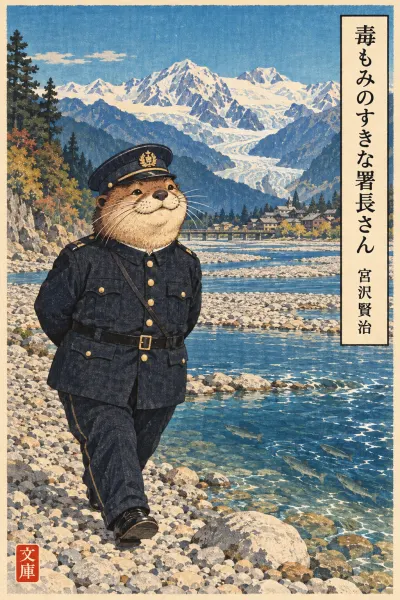
 N4 · easy
Simplified retelling · JLPT N4
毒もみのすきな署長さん Dokumomi no Sukina Shochōsan in easy Japanese (N4)
This is our own simplified retelling of The Police Chief and His Favourite Pastime, written for N4 learners and checked word by word against the N4 vocabulary list. A few story words and grammar patterns go beyond N4; the notes below give each one's level. It keeps the characters, events and ending of the original. When it feels easy, move on to the N3 version or the original text.
The story in brief
In the riverside country of Puhara, poisoning fish is strictly forbidden, and catching fish-poisoners is the police's most important job. A polite new police chief arrives, but soon fish start dying and the children gossip that the chief himself is the culprit. When the mayor confronts him, the chief cheerfully confesses, is sentenced to death, and goes to his end laughing that he will go fish-poisoning in hell.
AI translation · independently checked
むかし、プハラの国に大きな川がありました。Long ago, there was a great river in the country of Puhara.
山から四つのつめたい川が来て、プハラの町で一つになったのです。Four cold rivers came down from the mountains and joined into one at the town of Puhara.
いつもは水がきれいで、しずかな川でした。Most of the time it was a quiet river with clear water.
でも、雨がたくさんふると、川は大きくなって、とてもこわくなりました。But when a lot of rain fell, the river grew big and became very frightening.
川のそばには、細くて長いみずうみのような所が、いくつもありました。Beside the river there were a number of places like long, narrow lakes.
そこには魚がたくさんいました。Lots of fish lived there.
特に、なまずが多かったです。There were especially many catfish.
でも、プハラの人たちはなまずを食べませんでした。But the people of Puhara did not eat catfish.
だから、なまずはどんどんふえました。So the catfish kept on multiplying.
ある年、とこやのリチキが「海から大きなちょうざめが入って来た」と話しました。One year, Richiki the barber said, "A big sturgeon has come in from the sea."
小さい子どもたちは、毎日見に行きました。The little children went to look every day.
でも、ちょうざめはいませんでした。But there was no sturgeon.
リチキは仕事が下手で、大人はだれもリチキの話を本当だと思いませんでした。Richiki was bad at his job, and none of the grown-ups believed what he said.
この国には、大切なきそくがありました。This country had an important rule.
「どくを使って、鳥や魚を取ってはいけません。」どくもみは、さんしょうの木のかわと、はいで作ったどくを、水に入れることです。"You must not catch birds or fish using poison." Fish-poisoning means putting into the water a poison made from the bark of the sanshō tree and ash.
すると、魚はどくを飲んで、白いおなかを上にして死んでしまいます。Then the fish swallow the poison, turn their white bellies to the sky, and die.
どくもみをする人をつかまえることは、けいさつのいちばん大切な仕事でした。Catching people who poisoned fish was the most important job of the police.
ある夏、町のけいさつに、新しいしょちょうさんが来ました。One summer, a new police chief came to the town's police station.
しょちょうさんは赤いひげで、銀のはをしていました。The chief had a red beard and silver teeth.
長い赤い服を着て、毎日ていねいに町を見て歩きました。He wore a long red garment and walked carefully around the town every day, looking at everything.
赤んぼうがたくさんないていると、「病気かもしれませんよ」とお母さんに教えました。When a baby was crying a great deal, he would tell its mother, "It might be ill, you know."
ところが、そのころから、川のそばの水に魚がいなくなりました。However, from about that time, the fish disappeared from the waters beside the river.
時々、死んだ魚も見えました。Sometimes dead fish could be seen, too.
春の夜には、町のさんしょうの木のかわが、よくとられていました。On spring nights, the bark of the sanshō trees in town was often stripped away.
でも、しょちょうさんも、けいかんたちも、何もしませんでした。But neither the chief nor his officers did anything at all.
ある朝、子どもたちが集まって話していました。One morning, the children had gathered and were talking.
「しょちょうさんにしかられたよ。いしをなげたら、水のそばにしょちょうさんたちがいたんだ。どくもみをする人をつかまえるために、一日待っているんだって。」「じゃあ、もうすぐつかまえられるね。」"The chief told me off! I threw a stone, and the chief and his men were right there by the water. They say they're waiting all day to catch the fish-poisoners." "Then they'll catch them soon, won't they?"
しばらくして、子どもたちはまたさわぎました。A little while later, the children were making a fuss again.
「ゆうべ、しょちょうさんが黒い服を着て、へんな男と話していたよ。『つぎは、もっとよく作って来い。高すぎるぞ』とおこっていたんだ。きっと、さんしょうのかわのことだよ。」「ぼくの家から、しょちょうさんがはいを買ったよ。」みんなは手をうって、「そうだ、きっとそうだ」とさわぎました。"Last night the chief was wearing black clothes and talking to a strange man. He was angry and said, 'Next time, make it better before you bring it. It's far too expensive!' I bet he meant the sanshō bark." "The chief bought ash from my house!" Everyone clapped their hands and shouted, "That's it! That must be it!"
リチキはひまだったので、この話を聞いて考えました。Richiki had nothing to do, so when he heard this story he thought it over.
「さんしょうとはいは安い。でも、魚を売れば、たくさんお金が入る。しょちょうさんは、ずいぶんお金を作っただろう。」"Sanshō and ash are cheap. But if you sell the fish, lots of money comes in. The chief must have made quite a lot of money."
小さな子どもたちも、けいかんを見ると遠くへにげて、「どくもみけいかん、なまずをくれ」と大きなこえで歌いました。Even the little children, whenever they saw a police officer, would run far away and sing at the top of their voices, "Fish-poisoning policeman, give us a catfish!"
町長さんはこまって、けいさつへ行きました。The mayor was troubled, and went to the police station.
そして、しょちょうさんに会いました。And there he met the chief.
「このごろ、どくもみをする人がたくさんいるそうですね。私の家のさんしょうのかわも、とられました。」"I hear there are a lot of fish-poisoners these days. The sanshō bark at my house was taken, too."
しょちょうさんは、少しへんにわらいました。The chief gave a slightly odd laugh.
「そうですか。」"Is that so?"
「子どもたちは、あなたがやっていると話していますよ。こまりましたね。」"The children are saying that you're the one doing it. It's quite a problem."
すると、しょちょうさんはいすから立ちました。At that, the chief stood up from his chair.
「それは大へんだ。どくもみをした人を、すぐにつかまえます。」"That's terrible. I'll catch the fish-poisoner at once."
「だれだか、わかりますか。」"Do you know who it is?"
「よくわかっていますよ。どくもみは、わたしです。」"I know very well. The fish-poisoner is me."
町長さんはおどろきました。The mayor was astonished.
「あなたですか。やっぱりそうでしたか。」"It's you? So it was true after all."
「そうです。」"It is."
しょちょうさんは、つくえの上のベルをおして、けいかんをよびました。The chief pressed the bell on his desk and called for an officer.
しょちょうさんはつかまえられて、くびを切られることにきまりました。The chief was arrested, and it was decided that his head would be cut off.
さいごの時、しょちょうさんはわらって、こう話しました。At the very end, the chief laughed and said this:
「ああ、おもしろかった。わたしは、どくもみが大好きなんだ。今度は、じごくでどくもみをやろうかな。」"Ah, that was fun. I just love fish-poisoning. Maybe next time I'll go fish-poisoning in hell."
みんなはすっかりおどろいて、すごい人だと思いました。Everyone was completely astonished, and thought he was quite a remarkable man.
Vocabulary
| Word | Meaning | JLPT |
|---|---|---|
| なまずなまず | catfishWritten 鯰 in kanji. | — |
| とこやとこや | barber床屋; also means a barber's shop. | N4 |
| ちょうざめちょうざめ | sturgeonA large fish that swims up rivers from the sea. | — |
| きそくきそく | rule, regulation規則. | N4 |
| どくもみどくもみ | fish-poisoning: catching fish by putting poison in the water毒 (poison) + もむ (to rub, knead). Also used here for the person who does it. | — |
| さんしょうさんしょう | sanshō, the Japanese pepper tree山椒; a prickly shrub whose seeds are used as a spice. Its bark was used in the poison. | N1 |
| はいはい | ash (from burning wood)灰; not the same word as はい 'yes'. | N5 |
| しょちょうしょちょう | police chief, head of a station署長; さん is added in the title for a friendly, storybook tone. | — |
| けいかんけいかん | police officer警官. | N5 |
| しかられたしかる | to scold, tell offdictionary form: しかるPassive しかられる: to be scolded. | N3 |
| さわぎましたさわぐ | to make a fuss, be noisy and exciteddictionary form: さわぐ | N4 |
| ひまひま | free, with nothing to do暇; here hinting that Richiki is idle. | N5 |
| くびくび | neck, head首; くびを切る literally 'cut the neck' means to behead, and in modern speech also 'to fire someone'. | N4 |
| じごくじごく | hell地獄. | N1 |
Grammar
〜てはいけません N5 must not ~
The て-form plus はいけません states a prohibition. It is used here for the country's strict rule against using poison.
どくを使って、鳥や魚を取ってはいけません。
You must not catch birds or fish using poison.
〜てしまう N4 to end up ~ (completely, often regrettably)
て-form plus しまう shows that an action is finished completely, often with a sense of something unfortunate. Here it stresses that the fish die.
白いおなかを上にして死んでしまいます。
they turn their white bellies to the sky and die.
〜ために N4 in order to ~
Dictionary form plus ために gives the purpose of an action. The officers say they are waiting so that they can catch the poisoners.
どくもみをする人をつかまえるために、一日待っているんだって。
They say they're waiting all day to catch the fish-poisoners.
〜んだって N3 they say that ~ (casual hearsay)
って is a casual quotation marker; after んだ it reports what someone else said. Children use it to pass on what the chief told them.
一日待っているんだって。
They say they're waiting all day.
〜そうです (hearsay) N4 I hear that ~
A plain-form verb or adjective plus そうです reports information heard from others. The mayor politely mentions the rumour without claiming it as fact.
このごろ、どくもみをする人がたくさんいるそうですね。
I hear there are a lot of fish-poisoners these days.
Passive 〜られる + ことにきまる N4 it was decided that (someone) would be ~
The passive forms つかまえられる and 切られる show the chief receiving the actions. Dictionary form plus ことにきまる, like ことになる, means a decision was made by others.
しょちょうさんはつかまえられて、くびを切られることにきまりました。
The chief was arrested, and it was decided that his head would be cut off.