 N4 · easy
Simplified retelling · JLPT N4
どんぐりと山猫 Donguri to Yamaneko in easy Japanese (N4)
This is our own simplified retelling of The Wildcat's Acorn Trial, written for N4 learners and checked word by word against the N4 vocabulary list. A few story words and grammar patterns go beyond N4; the notes below give each one's level. It keeps the characters, events and ending of the original. When it feels easy, move on to the N3 version or the original text.
The story in brief
Ichirō receives a strange postcard from a wildcat inviting him to a difficult trial, and he climbs into the mountains. In a golden meadow he meets the wildcat's coachman, who wrote the card, and then the wildcat, who cannot stop a noisy quarrel among hundreds of acorns about which of them is the greatest. Ichirō's clever answer ends the trial at once. When he advises the wildcat not to write 'you must come' on future postcards, the wildcat looks disappointed, and no more postcards ever arrive; Ichirō later wishes he had agreed.
AI translation · independently checked
ある土曜日の夕方、いちろうの家に、へんなはがきが来ました。One Saturday evening, a strange postcard came to Ichirō's house.
「あした、むずかしいさいばんをしますから、来てください。山ねこ」と書いてありました。It said: "Tomorrow I am holding a difficult trial, so please come. The Wildcat."
字はとても下手でした。The handwriting was very bad.
でも、いちろうはとてもうれしくて、夜おそくまでねられませんでした。But Ichirō was so happy that he could not fall asleep until late at night.
つぎの朝は、とてもいい天気でした。The next morning the weather was beautiful.
いちろうはいそいで朝ご飯を食べて、一人で川の近くの道を、山の方へのぼって行きました。Ichirō hurried through his breakfast and set off alone up the path beside the stream, toward the mountains.
風がふくと、くりの木が小さなくりをたくさんおとしました。Whenever the wind blew, the chestnut tree dropped lots of little chestnuts.
「くりの木さん、山ねこがここを通りましたか。」と聞くと、くりの木は「山ねこなら、けさ早く、ばしゃで東の方へ行きましたよ。」と答えました。"Mr. Chestnut Tree, did the Wildcat come by here?" he asked, and the chestnut tree answered, "The Wildcat? He went off east in his carriage early this morning."
もう少し行くと、たきがありました。A little farther on, there was a waterfall.
たきは「山ねこは、さっき西の方へ行きましたよ。」と答えました。The waterfall answered, "The Wildcat went west just a moment ago."
白いきのこたちは「南の方へ行きましたよ。」と答えました。The white mushrooms answered, "He went south."
木の上のりすも「南へ行きましたよ。」と答えました。The squirrel up in the tree answered too, "He went south."
みんなちがうことを話すので、いちろうはへんだと思いました。Everyone was saying something different, so Ichirō thought it was strange.
でも、もっと行ってみることにしました。Still, he decided to go a little farther and see.
川の近くの道はなくなって、くらいもりの中に、新しい小さな道がありました。The path by the stream came to an end, and inside a dark forest there was a small new path.
その道をのぼると、急に広い金色のくさのばしょに出ました。He climbed up that path, and suddenly he came out into a wide place of golden grass.
そのまん中に、せのひくいへんな男が、むちを持って立っていました。Right in the middle stood a strange, short man holding a whip.
足はひどくまがっていました。His legs were terribly bent.
「あなたは山ねこを知りませんか。」と聞くと、男はわらって答えました。"Do you know the Wildcat?" Ichirō asked, and the man laughed and answered.
「山ねこさまは、すぐにもどって来るよ。きみはいちろうさんだな。」いちろうはびっくりしました。"The Master Wildcat will be back very soon. You're Ichirō, aren't you?" Ichirō was astonished.
男は「あのはがきのぶんしょうは、下手だったか。」と、かなしそうに聞きました。"Was the writing on that postcard poor?" the man asked sadly.
いちろうが「いいえ、なかなかいいぶんしょうでしたよ。」と答えると、男はとてもよろこびました。When Ichirō answered, "No, it was really quite good writing," the man was overjoyed.
「あのはがきは私が書いたのだ。私は山ねこさまのばしゃの運転手だよ。」"It was I who wrote that postcard. I'm the driver of the Master Wildcat's carriage."
そこへ強い風がふいて、山ねこが来ました。Just then a strong wind blew, and the Wildcat arrived.
きいろい服を着て、みどり色の目をまるくしていました。He was dressed in yellow clothes, and his green eyes were perfectly round.
「よく来てくださいました。どんぐりのけんかで、こまっています。あなたの意見を聞きたいのです。」"How very good of you to come. We are greatly troubled by a quarrel among the acorns. I wish to hear your opinion."
足もとのくさの中に、金色にひかるまるい物がたくさんありました。In the grass at their feet lay lots of round things shining gold.
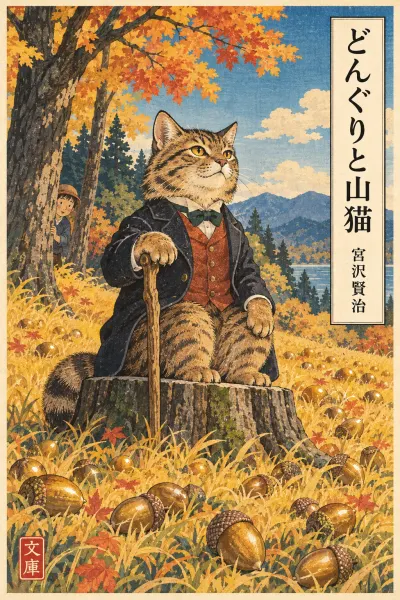
赤いズボンをはいたどんぐりで、三百より多いようでした。They were acorns wearing red trousers, and there seemed to be more than three hundred of them.
みんな大きなこえでさわいでいます。All of them were making a racket in loud voices.
男がむちをうつと、どんぐりたちは少ししずかになりました。When the man cracked his whip, the acorns grew a little quieter.
黒い長い服を着た山ねこが、どんぐりの前にすわりました。The Wildcat, wearing a long black robe, sat down in front of the acorns.
「さいばんはもう三日目だ。そろそろけんかをやめたらどうだ。」"This trial is already in its third day. Is it not time you stopped quarreling?"
「いいえ、あたまがとがっているのが、いちばんりっぱです。」"No! The one with the pointiest head is the greatest!"
「ちがいます。まるいのが、いちばんりっぱです。」"Wrong! The roundest one is the greatest!"
「大きいのがりっぱです。」「せが高いのがりっぱです。」"The biggest one is the greatest!" "The tallest one is the greatest!"
みんながさわいで、何もわからなくなりました。Everyone was making such a din that nothing could be understood at all.
山ねこが「うるさい、しずかにしろ。」と大きなこえを出しても、同じことが何回もつづきました。Even when the Wildcat shouted, "You're too noisy! Be quiet!", the same thing happened again and again.
山ねこは、いちろうに小さなこえで聞きました。The Wildcat asked Ichirō in a small voice.
「このように、こまっています。どうしたらいいでしょう。」"You see how troubled we are. What ought we to do?"
いちろうはわらって答えました。Ichirō laughed and answered.
「では、こう話したらどうですか。この中で、いちばんだめで、いちばんりっぱでないものが、いちばんりっぱだ、と。おてらで聞いた話です。」"Well, why not tell them this: the one among them who is the most useless and the least great is the greatest of all. It's something I heard at the temple."
山ねこは、どんぐりたちにそう話しました。The Wildcat told the acorns just that.
すると、どんぐりたちはもう何も話さなくなって、少しも動かなくなりました。Then the acorns stopped saying anything at all and did not move even a little.
山ねこはいちろうの手をとって、「どうもどうも。こんなにひどいさいばんを、すぐに終わらせてくださいました。これからも、はがきを出したら、来てくださいませんか。」と話しました。The Wildcat took Ichirō's hand and said, "Thank you, thank you indeed. You have ended this dreadful trial at once. From now on, when I send a postcard, would you kindly come?"
いちろうは「いいですよ。」と答えました。"All right," Ichirō answered.
山ねこは少しこまったかおで聞きました。The Wildcat asked with a slightly troubled face.
「これからは、はがきに『あした、かならず来なさい』と書いてもいいですか。」いちろうはわらって、「それはちょっとへんですね。やめた方がいいでしょう。」と答えました。"From now on, may I write on the postcard, 'Tomorrow you must come without fail'?" Ichirō laughed and answered, "That's a bit strange. You'd better not."
山ねこはざんねんそうに、下をむいていました。The Wildcat looked down, as if disappointed.
「では、今日のおれいです。金色のどんぐりと、魚のあたまと、どちらがいいですか。」"Well, then, here is your reward for today. Which would you prefer, golden acorns or a fish head?"
「金色のどんぐりがいいです。」"I'd like the golden acorns."
男は、どんぐりをはこにいっぱい入れて持って来ました。The man brought a box filled to the top with acorns.
大きな白いきのこで作ったばしゃを、へんな形の動物がひいていました。A carriage made from a big white mushroom was being pulled by an oddly shaped animal.
二人はばしゃにのりました。The two of them got into the carriage.
ばしゃがすすむと、どんぐりのひかりはだんだんよわくなって、ふつうの茶色のどんぐりにかわりました。As the carriage moved along, the shine of the acorns grew fainter and fainter until they turned into ordinary brown acorns.
そして、山ねこも男もばしゃも見えなくなって、いちろうはじぶんの家の前に、どんぐりのはこを持って立っていました。Then the Wildcat, the man and the carriage all disappeared, and Ichirō was standing in front of his own house, holding the box of acorns.
それから、山ねこのはがきは、もう来ませんでした。After that, no more postcards ever came from the Wildcat.
「かならず来なさい、と書いてもいいと答えればよかった。」と、いちろうは今でも思っています。Even now Ichirō thinks, "I should have told him it was fine to write 'You must come.'"
Vocabulary
| Word | Meaning | JLPT |
|---|---|---|
| へんなへん | strange, odddictionary form: 変A na-adjective: へんな はがき "a strange postcard"; へんだと思う "to think something is strange". | N4 |
| さいばんさいばん | trial (in a court)dictionary form: 裁判さいばんをする means "to hold a trial". | N3 |
| 下手へた | unskillful, poorThe opposite of 上手 (じょうず). Here it describes the handwriting. | N5 |
| ばしゃばしゃ | carriage, horse-drawn cartdictionary form: 馬車Kanji: 馬 "horse" + 車 "vehicle". | — |
| むちむち | whipdictionary form: 鞭むちをうつ means "to crack or strike with a whip". | — |
| まがってまがる | to be bent, to curvedictionary form: 曲がるまがっている describes a state: "is bent". You also know it from 右にまがる "turn right". | N5 |
| 運転手うんてんしゅ | driverToday it usually means a car or train driver; here it is the carriage driver (coachman). | N4 |
| 意見いけん | opinion意見を聞く "to ask someone's opinion". | N4 |
| さわいでさわぐ | to make a noise, to clamordictionary form: 騒ぐUsed for noisy, excited crowds. | N4 |
| とがってとがる | to be pointed, sharpdictionary form: 尖るUsually in the ている form: あたまがとがっている "has a pointed head". | N2 |
| りっぱりっぱ | great, fine, splendiddictionary form: 立派A key word of the story: the acorns argue about which one is the most りっぱ. | N5 |
| かならずかならず | without fail, certainlydictionary form: 必ずAdds strong force to a request or promise. | N4 |
| ざんねんそうざんねん | regrettable, disappointing (ざんねんそう = looking disappointed)dictionary form: 残念ざんねん + そう = "looking disappointed". | N4 |
| おれいおれい | thanks; a reward or thank-you giftdictionary form: お礼Can be words of thanks or a present given as thanks. | N4 |
Grammar
〜てある N4 something has been done (and the result remains)
With a transitive verb, 〜てある shows that someone did something on purpose and the result is still there. 書いてありました means the words were written on the postcard.
「あした、むずかしいさいばんをしますから、来てください。山ねこ」と書いてありました。
It said: "Tomorrow I am holding a difficult trial, so please come. The Wildcat."
〜てみることにする N4 decide to try doing something
〜てみる means "try doing and see", and 〜ことにする means "decide to". Together, Ichirō decides to go farther and see what he finds.
でも、もっと行ってみることにしました。
Still, he decided to go a little farther and see.
〜そうに N4 looking ~, in a ~ way
Drop い from an i-adjective (or use a na-adjective stem) and add そう to mean "looks ~" (here かなしい → かなしそう). With に it describes how someone does an action, as in かなしそうに聞きました "asked sadly".
男は「あのはがきのぶんしょうは、下手だったか。」と、かなしそうに聞きました。
"Was the writin' on that postcard bad?" the man asked sadly.
〜ようだ N4 it seems / it looks like
ようだ expresses a conjecture based on what the speaker observes. 三百より多いようでした means 'it appeared that there were more than three hundred.'
赤いズボンをはいたどんぐりで、三百より多いようでした。
They were acorns wearing red trousers, and there seemed to be more than three hundred of them.
〜たらどうですか N4 why don't you ~? (suggestion)
The た-form + らどうですか makes a gentle suggestion. The Wildcat uses the plain form やめたらどうだ, and Ichirō uses the polite form.
では、こう話したらどうですか。
Well, why not tell them this.
〜ばよかった N4 I should have ~ (regret)
The ば-form + よかった expresses regret about something one did not do. Here Ichirō regrets not having answered that the Wildcat could write 'You must come.'
「かならず来なさい、と書いてもいいと答えればよかった。」
"I should have told him it was fine to write 'You must come.'"