Upper intermediate · JLPT N2
どんぐりと山猫Donguri to Yamaneko — The Wildcat's Acorn Trial
- JLPT N2
- 6,271 characters
- 5 parts
- about 52 minutes
- 2 easier versions
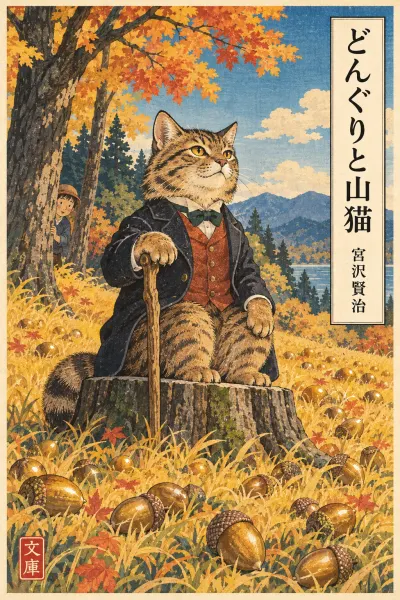
A short fairy tale by Miyazawa Kenji, told in a warm, playful storyteller's voice. A boy named Ichirō receives a clumsy postcard from a wildcat asking him to come and help with a troublesome trial. The next morning he heads up a mountain valley, chatting with a chestnut tree, a waterfall, mushrooms and a squirrel, none of whom agree on where the wildcat went. What he finds in a golden meadow is a noisy dispute that turns on a simple question: who is the greatest? The tone is gentle and funny, with a quiet sting of satire underneath. For learners, the narration is friendly and uses polite -mashita past tense, and it is full of sound words and repetition that make the scenes easy to picture. The challenge lies in the voices. The wildcat speaks in overblown keigo that suddenly turns gruff, the coachman uses rustic northern dialect, and the postcard is deliberately misspelled. Working out how each character talks is a good part of the fun.
Contents
Easier versions
This story is also retold in simpler Japanese. Reading an easier version first makes the original much more approachable.
Before you read
- Read the postcard in Part 1 aloud. Its odd spellings and awkward phrasing are intentional, so don't look them up as real words. Sound them out and match them to the standard forms. Ichirō's reaction to the card, and the coachman's worry about it in Part 2, only make sense once you see how clumsy it is.
- Expect rustic dialect from the coachman, such as だべ, そんだら and お出やる. Treat だべ as roughly だろう and そんだら as それなら. You don't need to master the dialect, just recognize these few recurring forms.
- Notice how the wildcat's speech shifts. He uses stiff, overpolite keigo toward Ichirō, then gruff commands toward the acorns, including forms like 〜たらどうだ. This contrast is where much of the humor comes from, so compare his sentences with Ichirō's plain, boyish speech.
- Watch for 〜と used for discovery ("when he looked, there was..."). It marks each new surprise on Ichirō's walk and in the meadow. Also watch for 〜てみる, used as he tries asking each creature in turn.
- Learn a few key words before starting: どんぐり (acorn), 山猫 (wildcat), 裁判 (trial), 馬車 (carriage) and 葉書 (postcard). Also expect many onomatopoeic words. Guess their feel from context rather than stopping to translate each one.
Words to know
The most useful words from the notes across the story.
| Word | Meaning | JLPT |
|---|---|---|
| 別当べっとう | groom, stableman (one who tends horses); in 馬車別当, the Wildcat's coachman/groomOld word for a man who looks after horses; 馬車別当 = the one who drives the carriage. | — |
| 陣羽織じんばおり | sleeveless battle coat worn over armourA samurai garment; here it makes the wildcat look grand and official. | — |
| 裁判さいばん | trial, court caseThe postcard writes it in kana, さいばん. | N3 |
| 尖ってとがる | to be pointed, sharpdictionary form: 尖るAlso a key word later: the acorns argue about whose head is most pointed (とがってる). | N2 |
| 谷川たにがわ | mountain stream, valley stream川 becomes がわ by rendaku. | — |
| はがきはがき | postcarddictionary form: 葉書Usually written in kana or as 葉書. | N5 |
| 急なきゅう | steep (of a slope)dictionary form: 急急 also means 'sudden' (急に, later in this passage) and 'urgent'. | N4 |
| 残念ざんねん | regrettable, disappointing | N4 |
| しまってしまう | to put away, to tuck awaydictionary form: しまうThis is the main verb, not the auxiliary 〜てしまう. | N3 |
| きのどくきのどく | sorry for someone, pitifuldictionary form: 気の毒気の毒になる = to come to feel sorry for someone. | N3 |
| 利かないきく | (in negative) not be enough, not coverdictionary form: 利く〜でも利かない: 'even ~ wouldn't be enough'. | N3 |
| 文句もんく | wording, phrasingAlso commonly means 'complaint' (文句を言う), but here it means the words written on the card. | N3 |
| 墨すみ | ink (for brush writing)Traditional ink made from soot and ground on an inkstone. | N2 |
| もぐってもぐる | to crawl into, to dive underdictionary form: 潜るUsed for burrowing under the covers. | N2 |
| すきとおったすきとおる | clear, transparentdictionary form: 透き通るA favourite word of Miyazawa Kenji for pure, clean air and light. | N2 |
Plot summary
Show the full summary (contains spoilers)
One Saturday evening, Ichirō gets a badly spelled postcard inviting him to a wildcat's troublesome trial. Next morning he walks up a valley, asking a chestnut tree, a waterfall, mushrooms and a squirrel about the wildcat, and their answers conflict. In a golden meadow beyond a kaya forest he meets the one-eyed coachman who wrote the card and cheers him by praising it. The wildcat then appears, and hundreds of golden acorns pour out of the grass, arguing whether the pointiest, roundest, biggest, tallest or best-pushing acorn is greatest. Ichirō suggests declaring the silliest, most hopeless acorn the greatest, and they fall silent at once. The delighted wildcat names him honorary judge. Ichirō advises against a stiff new postcard wording and picks golden acorns over a salted salmon head. A mushroom carriage takes him home. The acorns lose their shine on the way, and at his door the wildcat, coachman and carriage vanish. No more postcards ever come, which Ichirō sometimes regrets.
About the author
Miyazawa Kenji was a poet and writer of children's stories from Hanamaki in Iwate Prefecture. He studied agricultural science in Morioka and later taught at an agricultural school. He devoted much of his life to helping local farmers improve their methods and their cultural lives. He was a devout Buddhist, and his faith, love of nature and interest in science run through his writing. His fame came after his death, with works such as 銀河鉄道の夜, 風の又三郎 and the poem 雨ニモマケズ.