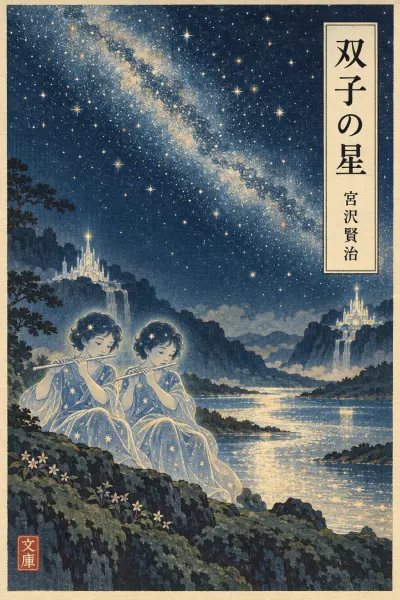
 N5 · easy
Simplified retelling · JLPT N5
双子の星 Futago no Hoshi in easy Japanese (N5)
This is our own simplified retelling of The Star Twins by the Silver River, written for N5 learners and checked word by word against the N5 vocabulary list. A few story words and grammar patterns go beyond N5; the notes below give each one's level. It keeps the characters, events and ending of the original. When it feels easy, move on to the N4 version or the original text.
The story in brief
The twin stars Chunse and Pōse help a crow and a scorpion who have hurt each other in a fight, and walk slowly with the heavy scorpion toward his home until a man from the King brings medicine. Later a comet tricks them into a journey and pushes them into the sea, where a sea serpent speaks up for them as good stars and its king sends them back to the sky. The twins apologize to the King of the Sky and play their flutes again as dawn comes.
AI translation · independently checked
そらの川の西に、小さな青いほしが二つあります。To the west of the River of the Sky, there are two small blue stars.
チュンセとポウセです。They are Chunse and Pōse.
二人は毎ばん、うたにあわせて、ふえをふきます。Every night the two of them play their flutes along with a song.
ある朝、二人はそらのいけへ行きました。One morning, the two of them went to the pond in the sky.
からすが来て、水をのみました。A crow came and drank some water.
さそりも来て、からすにわるいことばをいいました。A scorpion came too, and said nasty things to the crow.
からすとさそりはけんかをしました。The crow and the scorpion had a fight.
からすもさそりも、いたくておきません。Both the crow and the scorpion were in such pain that they could not get up.
チュンセはくちで、からすのわるいものをすって、出しました。With his mouth, Chunse sucked the bad stuff out of the crow and spat it out.
からすはげんきになって、いえにかえりました。The crow got well again and went back home.
二人はさそりのあたまを水であらいました。The two of them washed the scorpion's head with water.
さそりは「いえまでいっしょに来て。」とたのみました。The scorpion begged them, "Come with me all the way to my house."
さそりはとてもおもいです。The scorpion is very heavy.
でも、二人はゆっくりあるきました。But the two of them walked slowly on.
よるになりました。Night came.
ふえをふく時間です。It is time to play the flutes.
ポウセはつかれて、もうあるけません。Pōse was so tired that he could not walk any more.
さそりは「わたしがわるかったです。これから、いいさそりになります。」といいました。The scorpion said, "I was in the wrong. From now on, I will be a good scorpion."
その時、おうさまのところから男が来ました。Just then, a man came from the King.
男はさそりにくすりをわたしました。The man handed the scorpion some medicine.
二人はあたらしいふくをきて、いえにかえりました。The two of them put on new clothes and went back home.
そして、いつもの時間にふえをふきました。And they played their flutes at the usual time.
ある雨のよる、ほうきぼしが来て、「りょこうに行こう。おうさまも、いいといったよ。」といいました。One rainy night, a comet came and said, "Let's go on a journey. The King said it's fine, too."
二人はほうきぼしにのって、行きました。The two of them climbed onto the comet and off they went.
でも、ほうきぼしは「あれは本当ではないよ。」といって、二人をおしました。But the comet said, "That wasn't true, you know!" and pushed the two of them off.
二人はうみの中に入りました。The two of them went into the sea.
うみの中で、あかいひとでたちが「あたらしいひとでだね。」といいました。In the sea, the red starfish said, "New starfish, aren't they?"
くじらは「わるいほしだ。食べるぞ。」といいました。The whale said, "Wicked stars, are you? I'll eat you up!"
そこへ、うみへびが来て、「この二人はいいほしです。」といいました。Just then a sea serpent came and said, "These two are good stars."
うみへびのおうさまは、さそりの話をしっていました。The King of the Sea Serpents knew the story of the scorpion.
おうさまは大きなかぜで、二人をそらへかえしました。With a great wind, the King sent the two of them back to the sky.
そらへ行く時、二人はほうきぼしを見ました。As they were going up to the sky, the two of them saw the comet.
ほうきぼしはうみに入って、小さなどうぶつになりました。The comet went into the sea and became a small creature.
二人はいえにかえって、そらのおうさまに「わたしたちがわるかったです。」といいました。The two of them went home and said to the King of the Sky, "We were in the wrong."
ひとでとほうきぼしの話もしました。They also told him about the starfish and the comet.
そして、ふえをふきました。And then they played their flutes.
東のそらがあかるくなりました。The eastern sky grew bright.
Vocabulary
| Word | Meaning | JLPT |
|---|---|---|
| ふえふえ | flute; pipedictionary form: 笛Usually written 笛. | N3 |
| ふきますふく | to play (a wind instrument); to blowdictionary form: 吹くふえをふく = to play the flute. Also used for wind: かぜがふく. | N5 |
| いけいけ | ponddictionary form: 池 | N5 |
| けんかけんか | fight; quarreldictionary form: 喧嘩けんかをする = to have a fight. | N4 |
| たのみましたたのむ | to ask (a favour); to begdictionary form: 頼む | N5 |
| おもいおもい | heavydictionary form: 重いOpposite: かるい (light). | N5 |
| つかれてつかれる | to get tireddictionary form: 疲れる | N5 |
| くすりくすり | medicinedictionary form: 薬 | N5 |
| わたしましたわたす | to hand over; to givedictionary form: 渡すDon't confuse with わたし (I). | N5 |
| ほうきぼしほうきぼし | cometdictionary form: 箒星Literally 'broom star', from the tail's shape; ほし becomes ぼし here. | — |
| おしましたおす | to pushdictionary form: 押す | N5 |
| ひとでひとで | starfishdictionary form: 海星 | — |
| くじらくじら | whaledictionary form: 鯨 | — |
| あかるくあかるい | bright; lightdictionary form: 明るいあかるくなる = to become bright; here, dawn is coming. | N5 |
Grammar
〜にあわせて N3 along with; in time with
Noun + にあわせて means doing something so that it matches or fits the noun. Here the twins play their flutes in time with the song.
二人は毎ばん、うたにあわせて、ふえをふきます。
Every night the two of them play their flutes along with a song.
〜くて (reason) N4 because (it is) …, so …
The て-form of an い-adjective can give a reason for what follows. いたくて means 'because it hurt', so they could not get up.
からすもさそりも、いたくておきません。
Both the crow and the scorpion were in such pain that they could not get up.
〜になる N5 to become …
Noun or な-adjective + になる shows a change of state. げんきになる means 'to get well'.
からすはげんきになって、いえにかえりました。
The crow got well again and went back home.
もう + potential negative N4 can't … any more
あるけません is the negative potential form of あるく (can't walk). With もう, it means he is no longer able to do it.
ポウセはつかれて、もうあるけません。
Pōse was so tired that he could not walk any more.
Volitional 〜よう/〜おう N4 let's …
行こう is the plain volitional form of 行く, a casual version of 行きましょう. The comet uses it to invite the twins.
りょこうに行こう。
Let's go on a journey.
〜時 N5 when …; as …
A plain-form verb + 時 tells when something happens. Dictionary form 行く時 means 'while going / on the way'.
そらへ行く時、二人はほうきぼしを見ました。
As they were going up to the sky, the two of them saw the comet.