Part 1 of 8 · JLPT N2
双子の星 Futago no Hoshi, part 1: The Twins Go to the Sky Spring
In this part
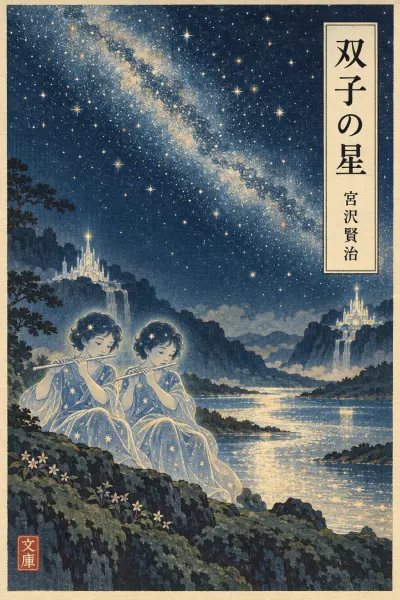
Chunse and Pōse are twin stars who live in two small crystal palaces on the western bank of the Silver River, and each night they play silver flutes in time with the star-circling song. One morning, when their night's work is done, they walk to a spring in the sky and start building a little waterfall. While they work, they hear singing from across the meadow, and the Great Crow star comes striding toward them.
AI translation · independently checked
双子の星 一The Twin Stars: One
天の川の西の岸にすぎなの胞子ほどの小さな二つの星が見えます。On the western bank of the Silver River you can see two small stars, each no bigger than a horsetail spore.
あれはチュンセ童子とポウセ童子という双子のお星さまの住んでいる小さな水精のお宮です。Those are the little crystal palaces where the twin stars called Chunse Dōji and Pōse Dōji live.
このすきとおる二つのお宮は、まっすぐに向い合っています。These two clear, shining palaces stand directly facing each other.
夜は二人とも、きっとお宮に帰って、きちんと座り、空の星めぐりの歌に合せて、一晩銀笛を吹くのです。At night the two of them never fail to return to their palaces, sit up properly, and play their silver flutes the whole night through, in time with the star-circling song of the sky.
それがこの双子のお星様の役目でした。That was the duty of these twin stars.
ある朝、お日様がカツカツカツと厳かにお身体をゆすぶって、東から昇っておいでになった時、チュンセ童子は銀笛を下に置いてポウセ童子に申しました。One morning, as the Sun came up in the east, solemnly shaking His body with a clack, clack, clack, Chunse Dōji put down his silver flute and said to Pōse Dōji:
「ポウセさん。もういいでしょう。お日様もお昇りになったし、雲もまっ白に光っています。今日は西の野原の泉へ行きませんか。」"Pōse, surely that is enough now. The Sun has risen, and the clouds are shining pure white. Shall we go to the spring in the western meadow today?"
ポウセ童子が、まだ夢中で、半分眼をつぶったまま、銀笛を吹いていますので、チュンセ童子はお宮から下りて、沓をはいて、ポウセ童子のお宮の段にのぼって、もう一度云いました。But Pōse Dōji was still lost in his playing and went on blowing his silver flute with his eyes half closed, so Chunse Dōji came down from his palace, put on his shoes, climbed the steps of Pōse Dōji's palace, and said it once more:
「ポウセさん。もういいでしょう。東の空はまるで白く燃えているようですし、下では小さな鳥なんかもう目をさましている様子です。今日は西の野原の泉へ行きませんか。そして、風車で霧をこしらえて、小さな虹を飛ばして遊ぼうではありませんか。」"Pōse, surely that is enough now. The eastern sky looks as if it were burning white, and down below it seems the little birds and such are already awake. Shall we go to the spring in the western meadow today? And let's make mist with a pinwheel and play at sending little rainbows flying, shall we not?"
ポウセ童子はやっと気がついて、びっくりして笛を置いて云いました。At last Pōse Dōji noticed, and in surprise he put down his flute and said:
「あ、チュンセさん。失礼いたしました。もうすっかり明るくなったんですね。僕今すぐ沓をはきますから。」"Oh, Chunse! I do beg your pardon. It's already quite light, isn't it? I'll put my shoes on right away."
そしてポウセ童子は、白い貝殻の沓をはき、二人は連れだって空の銀の芝原を仲よく歌いながら行きました。Then Pōse Dōji put on his white seashell shoes, and the two set off together across the silver lawns of the sky, singing happily side by side:
「お日さまの、"Along the Sun's
お通りみちを はき浄め、highway, sweep it clean,
ひかりをちらせ あまの白雲。and scatter your light, white clouds of heaven.
お日さまの、Along the Sun's
お通りみちの 石かけをhighway, the broken stones
深くうずめよ、あまの青雲。」bury them deep, blue clouds of heaven."
そしてもういつか空の泉に来ました。And before they knew it they had come to the spring in the sky.
この泉は霽れた晩には、下からはっきり見えます。On clear nights this spring can be seen plainly from down below.
天の川の西の岸から、よほど離れた処に、青い小さな星で円くかこまれてあります。It lies a good way off from the western bank of the Silver River, ringed round with small blue stars.
底は青い小さなつぶ石でたいらにうずめられ、石の間から奇麗な水が、ころころころころ湧き出して泉の一方のふちから天の川へ小さな流れになって走って行きます。Its bottom is paved smooth with small blue pebbles, and between the stones clear water comes bubbling up, burble burble burble, and runs off from one edge of the spring into the Silver River as a little stream.
私共の世界が旱の時、瘠せてしまった夜鷹やほととぎすなどが、それをだまって見上げて、残念そうに咽喉をくびくびさせているのを時々見ることがあるではありませんか。In our world, in times of drought, haven't you sometimes seen gaunt nighthawks and cuckoos and other birds gazing silently up at it, their throats working sadly as they swallow?
どんな鳥でもとてもあそこまでは行けません。No bird of any kind can possibly get that far.
けれども、天の大烏の星や蠍の星や兎の星ならもちろんすぐ行けます。But the Great Crow star of the heavens, or the Scorpion star, or the Hare star, can of course get there in no time.
「ポウセさんまずここへ滝をこしらえましょうか。」"Pōse, shall we start by making a waterfall here?"
「ええ、こしらえましょう。僕石を運びますから。」"Yes, let's make one. I'll carry the stones."
チュンセ童子が沓をぬいで小流れの中に入り、ポウセ童子は岸から手ごろの石を集めはじめました。Chunse Dōji took off his shoes and stepped into the little stream, and Pōse Dōji began gathering stones of a handy size from the bank.
今は、空は、りんごのいい匂いで一杯です。By now the sky was full of the sweet smell of apples.
西の空に消え残った銀色のお月様が吐いたのです。The silver Moon, still lingering in the western sky, had breathed it out.
ふと野原の向うから大きな声で歌うのが聞えます。Suddenly, from the far side of the meadow, came the sound of someone singing in a loud voice:
「あまのがわの にしのきしを、"On the Silver River's western bank,
すこしはなれたそらの井戸。a little way off, there's a well in the sky.
みずはころろ、そこもきらら、Its water goes trickle, its bottom goes twinkle,
まわりをかこむあおいほし。and all around it the blue stars lie.
夜鷹ふくろう、ちどり、かけす、Nighthawk and owl, and plover and jay,
来よとすれども、できもせぬ。」would come if they could, but they can't find the way."
「あ、大烏の星だ。」童子たちは一緒に云いました。"Oh, it's the Great Crow star!" the boys said together.
もう空のすすきをざわざわと分けて大烏が向うから肩をふって、のっしのっしと大股にやって参りました。Already the Great Crow was coming toward them from over there, parting the silver grass of the sky with a great rustling, swinging his shoulders and tramping along with long, heavy strides.
まっくろなびろうどのマントを着て、まっくろなびろうどの股引をはいて居ります。He wore a cape of jet-black velvet and jet-black velvet breeches.
Vocabulary
| Word | Meaning | JLPT |
|---|---|---|
| 天の川あまのがわ | the Milky Way (literally 'the River of Heaven')Here rendered as 'the Silver River'. 天 is read あま, an old reading, only in set words like this one. | — |
| 岸きし | bank, shore | N3 |
| 童子どうじ | boy, childA literary or Buddhist-flavoured word, used here almost like a title after each twin's name. | — |
| 水精すいしょう | crystalAn old way of writing 水晶 (rock crystal). | — |
| お宮みや | palace, shrinedictionary form: 宮With お, it usually means a Shinto shrine. Here it is the twins' little dwelling. | — |
| すきとおるすきとおる | to be transparent, see-throughdictionary form: 透き通る | N2 |
| 役目やくめ | duty, role, job | N2 |
| 厳かにおごそか | solemnly, with dignitydictionary form: 厳か | N1 |
| 夢中むちゅう | absorbed, lost in (something) | N3 |
| 沓くつ | shoes, footwearAn old kanji for くつ. Modern Japanese writes 靴. | N5 |
| こしらえてこしらえる | to make, to put togetherdictionary form: こしらえるA slightly old-fashioned, homely word for 作る. | N2 |
| 湧き出してわきだす | to well up, gush out (of water)dictionary form: 湧き出す | — |
| 旱ひでり | droughtNow usually written 日照り. | — |
| のっしのっしのっしのっし | with heavy, swaggering stepsOnomatopoeia for a big, self-important creature walking slowly and heavily. | — |
Grammar
お〜になる / おいでになる N3 honorific verb forms
The narrator raises the Sun's actions with honorific language. 昇っておいでになった is a respectful form of 昇ってきた, and お昇りになった in the next speech is the お+stem+になる pattern.
お日様がカツカツカツと厳かにお身体をゆすぶって、東から昇っておいでになった時
as the Sun came up in the east, solemnly shaking His body with a clack, clack, clack
〜たまま N4 while still in the state of ~; leaving it as it is
たまま shows that one state continues while something else happens. Pōse keeps his eyes half closed the whole time he plays.
半分眼をつぶったまま、銀笛を吹いています
is playing his silver flute with his eyes half closed
〜ようだ N4 looks as if ~, seems like ~
Combined with まるで, ようだ makes a vivid comparison: the eastern sky looks exactly as though it were burning white. Here it appears in its connective form ようですし.
東の空はまるで白く燃えているようですし
the eastern sky looks as if it were burning white
〜(よ)うではありませんか N2 let's ~, shall we not? (polite, rather formal invitation)
〜(よ)うではありませんか: a polite, formal invitation ('let's ~, shall we?'), made from the volitional form plus ではありませんか. Separately, 〜ではありませんか after a plain-form clause is a rhetorical question seeking agreement ('isn't it the case that ~?'), as in the narrator's ことがあるではありませんか. The example 遊ぼうではありませんか is the invitation use.
小さな虹を飛ばして遊ぼうではありませんか。
let's play at sending little rainbows flying, shall we not?
〜ながら N4 while doing ~
ながら attaches to a verb stem and shows two actions done by the same subject at once. The twins sing as they walk.
二人は連れだって空の銀の芝原を仲よく歌いながら行きました。
the two set off together across the silver lawns of the sky, singing happily side by side.
〜なら N4 if it's ~; as for ~
なら picks out a topic and contrasts it with what was just said. Ordinary birds cannot reach the spring, but star creatures like the Great Crow can.
天の大烏の星や蠍の星や兎の星ならもちろんすぐ行けます。
the Great Crow star of the heavens, or the Scorpion star, or the Hare star, can of course get there in no time.