Upper intermediate · JLPT N2
双子の星Futago no Hoshi — The Star Twins by the Silver River
- JLPT N2
- 10,891 characters
- 8 parts
- about 91 minutes
- 3 easier versions
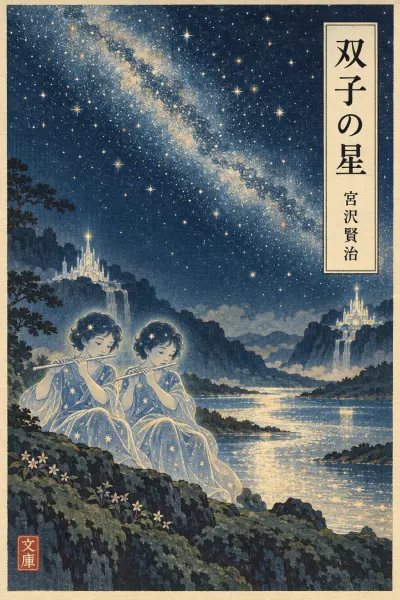
双子の星 is a fairy tale by Miyazawa Kenji set in the night sky. Chunse and Pōse are two small blue stars who live in crystal palaces on the western bank of the Silver River, the Milky Way. Every night they play silver flutes in time with the star-circling song. The story falls into two linked adventures. In the first, the twins' kindness is tested when the boastful Great Crow and the Scorpion quarrel beside their spring. In the second, a smooth-talking comet invites them on a journey that carries them much farther than they expected. A gentle narrator tells the story in desu/masu form. The tone is warm, moral and quietly strange, and stars, weather and sea creatures all have their own voices. For a learner, those voices are both the main challenge and the main reward. The twins speak politely, while the Crow, the Scorpion, the comet and the whale trade rough plain-form insults. The sea-serpent king uses elaborate humble keigo. Words for stars, water and the sea come back again and again, so the text gets easier as you read on.
Contents
Easier versions
This story is also retold in simpler Japanese. Reading an easier version first makes the original much more approachable.
Before you read
- Watch for honorific forms such as おいでになる and お〜になる. The narrator and the twins use them for the Sun, the Moon and the unseen King. They are respectful versions of everyday verbs, not new vocabulary.
- Use speech style to track who is talking. The twins use polite desu/masu forms and suggestions like 〜(よ)うではありませんか. The Crow, the Scorpion, the comet and the whale use blunt plain forms and 〜てやる for threats and boasts ('I'll show you').
- Descriptive scenes lean on a few patterns: 〜ようだ (seems/looks like), 今にも〜そうだ (on the verge of), 〜たまま (while still in a state) and 〜ながら (while doing). Learn these early, especially for the long carrying scene in parts 3–4.
- Duty and obligation drive the plot. Expressions like 〜ないといけない show up whenever the twins worry about getting back in time for the star-circling. Noticing them helps you follow the twins' motives.
- The story splits into two halves (parts 1–4 and 5–8), and each half has its own set of words. The first half centres on the spring, poison and wounds. The second half is full of sea-floor creatures such as starfish (ひとで) and the whale. If the first half feels hard, the second may read more easily, because the narration and the twins' speech follow the same patterns.
Words to know
The most useful words from the notes across the story.
| Word | Meaning | JLPT |
|---|---|---|
| 童子どうじ | boy, childA literary or Buddhist-flavoured word, used here almost like a title after each twin's name. | — |
| 生意気なまいき | cheeky, insolentSaid of someone acting above their station. | N2 |
| 沓くつ | shoes, footwearAn old kanji for くつ. Modern Japanese writes 靴. | N5 |
| 役目やくめ | duty, role, job | N2 |
| 欺されただます | to trick, to deceivedictionary form: 欺すUsually written 騙す today; 欺 is normally read あざむく. | N2 |
| 厳かにおごそか | solemnly, with dignitydictionary form: 厳か | N1 |
| 畜生ちくしょう | damn it!, curse it!Literally 'beast'; a common rough curse. | N1 |
| 慈悲じひ | mercy, compassionお慈悲でございます is a set phrase for begging someone's mercy. | — |
| 彗星ほうきぼし | cometLiterally a 'broom star'. The standard modern reading is すいせい. | — |
| 痛快つうかい | thrilling; exhilarating; delightfulUsed for an intensely satisfying excitement. | — |
| めつけたみつける | founddictionary form: 見つけるめつける is a colloquial, childish pronunciation of みつける. | N4 |
| 支度したく | preparations; getting readyUsually used as 支度をする. A more everyday word than 準備. | N4 |
| 岸きし | bank, shore | N3 |
| 夢中むちゅう | absorbed, lost in (something) | N3 |
| 泉いずみ | spring, fountainThe twins' spring, where the quarrel takes place. | N3 |
Plot summary
Show the full summary (contains spoilers)
The twin stars Chunse and Pōse are building a waterfall at a sky spring when the Great Crow and the Scorpion quarrel, fight and both collapse. The twins suck the poison from the Crow's wound and send him home. Then they spend hours carrying the heavy Scorpion home, and night falls before they finish. Pōse collapses, the Scorpion repents, and Lightning arrives with the King's medicine, refreshes the twins and returns them home. Later a comet falsely claims the King has allowed the twins to travel with it, then hurls them into the sea. There a whale threatens them, but a sea-serpent sees they are innocent and leads them to the sea-serpent king. He serves their King too, and he sends them home on a waterspout. On the way they see the comet fall and become a sea cucumber. Just before dawn, the twins apologise to the King and take up their flutes again.
About the author
Miyazawa Kenji was a poet and writer of children's stories from Hanamaki in Iwate Prefecture. He studied agricultural science in Morioka and later taught at an agricultural school. He devoted much of his life to helping local farmers improve their methods and their cultural lives. He was a devout Buddhist, and his faith, love of nature and interest in science run through his writing. His fame came after his death, with works such as 銀河鉄道の夜, 風の又三郎 and the poem 雨ニモマケズ.