 N5 · easy
Simplified retelling · JLPT N5
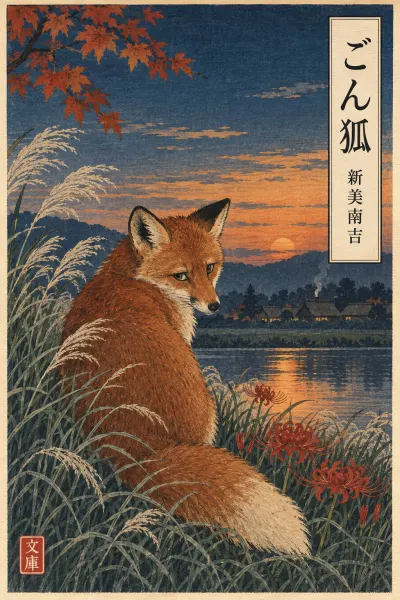
ごん狐 Gongitsune in easy Japanese (N5)
This is our own simplified retelling of Gon's Chestnuts, written for N5 learners and checked word by word against the N5 vocabulary list. A few story words and grammar patterns go beyond N5; the notes below give each one's level. It keeps the characters, events and ending of the original. When it feels easy, move on to the N4 version or the original text.
The story in brief
Gon, a lonely little fox, steals an eel from Hyōjū as a prank, then learns that Hyōjū's sick mother has died without eating eel. Feeling guilty, Gon secretly leaves sardines and then chestnuts at Hyōjū's house every day, but Hyōjū believes the gods are sending them. When Hyōjū sees Gon slip into his kitchen, he shoots him, and only then realises who had been bringing the chestnuts.
AI translation · independently checked
山の中に、ごんという小さなきつねが一人ですんでいました。In the hills lived a little fox called Gon, all on his own.
ごんはよくむらへ出て来て、いたずらをしました。Gon often came down to the village and got up to mischief.
あきのあさ、ごんは川へ行きました。One autumn morning, Gon went to the river.
川の中で、ひょうじゅうという男がさかなをとっていました。In the river, a man called Hyōjū was catching fish.
ひょうじゅうは、大きなうなぎもとりました。Hyōjū caught a big eel, too.
そして、さかなを川のそばにおいて、どこかへ行きました。Then he left the fish by the river and went off somewhere.
ごんは、いたずらをしました。Gon played a trick.
さかなを川へかえしました。He threw the fish back into the river.
うなぎはくちでもちました。The eel he held in his mouth.
そこへ、ひょうじゅうがかえって来ました。Just then, Hyōjū came back.
「きつねがうなぎをぬすんだ!」"A fox stole my eel!"
ごんはうなぎをもったまま、山へはしってかえりました。Still holding the eel, Gon ran back to the hills.
十日ぐらいあとで、ひょうじゅうのところに人がおおぜい来ていました。About ten days later, a lot of people had come to Hyōjū's house.
そうしきでした。It was a funeral.
ひょうじゅうのおかあさんがしんだのです。Hyōjū's mother had died.
その夜、ごんは一人で言いました。That night, Gon said to himself:
「おかあさんはびょうきで、うなぎが食べたかったでしょう。でも、わたしがうなぎをとりました。おかあさんはうなぎを食べないで、しにました。わたしはわるいきつねです。」"His mother was sick, and she must have wanted to eat eel. But I took the eel. His mother died without eating any eel. I'm a bad fox."
ひょうじゅうも一人です。Hyōjū was all alone now, too.
「わたしとおなじだ。」と、ごんは言いました。"He's just like me," said Gon.
そのあと、むらにいわしをもった男が来ました。After that, a man carrying sardines came to the village.
ごんはいわしを五つとって、ひょうじゅうのだいどころに入れました。Gon took five sardines and put them in Hyōjū's kitchen.
つぎのあさ、ごんはくりをもって行きました。The next morning, Gon went along with some chestnuts.
ひょうじゅうは一人で言っていました。Hyōjū was talking to himself.
「だれかが、だいどころにいわしを入れました。いわしの男は、わたしがぬすんだと言いました。わたしはその男にやられました。」"Somebody put sardines in my kitchen. The sardine man said I stole them. That man gave me a real beating."
「わたしがわるかった。」と、ごんは言いました。"It was my fault," said Gon.
そして、しずかにくりをおいてかえりました。Then he quietly left the chestnuts and went home.
つぎのあさも、そのつぎのあさも、ごんはくりをもって行きました。The next morning, and the morning after that, Gon went with chestnuts.
あきの夜、ひょうじゅうが友だちと話していました。One autumn night, Hyōjū was talking with a friend.
「毎日、だれかがくりをおいていきます。だれかわかりません。」"Every day somebody leaves chestnuts for me. I don't know who it is."
「それはかみさまですよ。毎日、かみさまに『どうも』と言ってください。」That's the gods, you know. Please say 'thank you' to the gods every day.
ごんは、その話を聞いていました。Gon was listening to them talk.
「くりをもって行くのは、わたしだ。かみさまじゃない。おもしろくないなあ。」"I'm the one bringing the chestnuts. Not the gods. That's no fun at all."
つぎのあさも、ごんはくりをもって、ひょうじゅうのだいどころに入りました。The next morning, too, Gon took chestnuts and went into Hyōjū's kitchen.
ひょうじゅうは、ごんを見ました。Hyōjū saw Gon.
「うなぎをぬすんだきつねが、また来た。」"That fox that stole my eel has come back again."
ひょうじゅうはてっぽうをとって、ごんをうちました。Hyōjū took his gun and shot Gon.
ごんは、もうたてませんでした。Gon could not get up anymore.
ひょうじゅうは、だいどころのくりを見ました。Hyōjū saw the chestnuts in the kitchen.
「ごんだったのか。いつもくりをもって来たのは。」"So it was you, Gon? You were the one always bringing the chestnuts?"
ごんはめをあけないで、小さくあたまを下げました。Without opening his eyes, Gon gave a small nod.
ひょうじゅうは、てっぽうを下におきました。Hyōjū put the gun down.
あおいけむりが、ほそく出ていました。Blue smoke was still rising thinly from it.
Vocabulary
| Word | Meaning | JLPT |
|---|---|---|
| いたずらいたずら | mischief, prank, trickUsed with する: いたずらをする = to play a trick. | N3 |
| うなぎうなぎ | eelKanji: 鰻. A special, nourishing food in Japan. | — |
| ぬすんだぬすむ | to stealdictionary form: 盗むぬすんだ is the plain past form. | N4 |
| おおぜいおおぜい | a lot of people, a crowddictionary form: 大勢Used only for people, not things. | N5 |
| そうしきそうしき | funeraldictionary form: 葬式 | N2 |
| びょうきびょうき | illness, sickness (びょうきで = being ill)dictionary form: 病気 | N5 |
| いわしいわし | sardinedictionary form: 鰯 | — |
| だいどころだいどころ | kitchendictionary form: 台所 | N5 |
| くりくり | chestnutdictionary form: 栗A typical autumn food. | — |
| しずかにしずか | quietlydictionary form: 静かな-adjective + に becomes an adverb. | N5 |
| かみさまかみさま | god, the godsdictionary form: 神様さま is a very polite form of さん. | N2 |
| てっぽうてっぽう | gun (an old-style rifle)dictionary form: 鉄砲 | N2 |
| うちましたうつ | to shootdictionary form: 撃つSame sound as 打つ (to hit), but written 撃つ for guns. | N3 |
| けむりけむり | smokedictionary form: 煙 | N3 |
Grammar
〜という N4 called ~, named ~
Name + という + noun introduces someone or something by name. ごんというきつね means 'a fox called Gon'.
ごんという小さなきつねが一人ですんでいました。
A little fox called Gon lived all on his own.
〜ていました N5 was doing ~
The て-form + いました shows an action going on at a past moment. Here it sets the scene: Hyōjū was in the middle of fishing.
ひょうじゅうという男がさかなをとっていました。
A man called Hyōjū was catching fish.
〜たまま N4 still doing ~, while keeping ~
Verb た-form + まま means a state stays the same while something else happens. Gon runs away with the eel still in his mouth.
ごんはうなぎをもったまま、山へはしってかえりました。
Still holding the eel, Gon ran back to the hills.
〜のです N4 explaining the reason or situation
Adding のです gives an explanation for what came before. The funeral is explained: it was because Hyōjū's mother had died.
ひょうじゅうのおかあさんがしんだのです。
Hyōjū's mother had died.
〜たかった N5 wanted to ~
Verb stem + たい means 'want to'. It changes like an い-adjective, so the past is たかった. The object can take が instead of を.
うなぎが食べたかったでしょう。
She must have wanted to eat eel.
〜ないで N4 without doing ~
Verb ない-form + で means doing the next action without doing the first one. The mother died without eating eel.
おかあさんはうなぎを食べないで、しにました。
His mother died without eating any eel.