Part 1 of 6 · JLPT N2
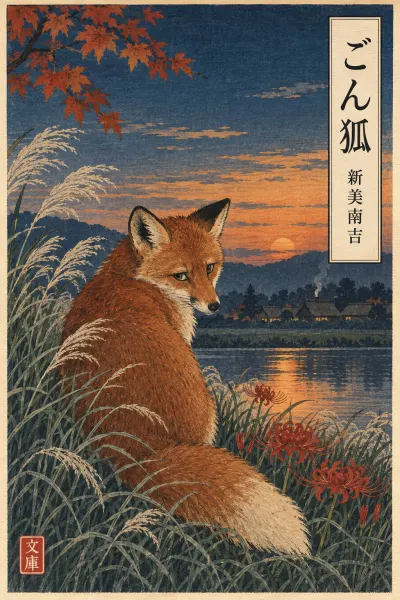
ごん狐(一) Gongitsune, part 1: Gon, the Lonely Little Trickster
In this part
The narrator tells a story he heard as a child about Gon, a lonely little fox who lives in the hills near Nakayama and plays tricks on the villagers. One autumn, after several days of rain, Gon sees Hyōjū fishing in the swollen river and throws his catch back into the water. When Gon tries to take a big eel, it coils around his neck, Hyōjū shouts at him, and Gon runs off to his den with the eel still wrapped around him.
AI translation · independently checked
これは、私が小さいときに、村の茂平というおじいさんからきいたお話です。This is a story I heard when I was little, from an old man in our village named Mohei.
むかしは、私たちの村のちかくの、中山というところに小さなお城があって、中山さまというおとのさまが、おられたそうです。Long ago, they say, at a place called Nakayama not far from our village, there stood a small castle, and a lord called Lord Nakayama lived there.
その中山から、少しはなれた山の中に、「ごん狐」という狐がいました。In the hills a little way off from Nakayama lived a fox called "Gon the Fox."
ごんは、一人ぼっちの小狐で、しだの一ぱいしげった森の中に穴をほって住んでいました。Gon was a little fox who was all alone, and he lived in a hole he had dug in a forest thick with ferns.
そして、夜でも昼でも、あたりの村へ出てきて、いたずらばかりしました。And by night and by day alike, he would come out into the villages round about and do nothing but make mischief.
はたけへ入って芋をほりちらしたり、菜種がらの、ほしてあるのへ火をつけたり、百姓家の裏手につるしてあるとんがらしをむしりとって、いったり、いろんなことをしました。He got into the fields and dug up the sweet potatoes and scattered them about, he set fire to the rapeseed stalks that had been laid out to dry, he tore down the red peppers hanging behind the farmhouses and ran off with them. He did all sorts of things.
或秋のことでした。It happened one autumn.
二、三日雨がふりつづいたその間、ごんは、外へも出られなくて穴の中にしゃがんでいました。For two or three days the rain kept falling, and all that time Gon couldn't even go outside, so he stayed crouched in his hole.
雨があがると、ごんは、ほっとして穴からはい出ました。When the rain stopped, Gon crawled out of his hole, feeling relieved.
空はからっと晴れていて、百舌鳥の声がきんきん、ひびいていました。The sky was clear and bright, and the shrill cries of the shrikes rang out.
ごんは、村の小川の堤まで出て来ました。Gon came out as far as the bank of the village stream.
あたりの、すすきの穂には、まだ雨のしずくが光っていました。All around, drops of rain were still glistening on the plumes of pampas grass.
川は、いつもは水が少いのですが、三日もの雨で、水が、どっとましていました。Usually there was little water in the stream, but after three whole days of rain it had risen in a rush.
ただのときは水につかることのない、川べりのすすきや、萩の株が、黄いろくにごった水に横だおしになって、もまれています。The pampas grass and clumps of bush clover along the bank, which were never under water at ordinary times, had been knocked flat by the muddy yellow water and were being tossed about.
ごんは川下の方へと、ぬかるみみちを歩いていきました。Gon walked downstream along the muddy path.
ふと見ると、川の中に人がいて、何かやっています。Then, glancing over, he saw someone standing in the river, doing something.
ごんは、見つからないように、そうっと草の深いところへ歩きよって、そこからじっとのぞいてみました。So as not to be seen, Gon crept quietly into a place where the grass was deep, and from there he peered out, keeping perfectly still.
「兵十だな」と、ごんは思いました。"It's Hyōjū," Gon thought.
兵十はぼろぼろの黒いきものをまくし上げて、腰のところまで水にひたりながら、魚をとる、はりきりという、網をゆすぶっていました。Hyōjū had tucked up his ragged black kimono and stood in the water up to his waist, shaking a fishing net called a harikiri net.
はちまきをした顔の横っちょうに、まるい萩の葉が一まい、大きな黒子みたいにへばりついていました。On the side of his face, his head bound with a twisted cloth, a single round bush-clover leaf was stuck fast, like a big mole.
しばらくすると、兵十は、はりきり網の一ばんうしろの、袋のようになったところを、水の中からもちあげました。After a while, Hyōjū lifted the very back of the harikiri net, the part shaped like a bag, up out of the water.
その中には、芝の根や、草の葉や、くさった木ぎれなどが、ごちゃごちゃはいっていましたが、でもところどころ、白いものがきらきら光っています。Inside it was a jumble of grass roots, leaves, bits of rotten wood and such, but here and there something white was glittering.
それは、ふというなぎの腹や、大きなきすの腹でした。It was the bellies of fat eels and big whiting.
兵十は、びくの中へ、そのうなぎやきすを、ごみと一しょにぶちこみました。Hyōjū tossed the eels and whiting into his fish basket, rubbish and all.
そして、また、袋の口をしばって、水の中へ入れました。Then he tied the mouth of the bag shut again and put it back in the water.
兵十はそれから、びくをもって川から上りびくを土手においといて、何をさがしにか、川上の方へかけていきました。After that, Hyōjū came up out of the river with the basket, left it on the embankment, and ran off upstream to look for something or other.
兵十がいなくなると、ごんは、ぴょいと草の中からとび出して、びくのそばへかけつけました。As soon as Hyōjū was gone, Gon sprang out of the grass and dashed over to the basket.
ちょいと、いたずらがしたくなったのです。He had suddenly felt like playing a little trick.
ごんはびくの中の魚をつかみ出しては、はりきり網のかかっているところより下手の川の中を目がけて、ぽんぽんなげこみました。Gon grabbed the fish out of the basket one after another and flung them, plop, plop, into the river below where the harikiri net was set.
どの魚も、「とぼん」と音を立てながら、にごった水の中へもぐりこみました。Every one of the fish went splash and dived down into the muddy water.
一ばんしまいに、太いうなぎをつかみにかかりましたが、何しろぬるぬるとすべりぬけるので、手ではつかめません。Last of all he went to grab the fat eel, but it was so slippery that it kept sliding away, and he couldn't catch it with his paws.
ごんはじれったくなって、頭をびくの中につッこんで、うなぎの頭を口にくわえました。Losing patience, Gon stuck his head into the basket and caught the eel's head in his mouth.
うなぎは、キュッと言ってごんの首へまきつきました。The eel gave a squeak and wrapped itself around Gon's neck.
そのとたんに兵十が、向うから、At that very moment, from over there, Hyōjū
「うわアぬすと狐め」と、どなりたてました。yelled, "Hey, you thieving fox!"
ごんは、びっくりしてとびあがりました。Gon jumped up in fright.
うなぎをふりすててにげようとしましたが、うなぎは、ごんの首にまきついたままはなれません。He tried to shake off the eel and run, but the eel stayed wrapped around his neck and wouldn't let go.
ごんはそのまま横っとびにとび出して一しょうけんめいに、にげていきました。So, just as he was, Gon leapt off sideways and ran away as fast as he could.
ほら穴の近くの、はんの木の下でふりかえって見ましたが、兵十は追っかけては来ませんでした。Under the alder tree near his den he turned around to look, but Hyōjū had not come after him.
ごんは、ほっとして、うなぎの頭をかみくだき、やっとはずして穴のそとの、草の葉の上にのせておきました。Relieved, Gon bit the eel's head to pieces, finally got it off, and laid it on the grass outside his hole.
Vocabulary
| Word | Meaning | JLPT |
|---|---|---|
| 一人ぼっちひとりぼっち | all alone, lonelyStresses loneliness, not just being by oneself. This is a key theme of the story. | — |
| しげったしげる | to grow thickly, be overgrowndictionary form: 茂るUsed for dense plants and trees. | N2 |
| いたずらいたずら | mischief, prankいたずらをする means to play a prank. | N3 |
| 百姓家ひゃくしょうや | farmhouse百姓 (farmer) is an old-fashioned word. | — |
| しゃがんでしゃがむ | to crouch, squatdictionary form: しゃがむ | N2 |
| 堤つつみ | bank, embankmentA literary word. 土手 (どて), used later, is the everyday equivalent. | N3 |
| すすきすすき | Japanese pampas grass (silver grass)dictionary form: 薄・芒A classic symbol of autumn. | — |
| ぬかるみぬかるみ | mud, muddy ground | — |
| はりきりはりきりあみ | harikiri net (a net stretched across a stream)dictionary form: 張り切り網A regional fishing net with a bag-shaped end. | — |
| びくびく | fish basket (a creel)dictionary form: 魚籠 | — |
| じれったくじれったい | frustrating, impatientdictionary form: じれったいThe feeling of being irritated when things don't go your way. | — |
| くわえましたくわえる | to hold in the mouthdictionary form: 銜える | N2 |
| ぬすとぬすと | thiefdictionary form: 盗人A colloquial or rustic form of ぬすびと. The suffix め is an insult: "you ...!" | — |
| びっくりしてびっくりする | to be startleddictionary form: びっくりする | — |
| ほっとしてほっとする | to feel relieveddictionary form: ほっとする | — |
Grammar
〜そうです (hearsay) N4 they say that; it is said that
Attached to the plain form, そうです reports information heard from others. Here it marks the lord's existence as a legend passed down to the narrator.
中山さまというおとのさまが、おられたそうです。
They say a lord called Lord Nakayama lived there.
〜たり〜たり(する) N4 doing things like A and B
This pattern lists typical examples from a larger set of actions. Here it runs through Gon's pranks and then sums them up with いろんなことをしました.
はたけへ入って芋をほりちらしたり、菜種がらの、ほしてあるのへ火をつけたり
getting into the fields and digging up the potatoes, setting fire to the rapeseed stalks laid out to dry
〜てある N4 has been done (a resulting state)
A transitive verb in the て-form plus ある describes a state left by someone's action. The peppers had been hung up and the stalks set out to dry by the farmers.
百姓家の裏手につるしてあるとんがらし
the red peppers hung up behind the farmhouses
〜ないように N4 so as not to
ように after a negative verb states the goal of an action. Gon moves quietly in order not to be found.
ごんは、見つからないように、そうっと草の深いところへ歩きよって
So as not to be seen, Gon crept quietly into the deep grass
〜ては (repeated action) N3 doing A and then B, over and over
The て-form plus は, followed by another action, describes a repeated cycle. Gon grabs a fish and throws it, again and again.
ごんはびくの中の魚をつかみ出しては、
Gon kept grabbing the fish out of the basket and
〜たまま N4 while still in the state of; as it is
The た-form plus まま means a state continues unchanged. The eel stays coiled around Gon's neck.
うなぎは、ごんの首にまきついたままはなれません。
The eel stayed wrapped around Gon's neck and wouldn't let go.