Upper intermediate · JLPT N2
ごん狐Gongitsune — Gon's Chestnuts
- JLPT N2
- 4,792 characters
- 6 parts
- about 40 minutes
- 3 easier versions
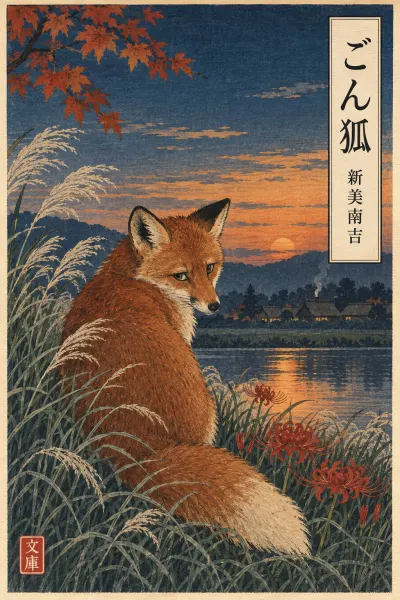
Gongitsune is one of the best-known children's stories in Japan and has long been a staple of elementary school textbooks. The narrator says he heard it as a child from an old man in his village. It follows Gon, a lonely little fox who lives by himself in the woods near a farming village and spends his days playing tricks on the villagers. One autumn a thoughtless prank against a poor young man named Hyōjū leaves Gon feeling guilty. He sets out, in secret, to make things right. The tone is gentle and quiet, with a strong feeling of the seasons: rain-swollen rivers, red spider lilies, chestnuts and mushrooms in the hills. For learners, the narration is friendly です/ます storytelling full of vivid onomatopoeia, and much of the story is told through Gon's small, private thoughts. The difficulty comes from the old rural setting (fishing nets, funerals, matchlock guns) and the rustic dialogue, which uses older and dialectal forms. The story is short, but its closing lines stay with many readers.
Contents
Easier versions
This story is also retold in simpler Japanese. Reading an easier version first makes the original much more approachable.
Before you read
- The narration is almost entirely in the past polite form (~ました, ~ていました, ~でした). Once you are used to it, the storytelling rhythm becomes easy to follow. Gon's thoughts, by contrast, appear in 「」 in casual plain form (~だな, ~んだろう), so watch for the switch.
- Onomatopoeia and mimetic words carry much of the action and mood: ぴょいと, そっと, ちょいと, ぽんぽん, かたかた and similar words. Learn to read them as adverbs describing how something moves or sounds, not as vocabulary to translate word for word.
- The villagers' dialogue is old rural speech. Expect おれ/わし, おっ母 (mother), ぬすと (= ぬすびと, thief), and the dialectal honorific 思わっしゃって (roughly 思われて/お思いになって). Katakana is also used for drawn-out vowels, as in うわア.
- Learn a few key nouns first, because the plot turns on them: うなぎ (eel), いわし (sardine), 栗 (chestnut), 松たけ (matsutake mushroom), 葬式 (funeral), 神さま (the gods), 火縄銃 (matchlock gun).
- Pay attention to the explanatory の in the final lines (~だったのか). It expresses sudden realization, and it is the emotional key to the ending.
Words to know
The most useful words from the notes across the story.
| Word | Meaning | JLPT |
|---|---|---|
| しゃがんでしゃがむ | to crouch, squatdictionary form: しゃがむ | N2 |
| 物置ものおき | storehouse, shed | N2 |
| 一人ぼっちひとりぼっち | all alone, lonelyStresses loneliness, not just being by oneself. This is a key theme of the story. | — |
| つまらないつまらない | disappointing, no fun, not worth itHere not "boring" but "what a letdown." | N5 |
| 家内かない | wifeHere used for another man's wife. In modern Japanese, 家内 is mostly a humble word for one's own wife. | N4 |
| すいていましたすく | to comb (hair)dictionary form: 梳くUsually written in kana. Used with 髪. | N4 |
| ふみふみふむ | stepping again and againdictionary form: 踏むRepeating a verb stem (ふみ+ふみ) shows an action repeated as one moves along. | N4 |
| お礼おれい | thanks, gratitudeお礼を言う = to say thank you. | N4 |
| いたずらいたずら | mischief, prankいたずらをする means to play a prank. | N3 |
| 堤つつみ | bank, embankmentA literary word. 土手 (どて), used later, is the everyday equivalent. | N3 |
| ぼんやりぼんやり | absent-mindedly, vacantly | N3 |
| じっとじっと | (keeping) perfectly stillじっとする = to stay motionless; also じっと見る, to stare. | N3 |
| ふしぎふしぎ | strange, mysteriousdictionary form: 不思議Na-adjective: ふしぎなこと = a strange thing. | N3 |
| あわれにあわれ | pitiful; あわれに思う = to feel pity fordictionary form: 哀れ | N3 |
| しげったしげる | to grow thickly, be overgrowndictionary form: 茂るUsed for dense plants and trees. | N2 |
Plot summary
Show the full summary (contains spoilers)
Gon, a mischievous young fox living alone, steals the eel and fish that Hyōjū has caught in the river. Ten days later he sees the funeral of Hyōjū's mother. He guesses that she had wanted to eat eel before she died, and that his prank took it from her. Now Hyōjū is alone, just like Gon. To make amends, Gon throws stolen sardines into Hyōjū's house, but Hyōjū is beaten as a thief because of it. After that, Gon leaves chestnuts and matsutake mushrooms every day. Hyōjū's friend Kasuke tells him the gifts must come from the gods, and Gon feels this is unfair. The next day Hyōjū sees the fox slip into his house and shoots him. Then he finds the chestnuts and realizes: 'Gon, it was you?' Gon nods with his eyes closed.
About the author
Niimi Nankichi was a Japanese writer of children's stories, poems and songs from Handa in Aichi Prefecture. The countryside of that area is widely thought to lie behind the village and hills of Gongitsune. He began writing as a young man. Gongitsune appeared in the children's magazine Akai Tori (The Red Bird), edited by Suzuki Miekichi. Niimi later worked as a teacher at a girls' school while continuing to write. His health was poor, and he died of tuberculosis while still in his twenties. Many of his works were published and became widely known only after his death. Besides Gongitsune, he is especially remembered for Tebukuro wo Kai ni (Buying Mittens).