Part 1 of 3 · JLPT N3
箱の中のあなた Hako no Naka no Anata, part 1: A Photograph on the Hilltop
In this part
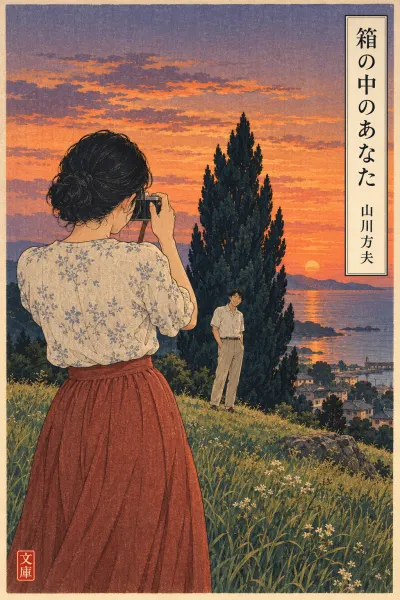
On a hilltop at sunset, a smooth-talking tourist from the city asks a painfully shy woman in her thirties to take his photograph. She cannot look men in the face, but through the camera's viewfinder she can finally gaze at him as a small, harmless figure she can possess. As she presses the shutter, a sudden despairing resolve sweeps through her.
AI translation · independently checked
「あの、失礼ですが」"Um, excuse me, but—"
なめらかな都会ふうの男の声がいった。said a man's voice, smooth and city-sounding.
彼女は、臆病と疑惑とがいっしょになったようなぎごちない様子で、立ち止った。She stopped awkwardly, with an air in which timidity and suspicion seemed to have merged into one.
丘の上は、すばらしい夕焼けで赤く染っていた。The hilltop was dyed red by a magnificent sunset.
馬の背のような地面に、まばらな木が細長い影をつくっていた。Across ground shaped like a horse's back, the sparse trees cast long, thin shadows.
「いい景色ですねえ、ほんとに。……これ、なんの木です?」"What a lovely view, really. ...What kind of tree is this?"
なれなれしく、この地方だけに生えている緑いろの炎のような形の樹をさして、男は訊く。The man asked familiarly, pointing to one of the trees, shaped like green flames, that grew only in this region.
男は、首からカメラを吊していた。A camera hung from the man's neck.
態度といい、口調といい、男はわざわざ東京あたりからやってきた観光客の一人にちがいなかった。From his manner and from his way of talking alike, he was surely one of the tourists who had come all the way from somewhere like Tokyo.
……この地方は、初夏から観光シーズンにはいって、駅前には歓迎の大きなアーチが立つ。...In this region the tourist season starts in early summer, and a large welcome arch goes up in front of the station.
今年も、もう十日あまり、彼女は毎日それを見てきていた。This year, too, she had been seeing it every day for more than ten days already.
「すみませんが」と、男はいった。"Excuse me," said the man.
「ここで、写真を一枚とってくれませんか」"Would you take a picture for me here?"
棒のように直立したまま、だが彼女は、その男の首から上、やさしい声の流れだす唇さえ、ろくに見ることができなかった。She stood bolt upright, stiff as a pole, yet she could barely look at any part of him above the neck, not even the lips from which that gentle voice flowed.
彼女は、男の顔を、いままでまっすぐに見られたことがなかった。She had never yet been able to look a man straight in the face.
その内気さ、臆病さが、結局のところ、三十才を過ぎた今日まで、彼女に一人暮しをさせていたのかもしれない。Perhaps it was that shyness, that timidity, which in the end had kept her living alone until now, when she was past thirty.
首すじのあたりまで真赤にして、極度の緊張に、彼女は呼吸がつまるような気がしていた。Flushed crimson right down to the nape of her neck, she felt as though the extreme tension would choke off her breath.
男は、明るい声でいった。The man spoke in a cheerful voice.
「じつはね、記念に、この風景をバックに、ぼくを入れて一枚うつしていただきたいんです。なに、セットはぼくがしますし、シャッターさえ押して下されば、いいんですから。……お願いします」"The thing is, I'd like you to take one of me with this scenery behind me, as a souvenir. Oh, I'll set everything up; all you have to do is press the shutter, that's all. ...Please."
彼女は、こわばった顔でちょっと道をふりかえった。Her face stiff, she glanced back along the path.
誰も通らなかった。No one was coming by.
「すみませんが」"Excuse me, but..."
男はやさしい声でくりかえした。the man repeated in a gentle voice.
彼女は手をのばした。She held out her hands.
おそるおそるカメラを手に受けると、ぎくしゃくと胸に抱えこんで、彼女はけんめいにその少しぼやけた男の映像を、小さな箱の中の暗いガラス板の上にとらえるのに熱中した。Timidly taking the camera into her hands, she clutched it clumsily to her chest and threw herself into the task of catching the man's slightly blurred image on the dark glass plate inside the little box.
やっと焦点があった。At last it came into focus.
彼女は、大きく呼吸を吐いた。She let out a long breath.
美しい、小さな世界だった。It was a beautiful little world.
血のような夕陽に染りながらぽつんと一人の男が立ち、にこやかなポーズで笑っていた。Steeped in a setting sun the colour of blood, a lone man stood there, smiling in a cheerful pose.
旅行者は茜色の光にくっきり映え、その光は、ちょっとぐずぐずしていれば跡方なく消えてしまいそうに思えた。The traveller stood out sharply in the madder-red light, and it seemed to her that the light would vanish without a trace if she lingered even a little.
まっすぐな鼻、薄い女のような唇、ひきしまった精悍な腰つき。A straight nose, thin lips like a woman's, the lean, taut, vigorous set of his hips.
……のしかかるような動物の圧力、圧倒的な恐怖そのものだったそれまでの「男性」は、どこかに消え、ガラス板の上に縮小され、定着された男は、いまは輪郭の明瞭な、小さな愛らしい一箇の人形となって、はじめて彼女は彼を所有することができていたのだった。...The "male" that until then had been an overbearing animal pressure, overwhelming terror itself, had vanished somewhere; shrunk and fixed upon the glass plate, the man had now become a small, lovable doll with clear outlines, and for the first time she was able to possess him.
うっとりと、彼女は飽かず眺めつづけた。Entranced, she went on gazing, never tiring of it.
それは、ゆるされた貴重な時間だった。It was a precious time, one that she was allowed.
こうでもしなければ、私は「彼」をとっくりと見ることもできない。Unless I do something like this, I can't even take a good long look at "him."
全身が熱く燃えあがって、彼女は、胸がはやくもある期待にわななきはじめたのがわかった。Her whole body blazed up with heat, and she knew that her heart had already begun to tremble with a certain expectation.
「まだですか」と、男がいった。"Not yet?" said the man.
「……え。いま……」と、彼女は答えた。"...Oh. Just a—" she answered.
そのとき、ある絶望のような決意が、すばやく彼女のなかを走った。At that moment a resolve, something like despair, flashed swiftly through her.
彼女は、自分が、もはやどうしてもそれを避けられなくなっているのを確認したのだった。She had realised, beyond doubt, that she could no longer avoid it, no matter what.
しずかな風景のなかに、シャッターが、突然、死んだ小鳥が水に落ちたような音を立てた。Into the quiet scenery, the shutter suddenly made a sound like a dead little bird dropping into water.
Vocabulary
| Word | Meaning | JLPT |
|---|---|---|
| 臆病おくびょう | timidity, cowardiceAlso used as a na-adjective; 臆病さ in a later sentence is the noun form with 〜さ. | N1 |
| 疑惑ぎわく | suspicion, doubtStronger and more formal than 疑い. | N1 |
| ぎごちないぎごちない | awkward, stiffAlso spelled ぎこちない, which is the more common form today. | — |
| なれなれしくなれなれしい | overly familiar, too friendlydictionary form: なれなれしいSlightly negative: friendliness that oversteps distance with a stranger. | N1 |
| 内気うちき | shy, reservedHere with 〜さ to make the noun 'shyness'. | — |
| 緊張きんちょう | tension, nervousness | N3 |
| おそるおそるおそるおそる | timidly, fearfullydictionary form: 恐る恐るDescribes doing something hesitantly, half afraid. | — |
| 焦点しょうてん | focus (of a lens)焦点が合う = to come into focus. | N2 |
| 茜色あかねいろ | madder red, deep sunset redFrom 茜, the madder plant used for red dye; a classic word for evening skies. | — |
| 跡方あとかた | trace, vestigedictionary form: 跡形Usually written 跡形; almost always in 跡形もなく 'without a trace'. | — |
| 所有しょゆう | possession, ownership所有する = to own, to possess. | — |
| 飽かずあく | without tiring (of it)dictionary form: 飽くLiterary negative 〜ず of 飽く; modern 飽きずに. | — |
| とっくりととっくり | carefully, at length, thoroughlydictionary form: とっくりOld-fashioned adverb; modern じっくり is similar. | — |
| わななきわななく | to tremble, quiverdictionary form: わななくLiterary verb, used for trembling from fear or strong emotion. | — |
Grammar
〜といい〜といい N1 both A and B; whether in A or B
Two nouns are listed as evidence for a judgement about the whole. Here the man's manner and his tone of voice both point to his being a city tourist.
態度といい、口調といい、男はわざわざ東京あたりからやってきた観光客の一人にちがいなかった。
From his manner and from his way of talking alike, he was surely one of the tourists who had come all the way from somewhere like Tokyo.
〜にちがいない N3 must be, surely
Expresses strong certainty based on evidence. With past ちがいなかった, it gives the woman's confident conclusion at that moment.
観光客の一人にちがいなかった
he was surely one of the tourists
〜さえ〜ば N2 if only, as long as (just)
さえ marks the single thing that is enough, and the conditional 〜ば states that it is all that is needed. The man reassures her that pressing the shutter is her only task.
シャッターさえ押して下されば、いいんですから。
all you have to do is press the shutter, that's all.
〜ていただきたい N3 I would like you to (humble request)
The humble いただく ('receive') with 〜たい makes a polite request to have someone do something for the speaker. It suits the man's courteous but breezy tone.
ぼくを入れて一枚うつしていただきたいんです。
I'd like you to take one of me.
〜でもしなければ N2 unless one does something like ~
でも softens the action to 'something like this', and しなければ sets the negative condition. The sentence then states what would be impossible otherwise, showing how desperate her situation feels.
こうでもしなければ、私は「彼」をとっくりと見ることもできない。
Unless I do something like this, I can't even take a good long look at "him."