Intermediate · JLPT N3
箱の中のあなたHako no Naka no Anata — The Stranger in the Viewfinder
- JLPT N3
- 3,337 characters
- 3 parts
- about 28 minutes
- 2 easier versions
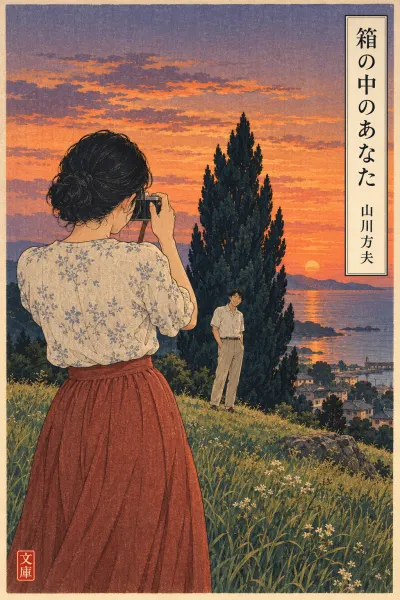
"The Stranger in the Viewfinder" (箱の中のあなた, literally "You Inside the Box") is a short psychological story by Yamakawa Masao. It is set in a provincial seaside tourist town at the start of summer. A breezy tourist from Tokyo asks a painfully shy woman in her thirties to take his picture on a hilltop at sunset. She cannot meet a man's eyes, but through the camera's viewfinder she can finally look at him freely. That small moment sets the story in motion. The narration stays close to her inner thoughts and is calm, restrained and quietly unsettling. The tension rests on what she feels rather than on what she says. For learners, the story is short (about 3,300 characters, measured at N3) and written in modern standard Japanese with no dialect. It also offers a clear contrast in speech styles: the man's easy desu/masu politeness against the woman's faltering feminine speech. The challenge is reading between the lines. Much depends on noticing how her perceptions shift, so the grammar of emphasis and limitation carries a lot of the meaning.
Contents
Easier versions
This story is also retold in simpler Japanese. Reading an easier version first makes the original much more approachable.
Before you read
- Track the two speech styles. The man uses relaxed, friendly desu/masu. The woman uses hesitant feminine forms such as 〜ですわ, and in her final words to the photograph she shifts to soft, intimate endings (〜わ, 〜のよ, 〜ね). That shift in tone is part of the story's effect.
- Learn the patterns that frame her way of seeing: 〜でしかない (is nothing but), 〜にちがいない (must surely be) and 〜さえ〜ば (if only). They often mark the moments when her view of the man changes, so read those sentences slowly.
- Watch for 〜かける (to start to do something, or to be about to). The narration often catches actions half-begun, which suits the woman's hesitancy.
- Expect a few older spellings. 染る appears where modern texts usually write 染まる, and 才 is used for 歳 in ages. Read them as you would the standard forms.
- Before reading, learn some basic camera and setting vocabulary, such as 写真, シャッター, ファインダー and 断崖 (cliff). In part 3, notice how the recurring image of the flame-shaped tree and the red sunset light take on new meaning.
Words to know
The most useful words from the notes across the story.
| Word | Meaning | JLPT |
|---|---|---|
| 浴びたあびる | to be bathed in (light), to be showered withdictionary form: 浴びるAlso used for showers: シャワーを浴びる. | N5 |
| 一昨年いっさくねん | the year before lastIn everyday speech usually read おととし. | N5 |
| 緊張きんちょう | tension, nervousness | N3 |
| 慄えてふるえる | to tremble, to shiverdictionary form: 慄えるUsually written 震える; 慄 adds a shade of dread or thrill. | N3 |
| 裏切りうらぎる | to betraydictionary form: 裏切るLiterally 'to cut from behind'. | N3 |
| 焦点しょうてん | focus (of a lens)焦点が合う = to come into focus. | N2 |
| 見下せるみおろす | to look down over (a view), to overlookdictionary form: 見下ろすRead みくだす, the same kanji means 'to look down on, despise'. | N2 |
| 夕刊ゆうかん | evening edition of a newspaperThe morning edition is 朝刊 (ちょうかん). | N2 |
| 臆病おくびょう | timidity, cowardiceAlso used as a na-adjective; 臆病さ in a later sentence is the noun form with 〜さ. | N1 |
| 疑惑ぎわく | suspicion, doubtStronger and more formal than 疑い. | N1 |
| なれなれしくなれなれしい | overly familiar, too friendlydictionary form: なれなれしいSlightly negative: friendliness that oversteps distance with a stranger. | N1 |
| 露骨ろこつ | open, undisguised, blatantOften slightly negative: showing feelings too plainly. | N1 |
| 現像げんぞう | developing (photographic film)現像する = to develop film; a word from the film-camera era. | N1 |
| 染ったそまる | to be dyed, to be tingeddictionary form: 染まるOlder spelling; today usually written 染まった. | N1 |
| ぎごちないぎごちない | awkward, stiffAlso spelled ぎこちない, which is the more common form today. | — |
Plot summary
Show the full summary (contains spoilers)
A tourist from Tokyo asks a shy woman to photograph him on a hilltop. Through the viewfinder she sees him as small, harmless and somehow hers, and as she presses the shutter she feels a sudden, despairing resolve. He then offers to photograph her, and she suggests a park on the edge of town with a better view of the sea. On the steep path there, he attacks her. She fights back, kills him with a stone, covers up the evidence and pushes his body off the cliff locals call the Devil's Cliff. The paper reports an accident, and the town soon forgets. She frames his sunset-lit photo on her dressing table and tells it gently that only the dead can truly be hers. Then, remembering another man's death anniversary, she unlocks her bookcase. Inside is a row of black-ribboned photos of smiling young men, all taken before the same flame-shaped tree.
About the author
Yamakawa Masao (山川方夫) was a Tokyo-born writer and the son of the nihonga painter Yamakawa Shūhō. His own fiction was nominated several times for the Akutagawa Prize. He died at the age of thirty-four from injuries suffered in a traffic accident.