 N4 · easy
Simplified retelling · JLPT N4
箱の中のあなた Hako no Naka no Anata in easy Japanese (N4)
This is our own simplified retelling of The Stranger in the Viewfinder, written for N4 learners and checked word by word against the N4 vocabulary list. A few story words and grammar patterns go beyond N4; the notes below give each one's level. It keeps the characters, events and ending of the original. When it feels easy, move on to the original text.
The story in brief
A shy woman who is afraid of men is asked by a tourist to take his picture on a hill at sunset. Through the camera she sees him for the first time as small and harmless, and she makes a quiet decision. She leads him to a lonely clifftop park, kills him with a stone when he attacks her, makes it look like an accident, and keeps his smiling photograph. On a cabinet shelf she keeps framed photographs of many young men, all taken at sunset on the same hill.
AI translation · independently checked
ある夏の夕方のことです。It happened one summer evening.
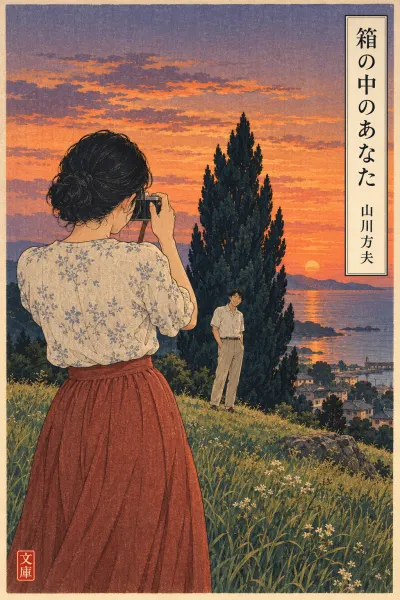
おかの上は、夕焼けで赤くなっていました。The hilltop had turned red in the glow of the sunset.
「あの、すみません。」"Um, excuse me."
一人の男が、女の人にこえをかけました。A man spoke to a woman.
男はくびにカメラをかけていました。He had a camera hanging around his neck.
東京から来た旅行の人のようです。He seemed to be a tourist who had come from Tokyo.
「ここで、写真を一まいとってくれませんか。このけしきと、ぼくを。」"Would you take a picture for me here? Of this view, and me."
女の人は三十さいをすぎていますが、ずっと一人で住んでいます。The woman was past thirty, but she had always lived alone.
男の人がこわくて、男の人のかおをまっすぐに見たことがありませんでした。Men frightened her, and she had never once looked a man straight in the face.
女の人はカメラを持って、小さなはこの中をのぞきました。She took the camera and peered into the little box.
そこには、小さな世界がありました。Inside it was a tiny world.
赤いひかりの中で、男が一人、わらって立っていました。In the red light, a man stood alone, smiling.
はこの中の男は、小さなにんぎょうのようでした。The man inside the box was like a little doll.
ぜんぜんこわくありません。He was not frightening at all.
女の人は、はじめて男のかおをゆっくり見ることができました。For the first time, she was able to take a slow, long look at a man's face.
体が熱くなりました。Her body grew hot.
「まだですか。」"Not yet?"
「…はい、今。」"...Yes, just a moment."
そのとき、女の人は心の中で、あることをきめました。At that moment, deep in her heart, the woman made up her mind about something.
しずかなけしきの中で、シャッターの音がしました。In the quiet scene, the shutter clicked.
「ありがとう。今度はあなたをとらせてください。」"Thank you. Now please let me take one of you."
「あの、ここはあまりいいけしきではありません。この先に、海が見えるこうえんがあります。」"Um, the view here isn't very good. A little farther on there's a park where you can see the sea."
「そうですか。じゃ、つれて行ってください。」"Is that so? Then please take me there."
そのこうえんは町の外にあって、いつも人がいませんでした。The park was outside the town, and there was never anyone there.
女の人は先に立って、古いじんじゃのうしろの、急な道を歩きました。The woman went ahead and walked along the steep path behind an old shrine.
「ちょっと待ってください。」"Wait a moment."
女の人が止まると、男は急に女の人のかたをつかんで、くさの中にたおしました。When she stopped, the man suddenly seized her by the shoulders and pushed her down into the grass.
「いや! そういうことはきらいです!」"No! I hate that sort of thing!"
女の人は、男を強くおしました。She pushed him hard.
でも、男は止めません。But he would not stop.
女の人は力いっぱい、男からにげようとしました。She tried with all her strength to get away from him.
気がつくと、女の人は右手に大きないしを持っていました。When she came to herself, she was holding a large stone in her right hand.
男は足の下にたおれていました。The man lay fallen at her feet.
あたまからちが出て、目は空を見ていました。Blood was coming from his head, and his eyes were looking at the sky.
男は、もう動きませんでした。He did not move any more.
もう、こわくありませんでした。She was no longer afraid.
女の人は、しずかに考えました。The woman thought calmly.
男のポケットからおちたたばこのはこを、もとにもどしました。She put the cigarette pack that had fallen from his pocket back where it belonged.
男にくつをはかせて、がけの上まで引いて行きました。She put his shoes back on him and dragged him to the top of the cliff.
二人がけんかしたあとも、ていねいに消しました。She also carefully wiped away the marks left by their struggle.
カメラは、自分のハンドバッグに入れました。The camera she put into her own handbag.
そして、男のせなかをそっとおしました。Then she gently pushed the man's back.
男はがけからおちて、少しあとで、下から小さな水の音がしました。He fell from the cliff, and a moment later a small splash of water sounded from below.
つぎの日の新聞に、みじかいきじが出ました。A short article appeared in the next day's newspaper.
旅行の人がまちがえて、がけからおちて死んだ、というきじです。It said that a tourist had made a misstep, fallen from the cliff and died.
町の人たちは、あそこを「あぶないがけ」とよんでいました。The people of the town called that place "the Dangerous Cliff."
でも、けいさつも新聞も、それ以上しらべませんでした。But neither the police nor the newspaper looked into it any further.
一週間すぎると、みんなこの話をわすれました。When a week had passed, everyone had forgotten the story.
その日、女の人はゆうびんきょくの仕事の帰りに、写真屋によって、写真をもらいました。That day, on her way home from her job at the post office, the woman stopped at the photo shop and picked up the photographs.
ほしいのは一まいだけです。There was only one she wanted.
夕焼けの中でわらっている、あの男の写真です。The picture of that man, smiling in the sunset.
女の人はその写真を写真立てに入れて、アパートのかがみの前にかざりました。She put the photograph in a frame and set it out in front of the mirror in her apartment.
「ころしてしまって、ごめんなさいね。でも、私は生きている人がこわいの。生きている人は、いつかどこかへ行ってしまうでしょう。でも、このあなたは、ずっと私といっしょにいてくれるわ。なかよく、いっしょにいましょうね。」"I'm sorry I killed you. But I'm afraid of living people. Living people always go away somewhere sooner or later, don't they? But you, this you, will stay with me forever. Let's be good friends and stay together, all right?"
まどから、きれいな金色のひかりが入っていました。Beautiful golden light was coming in through the window.
女の人はカレンダーを見て、小さいこえで言いました。The woman looked at the calendar and spoke in a small voice.
「あ、今日は、おととしのあの人が死んだ日だったわ。」"Oh, today was the day that man from the year before last died."
女の人は、かぎをかけた本だなの、いちばん上のとを開けました。She opened the topmost door of the locked bookcase.
そこには、黒いリボンのついた写真立てが、いくつもならんでいました。Inside, a row of photo frames with black ribbons stood one after another.
どれも、わかい男の人の写真です。Every one held a photograph of a young man.
「ええと、あの人は何ばんめだったかしら。」"Let me see, which one was he, I wonder?"
女の人は、とてもうれしそうなかおで、男たちのかおを一人ずつ、ゆっくり見ました。Looking very happy, she gazed slowly at the men's faces, one by one.
もう少しもこわくありません。She was not the least bit afraid any more.
男たちはみんな、あのおかの上の赤い夕焼けの中で、小さなはこに入れられたときのまま、わらっていました。All the men were smiling in the red sunset on that hilltop, just as they had been when they were put inside the little box.
Vocabulary
| Word | Meaning | JLPT |
|---|---|---|
| 夕焼けゆうやけ | sunset glow; red evening sky夕 'evening' + 焼け 'burning'. The red sky returns at the very end of the story. | N1 |
| こえをかけましたこえをかける | to speak to someone; to call out to a strangerdictionary form: 声をかけるA set phrase for starting a conversation with someone. | — |
| のぞきましたのぞく | to peer into; to look throughdictionary form: 覗くUsed for looking through a small opening, such as a camera viewfinder. | N2 |
| きめましたきめる | to decide; to make up one's minddictionary form: 決めるTransitive. Compare 決まる 'to be decided'. | N4 |
| つかんでつかむ | to grab; to seizedictionary form: 掴む | N3 |
| たおしましたたおす | to knock down; to push overdictionary form: 倒すTransitive. Its intransitive partner 倒れる ('to fall down') appears later in the story. | N3 |
| にげようにげる | to run away; to escapedictionary form: 逃げる | N4 |
| 気がつくきがつく | to notice; to come to one's senses気がつくと means 'when she came to herself' or 'before she knew it'. | — |
| がけがけ | cliffdictionary form: 崖 | N1 |
| きじきじ | newspaper article; reportdictionary form: 記事 | N3 |
| しらべませんでしたしらべる | to investigate; to look intodictionary form: 調べる | N4 |
| 写真立てしゃしんたて | photo frame (standing) | — |
| かざりましたかざる | to display; to decorate withdictionary form: 飾る | N4 |
| ならんでいましたならぶ | to stand in a row; to be lined updictionary form: 並ぶ | N5 |
Grammar
〜てくれませんか N4 Would you (do something) for me?
The te-form + くれませんか makes a polite request for a favour that benefits the speaker. The negative question softens the request.
ここで、写真を一まいとってくれませんか。
Would you take a picture for me here?
〜たことがない N4 have never (done)
The past form + ことがない states that something has never happened in one's experience. Here it is put in the past (ありませんでした) to describe her life up to that moment.
男の人のかおをまっすぐに見たことがありませんでした。
She had never looked a man straight in the face.
〜ことができる N4 can; be able to
The dictionary form + ことができる expresses ability or possibility. Combined with はじめて, it marks something she managed to do for the first time.
女の人は、はじめて男のかおをゆっくり見ることができました。
For the first time, she was able to take a slow, long look at a man's face.
〜ようとする N3 try to; attempt to
The volitional form (にげよう) + とする describes an effort to do something, often one that is not completed or is under way.
女の人は力いっぱい、男からにげようとしました。
She tried with all her strength to get away from him.
Causative 〜せる N4 make or have someone (do something)
はかせる is the causative of はく ('to put on shoes'). Here the man cannot act, so she puts the shoes on him herself.
男にくつをはかせて、がけの上まで引いて行きました。
She put his shoes back on him and dragged him to the top of the cliff.
〜てしまう N4 end up doing; do completely (with regret)
The te-form + しまう shows that an action is finished, often with a feeling of regret. ころしてしまって sounds like an apology for something that cannot be undone, and 行ってしまう means 'go away for good'.
ころしてしまって、ごめんなさいね。
I'm sorry I killed you.