 N5 · easy
Simplified retelling · JLPT N5
箱の中のあなた Hako no Naka no Anata in easy Japanese (N5)
This is our own simplified retelling of The Stranger in the Viewfinder, written for N5 learners and checked word by word against the N5 vocabulary list. A few story words and grammar patterns go beyond N5; the notes below give each one's level. It keeps the characters, events and ending of the original. When it feels easy, move on to the N4 version or the original text.
The story in brief
A lonely woman who fears men is asked by a tourist on a hilltop to take his photograph, and through the camera she sees him without fear. When they walk to a high park outside town, he attacks her. She kills him with a stone and pushes his body off the cliff. She puts his photograph on her desk and speaks to it tenderly. Two years later, on the anniversary, she unlocks a bookcase of photographs of young men, each with a black ribbon and each smiling under the same red sky.
AI translation · independently checked
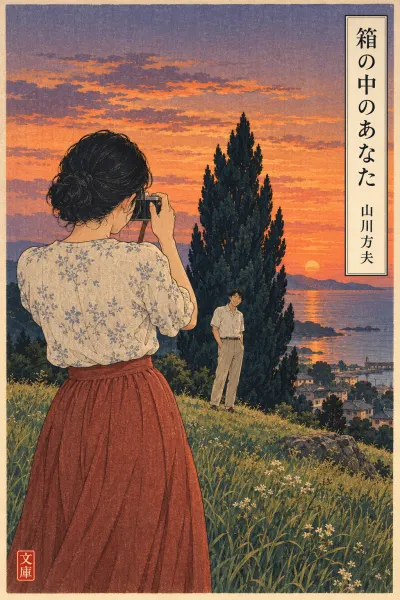
山の上の、おかです。It is a hill at the top of a mountain.
そらがとてもあかいです。The sky is very red.
火のような木が、たくさんあります。There are many trees that look like flames.
「すみません。」"Excuse me."
男の人のこえです。It is a man's voice.
女の人は、とまりました。The woman stopped.
男の人はカメラをもっています。The man is holding a camera.
とおいまちから来た、りょこうの人です。He is a tourist who has come from a distant city.
「ここで、わたしのしゃしんをとって。たのみます。ボタンをおすだけですよ。」"Could you take my picture here? Please. You just press the button."
女の人は、もうわかくありません。The woman is no longer young.
いつも一人です。She is always alone.
男の人がこわいです。Men frighten her.
男の人のかおを、よく見ません。She does not look closely at the man's face.
女の人は、カメラをもちました。The woman took the camera.
カメラの中に、小さい男の人がいます。Inside the camera there is a small man.
あかいそらの下で、わらっています。He is smiling beneath the red sky.
小さい男の人は、こわくありません。The small man is not frightening.
かわいいです。He is sweet.
女の人は、はじめて男の人のかおを、よく見ました。For the first time, the woman took a good look at the man's face.
長い間、見ていました。She kept looking for a long time.
「まだですか。」"Not yet?"
「今……。」"Just a moment..."
女の人は、ボタンをおしました。The woman pressed the button.
「どうも。じゃあ、今、あなたのしゃしんもとりましょう。」"Thanks. Well then, let me take your picture now, too."
「ここは、あまりきれいじゃありません。うみを見る、高いこうえんがあります。まちの外です。」"It isn't very pretty here. There's a park up high that looks out over the sea. It's outside town."
「いいですね。行きましょう。」"Sounds good. Let's go."
そのこうえんには、いつも人がいません。There is never anyone in that park.
女の人は、前をあるきました。The woman walked in front.
みちは細くて、あぶないです。The path is narrow and dangerous.
「ちょっとまって。」"Wait a moment."
女の人がとまると、男の人は女の人を下におしました。When the woman stopped, the man pushed her down.
男の人の大きなからだが、上に来ました。The man's large body came on top of her.
「いや! いやです!」"No! Please, no!"
女の人は、いっしょうけんめいでした。The woman fought with all her strength.
それから、女の人は大きいいしをもっていました。Afterwards, the woman was holding a large stone.
男の人は下にいます。The man is lying below her.
あたまがあかいです。His head is red.
目はそらを見ています。His eyes are looking at the sky.
男の人は、死にました。The man died.
女の人は、もうこわくありません。The woman is no longer afraid.
しずかでした。It was quiet.
女の人は、たばこの箱を男の人のポケットに入れました。The woman put a cigarette packet in the man's pocket.
二人がいたところを、きれいにしました。She tidied up the place where the two of them had been.
カメラは、じぶんのかばんに入れました。The camera she put in her own bag.
そして、男の人のからだを、がけの上までひきました。Then she dragged the man's body to the top of the cliff.
それから、おしました。And then she pushed.
男の人は、がけからうみにおちました。The man fell from the cliff into the sea.
つぎのしんぶんに、小さいニュースがありました。In the next newspaper there was a small news item.
「りょこうの人が、がけからおちて、死にました。」"A tourist fell from a cliff and died."
しゃしんは、ありませんでした。There was no photograph.
けいかんも、しんぶんも、あまり何も言いません。Neither the police nor the newspapers said much of anything.
七日の後、みんなはこのニュースをわすれました。A week later, everyone had forgotten the news.
女の人は、しごとの後、しゃしんのみせに行きました。After work, the woman went to the photo shop.
しゃしんができていました。The photographs were ready.
ほしいしゃしんは、一つだけです。There is only one photograph she wants.
あかいそらの下でわらっている、あの男の人のしゃしんです。It is the photograph of that man, smiling beneath the red sky.
女の人は、そのしゃしんを、アパートのつくえの上におきました。The woman put the photograph on the desk in her apartment.
「これでいいの。」"This is how it should be."
女の人は、しゃしんに話します。The woman speaks to the photograph.
「あなたをころして、わるかったわ。でも、わたしは生きている人がこわいの。生きている人は、どこかへ行くでしょう。このあなたは、どこにも行かないわ。いつまでも、いっしょにすみましょうね。」"I'm sorry I killed you. But I'm afraid of living people. Living people go off somewhere, don't they? You, as you are now, won't go anywhere. Let's live together forever, shall we?"
外は、まだあかるいです。Outside, it is still light.
女の人は、カレンダーを見ました。The woman looked at the calendar.
「おととしの今日、あの人が死んだのね。」"So it was two years ago today that he died."
女の人は、かぎで本だなをあけました。The woman unlocked the bookcase with a key.
そこに、しゃしんがたくさんならんでいます。Inside, many photographs stand in a row.
みんな、わかい男の人です。They are all young men.
どのしゃしんにも、くろいリボンがあります。Every photograph has a black ribbon.
「あの人は、何ばんめだったかしら。」"I wonder which number he was."
女の人は、もうこわくありません。The woman is no longer afraid.
とてもいいかおで、一つ一つのかおを、ゆっくり見ました。With a very contented face, she slowly looked at each face, one by one.
男の人たちは、みんなあのおかの上にいます。The men are all on that hill.
あかいそらと、火のような木の前で、わらっています。They are smiling in front of the red sky and the flame-like trees.
Vocabulary
| Word | Meaning | JLPT |
|---|---|---|
| おかおか | hillWritten 丘 in kanji. It means a low, gentle hill and is smaller than 山. | N3 |
| たのみますたのむ | to ask (a favour), to requestdictionary form: たのむOn its own, たのみます works as a polite "please, I'm counting on you." | N5 |
| おすおす | to press; to pushThe same verb is used for pressing the camera button and for pushing a person. | N5 |
| わかくわかい | youngdictionary form: わかいもう〜ない means "no longer ~". | N5 |
| こわいこわい | frightening; afraidXがこわい can mean either "X is scary" or "I'm afraid of X". | N4 |
| あぶないあぶない | dangerous | N5 |
| いっしょうけんめいいっしょうけんめい | with all one's might, desperatelyWritten 一生懸命 in kanji. It is often used as an adverb (〜にする). | N4 |
| がけがけ | cliffWritten 崖 in kanji. Locals call this place 魔の断崖, "the Devil's Cliff". | N1 |
| ひきましたひく | to pull, to dragdictionary form: ひくIts opposite is おす (to push). | N5 |
| しんぶんしんぶん | newspaper | N5 |
| けいかんけいかん | police officer; the policeWritten 警官 in kanji. The everyday word for a police officer is おまわりさん. | N5 |
| わすれましたわすれる | to forgetdictionary form: わすれる | N5 |
| ころしてころす | to killdictionary form: ころす | N3 |
| おととしおととし | the year before lastThe sequence runs おととし → きょねん → ことし. | N5 |
Grammar
Nのような N N4 like N, N-like
のような attaches to a noun and describes another noun by comparison. Here the trees are compared to fire because of their shape and colour.
火のような木が、たくさんあります。
There are many trees that look like flames.
V(dictionary form)だけ N5 just / only (doing) V
だけ after a verb says that this one action is all that is needed. The man uses it to make his request sound easy.
ボタンをおすだけですよ。
You just press the button.
V(dictionary form)と、〜 N4 when V, (then) ~
With a past-tense main clause, と shows that the second event happens right after the first, often unexpectedly. Her stopping is immediately followed by his attack.
女の人がとまると、男の人は女の人を下におしました。
When the woman stopped, the man pushed her down.
〜ています N5 is ~ing / is in a state of ~
〜ている can describe an ongoing action, as in わらっています. It can also describe a resulting state, as in しゃしんができていました, "the photos were ready."
あかいそらの下で、わらっています。
He is smiling beneath the red sky.
〜ましょう(ね) N5 let's ~
〜ましょう invites the listener to do something together, and adding ね makes it soft and intimate. She says it to a photograph of a dead man, which makes the line chilling.
いつまでも、いっしょにすみましょうね。
Let's live together forever, shall we?
〜かしら N3 I wonder ~
かしら is a soft, feminine sentence ending that expresses wondering to oneself. Its neutral equivalent is 〜かな.
あの人は、何ばんめだったかしら。
I wonder which number he was.