 N3 · easy
Simplified retelling · JLPT N3
花咲かじじい Hanasakajijii in easy Japanese (N3)
This is our own simplified retelling of Grandpa Blossom, written for N3 learners and checked word by word against the N3 vocabulary list. A few story words and grammar patterns go beyond N3; the notes below give each one's level. It keeps the characters, events and ending of the original. When it feels easy, move on to the original text.
The story in brief
A kind old couple's dog, Shiro, leads the old man to buried gold, but their greedy neighbour borrows Shiro and kills him when he digs up only filth. A mortar made from the pine on Shiro's grave produces endless rice, and its ashes make dead trees burst into bloom, so the lord rewards the honest old man. When the greedy neighbour tries the same trick, the ashes blow into the lord's eyes, and he is taken off to prison.
AI translation · independently checked
むかし、ある村に、やさしいおじいさんとおばあさんが住んでいました。Long, long ago, in a certain village, there lived a kind old man and a kind old woman.
二人とも正直で、とてもいい人でした。They were both honest, and very good people.
子供がいなかったので、白という犬を自分の子供のように大切にしていました。They had no children, so they took loving care of a dog called Shiro, as if he were their own child.
白もおじいさんとおばあさんが大好きでした。And Shiro loved the old man and the old woman dearly too.
となりの家にも、おじいさんとおばあさんが住んでいました。In the house next door there also lived an old man and an old woman.
こちらの二人は欲ばりで、いじわるでした。These two were greedy and mean.
白のことがきらいで、いつも白にひどいことをしていました。They hated Shiro, and they were always doing cruel things to him.
ある日、正直なおじいさんは、くわを持って、はたけに行きました。One day the honest old man took his hoe and went out to the field.
白も一緒について来ました。Shiro came along with him too.
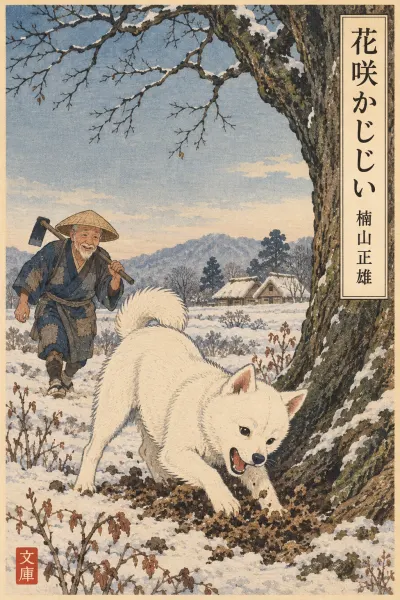
白はおじいさんの着物をかんで、大きな木の下まで引っぱって行きました。Shiro took the old man's kimono in his teeth and tugged him all the way to the foot of a big tree.
そして、足で土をかきながら、「ここほれ、ワン、ワン」と鳴きました。Then, scratching at the earth with his paws, he barked, "Dig here, woof, woof!"
おじいさんがそこをほってみると、カチリと音がしました。When the old man dug there, something went clink!
あなの中で、何かがきらきら光っています。Down in the hole, something was glittering and gleaming.
もっとほると、小判がたくさん出てきました。When he dug further, out came lots and lots of gold coins.
おじいさんはびっくりして、おばあさんを呼びました。The old man was amazed, and he called the old woman.
二人は小判を家に運びました。Together they carried the gold coins home.
こうして、正直なおじいさんとおばあさんは、急にお金持ちになりました。And so the honest old man and old woman suddenly became rich.
この話を聞いて、となりの欲ばりなおじいさんは、とてもうらやましくなりました。When the greedy old man next door heard about this, he grew terribly envious.
そして、すぐに白を借りに来ました。And he came straight over to borrow Shiro.
正直なおじいさんは、白を貸してあげました。The honest old man kindly lent him Shiro.
欲ばりなおじいさんは、いやがる白の首になわをつけて、強く引っぱりました。Shiro did not want to go, but the greedy old man tied a rope around his neck and dragged him hard.
「おれのはたけにも小判があるはずだ。どこだ」白は苦しくて、そこの土をかきました。"There must be gold coins in my field too. Where are they?" Shiro was in such pain that he scratched at the ground right where he was.
「ここか」と、おじいさんはほり始めました。"Here, is it?" said the old man, and he began to dig.
しかし、出てくるのは石ばかりです。But nothing came out except stones.
もっとほると、くさいにおいがして、きたない物がたくさん出てきました。When he dug further, there was a horrible smell, and out came lots and lots of filthy things.
欲ばりなおじいさんは怒って、くわで白の頭を打ちました。The greedy old man flew into a rage and struck Shiro on the head with his hoe.
白は「キャン」と鳴いて、死んでしまいました。Shiro gave a yelp and died.
正直なおじいさんとおばあさんは、とても悲しみました。The honest old man and old woman were terribly sad.
なみだを流しながら、庭のすみに白のおはかを作りました。With tears running down their faces, they made a grave for Shiro in a corner of the garden.
そして、その上に小さいまつの木を一本うえました。And on top of it they planted one little pine tree.
すると、まつの木はどんどん育って、すぐに大きな木になりました。Then the pine tree grew and grew, and soon it had become a big tree.
「これは白の思い出だ」おじいさんはそのまつを切って、うすを作りました。"This tree is something to remember Shiro by." The old man cut down the pine and made a mortar from it.
「白はもちが好きだったから」と言って、二人でうすに米を入れて、もちをつきました。"Shiro loved rice cakes, you know," he said, and the two of them put rice in the mortar and pounded rice cakes.
すると、ふしぎなことに、ついてもついても米が増えて、台所が米でいっぱいになりました。And then a strange thing happened: however much they pounded, the rice kept on growing, until the kitchen was full of rice.
これを知って、欲ばりなおじいさんは、また、うすを借りに来ました。When he found out about this, the greedy old man came again, this time to borrow the mortar.
正直なおじいさんは、今度もうすを貸してあげました。This time, too, the honest old man kindly lent him the mortar.
欲ばりなおじいさんとおばあさんが米をつくと、またくさいにおいがして、きたない物がたくさん出てきました。When the greedy old man and old woman pounded rice, again there was a horrible smell, and out came lots and lots of filthy things.
台所はきたない物でいっぱいになりました。Their kitchen was filled with filth.
欲ばりなおじいさんは怒って、うすをこわして、火で焼いてしまいました。The greedy old man flew into a rage, smashed the mortar, and burned it in the fire.
正直なおじいさんがうすを返してもらいに行くと、うすはもうはいになっていました。When the honest old man went to ask for his mortar back, it had already turned to ashes.
おじいさんはがっかりして、残ったはいをかごに集めて、家に帰りました。The old man was very disappointed; he gathered up the ashes that were left in a basket and went home.
おじいさんが白のおはかにはいをまくと、暖かい風が吹いて、はいが庭中に飛びました。When the old man scattered the ashes on Shiro's grave, a warm wind blew, and the ashes flew all over the garden.
すると、かれ木だったうめやさくらの木に、花がさきました。And then flowers bloomed on the plum and cherry trees that had been dead and bare.
外はまだ冬なのに、おじいさんの庭だけ春のようになりました。Outside it was still winter, yet the old man's garden alone had turned into spring.
おじいさんは喜んで、「ほかの木にも花をさかせよう」と思いました。The old man was overjoyed and thought, "I'll make flowers bloom on other trees too."
そして、はいを持って、「花さかじじい、日本一の花さかじじい。かれ木に花をさかせましょう」と言いながら、町を歩きました。So he took the ashes and walked through the town, calling, "Grandpa Blossom, Grandpa Blossom, the best in all Japan! I'll make dead trees bloom!"
そこへ、とのさまが馬に乗って、大ぜいのけらいと一緒に通りました。Just then, the lord came by on horseback, with a great many of his retainers.
とのさまは「めずらしいじじいだ。あのさくらのかれ木に、花をさかせて見せよ」と言いました。The lord said, "What a curious old fellow. Make that dead cherry tree bloom, and let us see it."
おじいさんは木に登って、「金のさくら、さらさら。銀のさくら、さらさら」と言いながら、はいをまきました。The old man climbed the tree and scattered the ashes, saying, "Cherries of gold, swish, swish! Cherries of silver, swish, swish!"
すると、木いっぱいにさくらの花がさきました。And then the whole tree burst into cherry blossom.
とのさまはびっくりして、おじいさんをほめて、たくさんほうびをくれました。The lord was astonished; he praised the old man and gave him a great many rewards.
これを聞いて、欲ばりなおじいさんはまたうらやましくなりました。When he heard about this, the greedy old man grew envious once again.
残ったはいを集めて、正直なおじいさんのまねをして、町を歩きました。He gathered up the ashes that were left, and, copying the honest old man, he walked through the town.
また、とのさまが通りました。Once again, the lord came by.
「この間の花さかじじいか。また花をさかせて見せよ」"Are you the Grandpa Blossom from the other day? Make flowers bloom for us again."
欲ばりなおじいさんは得意な顔で木に登って、同じ言葉を言いながら、はいをまきました。With a proud look on his face, the greedy old man climbed a tree and scattered the ashes, saying the very same words.
しかし、花は全然さきません。But not a single flower bloomed.
そのとき、強い風が吹いて、はいがとのさまやけらいの目やはなに入りました。At that moment a strong wind blew, and the ashes went into the eyes and noses of the lord and his retainers.
みんな目をこすったり、くしゃみをしたりして、大変なさわぎになりました。Everyone was rubbing their eyes and sneezing, and there was a terrible commotion.
とのさまはとても怒って、「これはにせものの花さかじじいに違いない」と言いました。The lord was furious and said, "This must be a fake Grandpa Blossom!"
欲ばりなおじいさんは「ごめんなさい」と謝りましたが、とうとうろうやに連れて行かれてしまいました。The greedy old man apologized, saying "I'm sorry!", but in the end he was taken away to prison.
Vocabulary
| Word | Meaning | JLPT |
|---|---|---|
| 正直しょうじき | honestA na-adjective: 正直な人 'an honest person'. Also used as an adverb meaning 'to be honest'. | N3 |
| 欲ばりよくばり | greedy; a greedy persondictionary form: 欲張りOften written 欲張り. Works as a noun or a na-adjective (欲ばりなおじいさん). | N2 |
| いじわるいじわる | mean, spitefuldictionary form: 意地悪Kanji: 意地悪. Common in everyday speech: いじわるしないで 'don't be mean'. | N2 |
| くわくわ | hoe (farming tool)dictionary form: 鍬 | — |
| 小判こばん | oval gold coin (old Japanese money)Used in the Edo period; in folktales it stands for treasure. | — |
| うらやましくうらやましい | envious, jealousdictionary form: 羨ましいい-adjective; うらやましくなる = 'to become envious'. | N2 |
| うすうす | (wooden) mortar for pounding ricedictionary form: 臼A large wooden tub in which steamed rice is pounded into rice cakes. | — |
| つきましたつく | to pound (rice into rice cakes)dictionary form: 搗くもちをつく is a set phrase: 'to make rice cakes by pounding'. | — |
| はいはい | ashesdictionary form: 灰Kanji: 灰. Don't confuse it with the answer word はい 'yes'. | N3 |
| かれ木かれき | dead (withered, bare) treedictionary form: 枯れ木From 枯れる 'to wither, die (plants)' + 木. | — |
| とのさまとのさま | lord (feudal ruler)dictionary form: 殿様 | N1 |
| けらいけらい | retainer, servant of a lorddictionary form: 家来 | N1 |
| ほうびほうび | reward, prizedictionary form: 褒美Related to ほめる 'to praise'. | N1 |
| にせものにせもの | fake, imitationdictionary form: 偽物The opposite is 本物 (ほんもの) 'the real thing'. | N1 |
Grammar
〜はずだ N4 should be; must be (expected)
Shows that the speaker is sure something is the case based on reasoning. The greedy man reasons that since there was gold in his neighbour's field, there must be gold in his own too.
おれのはたけにも小判があるはずだ。
There must be gold coins in my field too.
〜ばかり N4 nothing but; only
Added to a noun, ばかり means that there is only that thing, often with a feeling of disappointment. Here the old man finds only stones instead of gold.
出てくるのは石ばかりです。
Nothing came out except stones.
〜ても〜ても N3 no matter how much ...; however much ...
Repeating the て-form + も stresses that an action is done again and again. Here it shows that the rice kept increasing however much they pounded.
ついてもついても米が増えて
however much they pounded, the rice kept on growing
〜なのに N4 even though; despite
のに joins two facts where the second is surprising given the first. With nouns and na-adjectives it becomes なのに.
外はまだ冬なのに、おじいさんの庭だけ春のようになりました。
Outside it was still winter, yet the old man's garden alone had turned into spring.
Causative 〜させる N3 to make / let something happen
さく 'to bloom' becomes さかせる 'to make bloom'. The volitional form さかせよう means 'I'll make (them) bloom'.
ほかの木にも花をさかせよう
I'll make flowers bloom on other trees too
〜に違いない N3 must be; there is no doubt that
Expresses a strong conclusion the speaker feels certain about. The lord decides the old man must be a fake.
これはにせものの花さかじじいに違いない
This must be a fake Grandpa Blossom!