 N5 · easy
Simplified retelling · JLPT N5
花咲かじじい Hanasakajijii in easy Japanese (N5)
This is our own simplified retelling of Grandpa Blossom, written for N5 learners and checked word by word against the N5 vocabulary list. A few story words and grammar patterns go beyond N5; the notes below give each one's level. It keeps the characters, events and ending of the original. When it feels easy, move on to the N4 version or the original text.
The story in brief
A kind old couple's dog, Shiro, shows the old man where gold coins are buried, but their greedy neighbour borrows Shiro and kills him. A pine tree at Shiro's grave becomes a magic mortar; when the neighbour burns it, the kind old man collects the ash, which makes trees bloom, even in winter. The lord rewards him, but when the neighbour tries the same trick, the ash blows into everyone's eyes and he is thrown into prison.
AI translation · independently checked
ある むらに、やさしい おじいさんと おばあさんが いました。In a certain village, there lived a kind old man and old woman.
子どもは いませんでした。They had no children.
でも、白と いう 名まえの いぬが いました。But they did have a dog named Shiro.
二人は 白が 大すきでした。The two of them loved Shiro very much.
となりの いえにも、おじいさんと おばあさんが いました。In the house next door, there also lived an old man and an old woman.
この 二人は よくない 人でした。These two were not good people.
白が きらいでした。They did not like Shiro.
ある あさ、やさしい おじいさんは はたけに 行きました。One morning, the kind old man went to his field.
白も いっしょに 行きました。Shiro went with him.
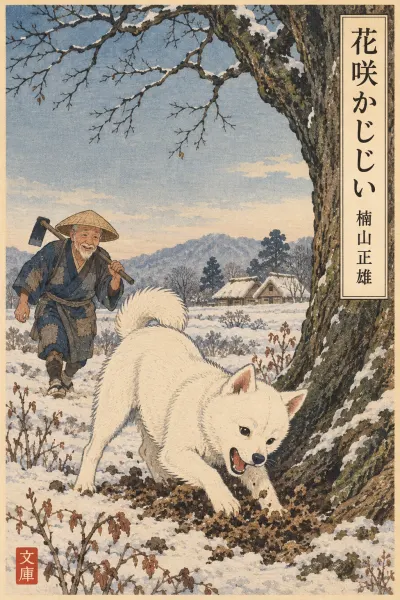
白は 大きな 木の そばで なきました。Beside a big tree, Shiro barked.
「ここを ほって。ここを ほって。」"Dig here! Dig here!"
おじいさんが そこを ほると、こばんが たくさん 出て 来ました。When the old man dug there, a lot of gold coins came out.
二人は お金が たくさん ある 人に なりました。The two of them became people with plenty of money.
となりの おじいさんは この 話を 聞きました。The old man next door heard about this.
そして、白を かりに 来ました。And so he came to borrow Shiro.
やさしい おじいさんは 白を かしました。The kind old man lent him Shiro.
となりの おじいさんは 白を はたけへ ひいて 行きました。The old man next door dragged Shiro off to his field.
「わたしの はたけにも こばんが ある。どこだ。」白は いたくて、なきました。"There are gold coins in my field too. Where are they?" Shiro was in pain, and he cried out.
「ここだな。」おじいさんは そこを ほりました。"So it's here, is it?" The old man dug there.
でも、出て 来たのは きたない ものだけでした。But all that came out was dirty things.
おじいさんは 大きな こえを 出して、白を ころしました。The old man gave a loud shout, and he killed Shiro.
やさしい おじいさんと おばあさんは たくさん なきました。The kind old man and old woman cried and cried.
二人は にわの かどを ほって、白を 入れました。The two of them dug a hole in a corner of their garden and laid Shiro in it.
そして、その 上に 小さな まつの 木を うえました。Then, on top of it, they planted a little pine tree.
まつの 木は だんだん 大きく なりました。Little by little, the pine tree grew big.
おじいさんは その 木を きって、うすを つくりました。The old man cut down the tree and made a mortar from it.
うすに おこめを 入れると、おこめが どんどん おおく なりました。When he put rice into the mortar, the rice increased more and more.
だいどころに おこめが たくさん ありました。There was a lot of rice in the kitchen.
となりの おじいさんは また うすを かりに 来ました。The old man next door came again to borrow the mortar.
でも、うすから 出て 来たのは きたない ものでした。But what came out of the mortar was nasty, dirty rubbish.
おじいさんは うすを はいに しました。So the old man burned the mortar to ash.
やさしい おじいさんは その はいを もって、いえに かえりました。The kind old man took the ash and went back home.
「白の まつの 木が はいに なったよ。」"Shiro's pine tree has turned into ash."
おじいさんは にわで はいを 出しました。In the garden, the old man took out the ash.
すると、あたたかい かぜが ふいて、はいが にわの 木に かかりました。Just then, a warm wind blew, and the ash drifted onto the trees in the garden.
ふゆなのに、木に はなが たくさん さきました。Even though it was winter, lots of flowers bloomed on the trees.
「これは おもしろい。ほかの 木にも かけましょう。」おじいさんは はいを もって、みちを 歩きました。"This is interesting. Let's sprinkle it on other trees too." The old man took the ash and walked along the road.
「はなの ない 木に、はなが さきますよ。」"Flowers will bloom on trees with no flowers!"
すると、とのさまが 来ました。Just then, the lord came by.
「あの さくらの 木に はいを かけて ください。」"Please sprinkle the ash on that cherry tree."
おじいさんは 木に のぼって、はいを かけました。The old man climbed up the tree and sprinkled the ash.
すると、きれいな さくらの はなが たくさん さきました。Then lots of beautiful cherry blossoms bloomed.
とのさまは 「これは りっぱだ。」と いって、おじいさんに お金を たくさん あげました。"This is splendid," said the lord, and he gave the old man a great deal of money.
となりの おじいさんは これを 聞きました。The old man next door heard about this.
そして、はいを 少し もって、同じように 歩きました。So he took a little of the ash and walked about in just the same way.
とのさまが また 来ました。Again, the lord came by.
となりの おじいさんも 木に のぼって、はいを かけました。The old man next door climbed a tree too, and sprinkled the ash.
でも、はなは さきませんでした。But no flowers bloomed.
つよい かぜが ふきました。A strong wind blew.
はいは とのさまや ほかの 人の めや はなに 入りました。The ash got into the eyes and noses of the lord and everyone else.
みんな たいへんでした。Everyone was in a terrible state.
「これは わるい おじいさんだ。」とのさまは そう いって、となりの おじいさんを ろうやに 入れました。"This is a wicked old man!" So said the lord, and he had the old man next door thrown into prison.
Vocabulary
| Word | Meaning | JLPT |
|---|---|---|
| はたけはたけ | field (for vegetables, not rice)dictionary form: 畑A rice paddy is たんぼ; はたけ is a dry field. | N3 |
| ほるほる | to digdictionary form: 掘る | N2 |
| こばんこばん | gold coin (old Japanese oval gold coin)dictionary form: 小判An oval gold coin used in old Japan; a classic sign of treasure in folktales. | — |
| かりにかりる | to borrowdictionary form: 借りるPair with かす (to lend): the borrower かりる, the owner かす. | N5 |
| かしましたかす | to lenddictionary form: 貸す | N5 |
| きたないきたない | dirty, nastydictionary form: 汚いOpposite of きれい (clean). | N5 |
| ころしましたころす | to killdictionary form: 殺す | N3 |
| うえましたうえる | to plantdictionary form: 植えるDo not confuse with うえ (above), also in this sentence. | N4 |
| うすうす | mortar (for pounding rice, e.g. into mochi)dictionary form: 臼Used for pounding rice, for example to make mochi. | — |
| はいはい | ashdictionary form: 灰Same sound as はい (yes); context tells you which one it is. | N3 |
| さきましたさく | to bloom (of flowers)dictionary form: 咲くThe title はなさか comes from this verb: 'making flowers bloom'. | N5 |
| とのさまとのさま | lord (local ruler in old Japan)dictionary form: 殿様 | N1 |
| ろうやろうや | prison, jaildictionary form: 牢屋An old word; today people say けいむしょ. | — |
Grammar
〜に 来る N5 to come (in order) to do ~
The verb's ます-stem (かり from かります) plus に 来る shows the purpose of coming. Here the neighbour comes in order to borrow Shiro.
白を かりに 来ました。
He came to borrow Shiro.
〜に なる / 〜く なる N5 to become ~
Nouns take に なる, and い-adjectives change い to く before なる. Here the couple become rich people, and later the tree becomes big (大きく なりました).
二人は お金が たくさん ある 人に なりました。
The two of them became people with plenty of money.
〜て ください N5 please do ~
The て-form plus ください makes a request. The lord uses it to tell the old man what to do.
あの さくらの 木に はいを かけて ください。
Sprinkle your ash upon that cherry tree.
〜と (when / if) N4 when ~, (then) ~
A plain verb plus と means that when the first thing happens, the second follows naturally. Here, digging leads to gold coins coming out.
おじいさんが そこを ほると、こばんが たくさん 出て 来ました。
When the old man dug there, lots and lots of gold coins came out.
〜のは 〜でした N4 what ~ was ~
の turns the clause 出て 来た into a noun ('the thing that came out'). The sentence then says what that thing was.
でも、出て 来たのは きたない ものだけでした。
But all that came out was nasty, dirty rubbish.
〜なのに N4 even though ~
A noun plus なのに shows a surprising result. It is winter, so flowers should not bloom, but they do.
ふゆなのに、木に はなが たくさん さきました。
Even though it was winter, the trees burst into lots of flowers.