 N4 · easy
Simplified retelling · JLPT N4
花咲かじじい Hanasakajijii in easy Japanese (N4)
This is our own simplified retelling of Grandpa Blossom, written for N4 learners and checked word by word against the N4 vocabulary list. A few story words and grammar patterns go beyond N4; the notes below give each one's level. It keeps the characters, events and ending of the original. When it feels easy, move on to the N3 version or the original text.
The story in brief
A kind old couple's dog, Shiro, helps them dig up gold coins, but their greedy neighbour borrows him and kills him. A pine tree grows on Shiro's grave and is made into a magic rice mortar; when the neighbour burns it, the kind old man uses its ash to make dead trees bloom and is rewarded by the lord. The greedy neighbour tries the same trick, but the ash blows into the lord's eyes, and the neighbour is taken away.
AI translation · independently checked
むかし、あるむらに、やさしいおじいさんとおばあさんが住んでいました。Long, long ago, in a certain village, there lived a kind old man and a kind old woman.
二人には子どもがいませんでした。The two of them had no children.
でも、白い犬を一ぴき持っていました。But they had one white dog.
名前はシロです。His name was Shiro.
二人はシロを子どものように大切にしていました。The old couple loved and cared for Shiro as if he were their own child.
となりにも、おじいさんとおばあさんが住んでいました。Next door there lived another old man and old woman.
この二人は悪い人たちで、いつもシロをいじめていました。These two were wicked people, and they were always being cruel to Shiro.
ある日、やさしいおじいさんがはたけで仕事をしていました。One day, the kind old man was working in his field.
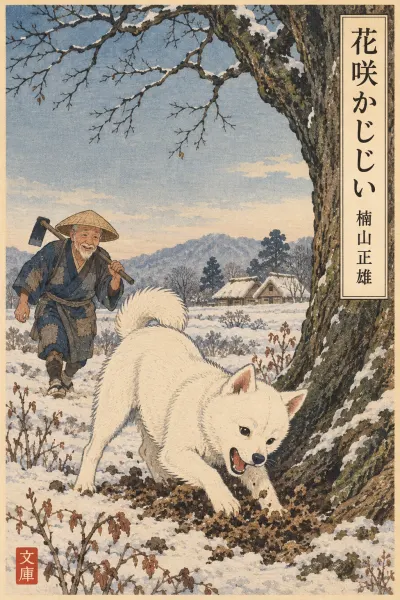
すると、シロが大きな木の下で、なきはじめました。Then Shiro began to bark at the foot of a big tree.
「ここをほってください」と言っているようでした。It seemed as though he was saying, "Please dig here."
おじいさんがそこをほると、こばんがたくさん出てきました。When the old man dug there, lots and lots of gold coins came out.
おじいさんはびっくりして、おばあさんをよびました。The old man was astonished, and he called for the old woman.
二人はお金持ちになりました。And so the two of them became rich.
となりの悪いおじいさんはそれを聞いて、じぶんもこばんがほしくなりました。When the wicked old man next door heard about it, he wanted gold coins too.
そして、シロをかりに来ました。So he came over to borrow Shiro.
やさしいおじいさんは、シロをかしました。The kind old man lent him Shiro.
悪いおじいさんは、いやがるシロのくびをひいて、じぶんのはたけへつれて行きました。The wicked old man pulled Shiro by the neck, though Shiro did not want to go, and dragged him off to his own field.
「さあ、どこだ。どこだ」シロが止まると、おじいさんはそこをほりました。"Come on, where is it? Where is it?" When Shiro stopped, the old man dug right there.
でも、出てくるのはいしやごみばかりです。But all that came out was stones and rubbish.
それから、いやなにおいのきたないものが、たくさん出てきました。After that, lots of dirty, nasty-smelling things came out.
悪いおじいさんはおこって、どうぐでシロのあたまをうちました。The wicked old man flew into a rage and struck Shiro on the head with his tool.
シロは死にました。Shiro died.
やさしいおじいさんとおばあさんは、とてもかなしくなって、なきました。The kind old man and old woman were terribly sad, and they wept.
二人はにわのすみにシロのはかを作って、その上に小さなまつの木をうえました。They made a grave for Shiro in a corner of their garden and planted a little pine tree on top of it.
まつはどんどん大きくなって、りっぱな木になりました。The pine grew bigger and bigger, until it became a fine, splendid tree.
おじいさんはその木を切って、うすを作りました。The old man cut down the tree and made a mortar out of it.
「シロはもちが好きだったね」二人がうすにこめを入れて、もちを作りはじめると、こめがどんどんふえました。"Shiro did love rice cakes, didn't he?" When the two of them put rice into the mortar and began making rice cakes, the rice grew more and more and more.
そして、だいどころがこめでいっぱいになりました。Soon the whole kitchen was full of rice.
となりの悪い二人は、またほしくなって、うすをかりに来ました。The wicked couple next door wanted some too, and they came to borrow the mortar.
悪いおじいさんがうすでもちを作ると、また、きたないものがたくさん出てきました。When the wicked old man made rice cakes in the mortar, once again lots of dirty things came out.
悪いおじいさんはおこって、うすをこわして、火に入れました。The wicked old man flew into a rage, smashed the mortar, and threw it into the fire.
やさしいおじいさんがうすをかえしてもらいに行くと、うすはもうはいになっていました。When the kind old man went to ask for the mortar back, it had already turned to ash.
おじいさんはのこったはいを集めて、家に帰りました。The old man gathered up the ash that was left and went home.
おじいさんがシロのはかに、そのはいをなげました。He scattered the ash over Shiro's grave.
すると、あたたかい風がふいて、はいをにわいっぱいに運びました。Then a warm wind blew and carried the ash all over the garden.
にわのかれた木に、花がさきはじめました。Flowers began to bloom on the dead trees in the garden.
まだ冬なのに、おじいさんのにわだけ、春のようになりました。Even though it was still winter, the old man's garden alone looked just like spring.
おじいさんはよろこびました。The old man was overjoyed.
「ほかの木にも、花をさかせましょう」おじいさんははいを持って、「はなさかじじい、はなさかじじい、かれた木に花をさかせましょう」と言いながら、町を歩きました。"Let's make the other trees bloom too!" The old man took the ash and walked through the town, calling out, "Grandpa Blossom, Grandpa Blossom! I'll make the dead trees bloom!"
そこへ、とのさまがおおぜいの人をつれて来ました。Just then, the lord came along with a great many of his people.
「めずらしいおじいさんだ。あのさくらのかれた木に、花をさかせて見せなさい」おじいさんは木にのぼって、はいをなげました。"What a curious old man. Make that dead cherry tree yonder bloom, and let me see it." The old man climbed up the tree and threw the ash.
すると、木いっぱいに、さくらの花がさきました。And all at once, the whole tree was covered in cherry blossoms.
とのさまはびっくりして、おじいさんをほめました。The lord was amazed, and he praised the old man.
そして、たくさんのお金をくださいました。Then he gave him a great deal of money.
となりの悪いおじいさんはそれを聞いて、のこったはいを集めました。When the wicked old man next door heard this, he gathered up the ash that was left.
そして、同じように言いながら、町を歩きました。Then he walked through the town, calling out the very same words.
また、とのさまが来て、「花をさかせて見せなさい」と言いました。Once again the lord came by and said, "Make the flowers bloom, and let me see it."
悪いおじいさんは木にのぼって、はいをなげました。The wicked old man climbed up a tree and threw the ash.
でも、花はぜんぜんさきません。But not a single flower bloomed.
強い風がふいて、はいはとのさまや人たちの目やはなに入りました。A strong wind blew, and the ash flew into the eyes and noses of the lord and his people.
みんなたいへんでした。Everyone was in a terrible state.
とのさまはとてもおこって、「これはうそのはなさかじじいだ」と言いました。The lord was furious and said, "This is a false Grandpa Blossom!"
悪いおじいさんはあやまりました。The wicked old man begged for forgiveness.
でも、とのさまの人たちにつれて行かれました。But he was taken away by the lord's men.
Vocabulary
| Word | Meaning | JLPT |
|---|---|---|
| 大切たいせつにする | to treasure, to take good care ofdictionary form: 大切にする大切 is a na-adjective meaning 'precious'; 〜を大切にする means 'to treat something as precious'. | — |
| いじめていじめる | to bully, to be cruel todictionary form: いじめるUsed for tormenting people or animals that are weaker than you. | N4 |
| ほってほる | to digdictionary form: 掘るUsually written 掘る in kanji. | N2 |
| こばんこばん | gold coin (an oval coin of old Japan)dictionary form: 小判Koban were oval gold coins used in the Edo period; a classic symbol of treasure in folktales. | — |
| かりかりる | to borrowdictionary form: 借りるCompare かす (貸す, 'to lend') in the next sentence. 〜に来る = 'come (in order) to …'. | N5 |
| はかはか | gravedictionary form: 墓Often said politely as お墓 (おはか). | N3 |
| うえましたうえる | to plantdictionary form: 植える | N4 |
| うすうす | mortar (a large wooden bowl for pounding rice)dictionary form: 臼Steamed rice is pounded in an うす with a mallet to make もち (rice cakes). | — |
| はいはい | ashdictionary form: 灰The key object of the story: the ash that makes dead trees bloom. | N3 |
| かれたかれる | to wither, to die (of plants)dictionary form: 枯れるかれた木 = a dead, bare tree. | N2 |
| とのさまとのさま | lord (a feudal ruler)dictionary form: 殿様The local ruler in old Japan; 様 shows great respect. | N1 |
| めずらしいめずらしい | unusual, rare, curiousdictionary form: 珍しい | N4 |
| ほめましたほめる | to praisedictionary form: 褒める | N4 |
| あやまりましたあやまる | to apologizedictionary form: 謝る | N4 |
Grammar
〜のように N4 like …, as if …
Noun + のように compares an action or state to something else. Here the couple treat Shiro the way they would treat a child.
二人はシロを子どものように大切にしていました。
The old couple cared for Shiro as if he were their own child.
〜ばかり N4 nothing but …, only …
Noun + ばかり means that there is only that thing, often with a feeling of disappointment. The greedy man hoped for gold but got only stones and rubbish.
でも、出てくるのはいしやごみばかりです。
But all that came out was stones and rubbish.
〜てもらう N4 to have someone do something (for you)
Verb te-form + もらう means receiving an action from someone. かえしてもらいに行く = 'go to have (them) give it back', with 〜に行く showing purpose.
やさしいおじいさんがうすをかえしてもらいに行くと、うすはもうはいになっていました。
When the kind old man went to ask for the mortar back, it had already turned to ash.
〜のに N4 even though …, although …
のに joins two facts where the second is surprising. After a noun it becomes なのに: it was winter, but the garden looked like spring.
まだ冬なのに、おじいさんのにわだけ、春のようになりました。
Even though it was still winter, the old man's garden alone looked just like spring.
〜させる (causative) N4 to make / let something do …
さく ('bloom') becomes さかせる ('make bloom'). The old man is the one who causes the flowers to bloom; 〜ましょう adds 'let's / I will'.
かれた木に花をさかせましょう
I'll make the dead trees bloom!
〜られる (passive) N4 to be …ed (by someone)
つれて行く ('take someone away') becomes つれて行かれる ('be taken away'). The person who does the action is marked with に.
でも、とのさまの人たちにつれて行かれました。
But he was taken away by the lord's men.