Part 1 of 3 · JLPT N2
かちかち山 Kachikachi Yama, part 1: The Trapped Raccoon Dog's Cruel Trick
In this part
An old raccoon dog keeps wrecking an old man's field until he catches it in a trap, hangs it from the ceiling, and tells his wife to make raccoon-dog soup. The raccoon dog tricks the old woman into untying it, kills her, cooks her into soup and disguises itself as her. When the old man comes home, he happily eats the soup, and the raccoon dog laughs and reveals its true form.
AI translation · independently checked
一I
むかし、むかし、あるところに、おじいさんとおばあさんがありました。Long, long ago, in a certain place, there lived an old man and an old woman.
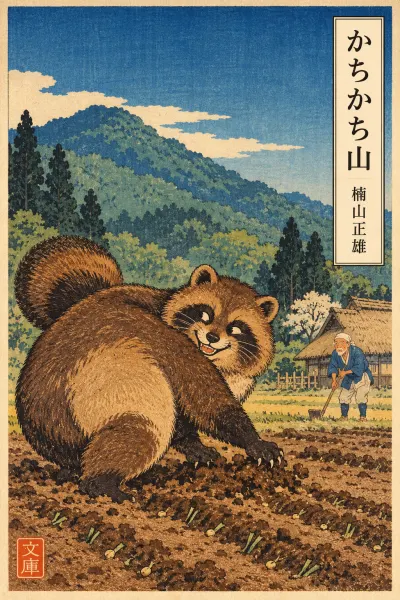
おじいさんがいつも畑に出て働いていますと、裏の山から一ぴきの古だぬきが出てきて、おじいさんがせっかく丹精をしてこしらえた畑のものを荒らした上に、どんどん石ころや土くれをおじいさんのうしろから投げつけました。As the old man was working out in his field as he always did, an old raccoon dog came down from the mountain behind the house. It ruined the crops he had taken such pains to grow, and on top of that it threw pebble after pebble and clods of earth at his back.
おじいさんがおこって追っかけますと、すばやく逃げて行ってしまいます。When the old man angrily chased after it, it would dart away and be gone.
しばらくするとまたやって来て、あいかわらずいたずらをしました。After a while it would come back again and get up to the same mischief as before.
おじいさんも困りきって、わなをかけておきますと、ある日、たぬきはとうとうそのわなにかかりました。At his wits' end, the old man set a trap, and one day the raccoon dog was finally caught in it.
おじいさんは躍り上がって喜びました。The old man jumped for joy.
「ああいい気味だ。とうとうつかまえてやった。」"Ha, serves you right! I've caught you at last!"
こう言って、たぬきの四つ足をしばって、うちへかついで帰りました。With these words he tied the raccoon dog's four legs together, slung it over his shoulder and carried it home.
そして天井のはりにぶら下げて、おばあさんに、Then he hung it from a beam in the ceiling and told the old woman,
「逃がさないように番をして、晩にわたしが帰るまでにたぬき汁をこしらえておいておくれ。」"Keep watch so it doesn't get away, and have raccoon-dog soup ready for me by the time I'm back this evening."
と言いのこして、また畑へ出ていきました。Leaving her with those words, he went off to the field again.
たぬきがしばられてぶら下げられている下で、おばあさんは臼を出して、とんとん麦をついていました。Underneath the spot where the raccoon dog hung tied up, the old woman brought out the mortar and was pounding barley, thump, thump.
そのうち、After a while,
「ああくたびれた。」"Oh, I'm worn out."
とおばあさんは言って、汗をふきました。the old woman said, and wiped away her sweat.
するとそのときまで、おとなしくぶら下がっていたたぬきが、上から声をかけました。Then the raccoon dog, which until that moment had been hanging there quietly, called down to her.
「もしもし、おばあさん、くたびれたら少しお手伝いをいたしましょう。その代わりこの縄をといて下さい。」"Excuse me, Granny, if you're tired, let me help you a little. In return, please untie this rope."
「どうしてどうして、お前なんぞに手伝ってもらえるものか。縄をといてやったら、手伝うどころか、すぐ逃げて行ってしまうだろう。」"Oh no, no, no! As if I'd ever let the likes of you help me! If I untied you, far from helping, you'd run off straight away."
「いいえ、もうこうしてつかまったのですもの、今さら逃げるものですか。まあ、ためしに下ろしてごらんなさい。」"No, no. I've been caught like this now, so why would I run away at this point? Come on, just try letting me down and see."
あんまりしつっこく、殊勝らしくたのむものですから、おばあさんもうかうか、たぬきの言うことをほんとうにして、縄をといて下ろしてやりました。It pleaded so persistently and so meekly that the old woman, without thinking, believed what the raccoon dog said, untied the rope and let it down.
するとたぬきは、Then the raccoon dog said,
「やれやれ。」"Phew, that's better."
としばられた手足をさすりました。and rubbed its arms and legs where they had been tied.
そして、Then,
「どれ、わたしがついてあげましょう。」"Now then, let me do the pounding for you."
と言いながら、おばあさんのきねを取り上げて、麦をつくふりをして、いきなりおばあさんの脳天からきねを打ち下ろしますと、「きゃっ。」という間もなく、おばあさんは目をまわして、倒れて死んでしまいました。Saying this, it took the pestle from the old woman and pretended to pound the barley. Then it suddenly brought the pestle crashing down on the top of her head, and before she could even cry "Eek!" the old woman blacked out, fell over and died.
たぬきはさっそくおばあさんをお料理して、たぬき汁の代わりにばばあ汁をこしらえて、自分はおばあさんに化けて、すました顔をして炉の前に座って、おじいさんの帰りを待ちうけていました。At once the raccoon dog cooked the old woman and made old-woman soup instead of raccoon-dog soup. Then it changed itself into the shape of the old woman and sat in front of the hearth with an innocent face, waiting for the old man to come home.
夕方になって、なんにも知らないおじいさんは、When evening came, the old man, who knew nothing of what had happened,
「晩はたぬき汁が食べられるな。」"Tonight I get to eat raccoon-dog soup!"
と思って、一人でにこにこしながら、急いでうちへ帰って来ました。he thought, and he hurried home, grinning away to himself.
するとたぬきのおばあさんはさも待ちかねたというように、Then the raccoon-dog old woman, as if she had been waiting impatiently for him,
「おや、おじいさん、おかいんなさい。さっきからたぬき汁をこしらえて待っていましたよ。」"Oh, Grandpa, welcome home. I made the raccoon-dog soup a while ago, and I've been waiting for you."
と言いました。she said.
「おやおや、そうか。それはありがたいな。」"Well, well, is that so? That's very kind of you."
と言いながら、すぐにお膳の前に座りました。With these words he sat straight down in front of his meal tray.
そして、たぬきのおばあさんのお給仕で、Then, with the raccoon-dog old woman serving him,
「これはおいしい、おいしい。」"My, this is delicious, delicious!"
と言って、舌つづみをうって、ばばあ汁のおかわりをして、夢中になって食べていました。he said, smacking his lips. He asked for a second helping of the old-woman soup and ate as if nothing else in the world mattered.
それを見てたぬきのおばあさんは、思わず、「ふふん。」と笑うひょうしにたぬきの正体を現しました。Seeing this, the raccoon-dog old woman couldn't help letting out a "Heh-heh!" and as she laughed she showed her true form as a raccoon dog.
Vocabulary
| Word | Meaning | JLPT |
|---|---|---|
| 古だぬきふるだぬき | an old raccoon dog; also a crafty old tricksterdictionary form: 古狸The たぬき (raccoon dog, a wild animal of the dog family) is a shape-shifting trickster in Japanese folklore. ふる + たぬき becomes ふるだぬき through rendaku. | — |
| 丹精たんせい | painstaking care, hard work put into somethingUsed as 丹精をする or 丹精して (to tend carefully). | — |
| こしらえたこしらえる | to make, to prepare (here: to grow crops; later: to cook soup)dictionary form: こしらえるA colloquial, slightly old-fashioned word for つくる. | N2 |
| 荒らしたあらす | to ruin, to ravage, to lay waste todictionary form: 荒らす | N1 |
| わなわな | a trapdictionary form: 罠わなをかける = to set a trap; わなにかかる = to be caught in a trap. | — |
| いい気味いいきみ | serves you right; how satisfyingSaid with glee at someone else's deserved misfortune. | — |
| 番ばん | watch, guard番をする = to keep watch. Compare 晩 (evening) in the same sentence, which has the same reading. | N3 |
| 臼うす | a mortar (for pounding grain)It is used with a きね (pestle). 麦をつく = to pound barley. | — |
| くたびれたくたびれる | to be tired out, to be worn outdictionary form: くたびれるA colloquial near-synonym of 疲れる. | N2 |
| 殊勝しゅしょう | admirable, commendable (of conduct); 殊勝らしく = putting on a show of contrite, well-behaved humility殊勝らしく = with a show of meekness, so the raccoon dog's goodness is only an act. | — |
| うかうかうかうか | carelessly, without thinking, off one's guard | — |
| 化けてばける | to transform oneself, to take on another's shapedictionary form: 化けるThis is the typical verb for shape-shifting foxes and raccoon dogs. Compare お化け (ghost). | N1 |
| 舌つづみをうってしたつづみをうつ | to smack one's lips (over delicious food)dictionary form: 舌鼓を打つ | — |
| 正体しょうたい | true form, true identity正体を現す = to reveal one's true self. | — |
Grammar
〜た上に N3 on top of ~, not only ~ but also
上に joins two actions or facts and adds the second to the first. Here it piles a second offence onto the first: the raccoon dog ruins the crops and, on top of that, throws stones.
畑のものを荒らした上に、どんどん石ころや土くれをおじいさんのうしろから投げつけました
it ruined the crops, and on top of that it threw pebble after pebble and clods of earth at the old man's back
〜ておく N4 to do something in advance / and leave it that way
〜ておく shows an action done in preparation for later. こしらえておいておくれ combines it with 〜ておくれ, an old-fashioned casual request ('do it for me').
晩にわたしが帰るまでにたぬき汁をこしらえておいておくれ。
have raccoon-dog soup ready for me by the time I'm back this evening.
〜ものか N2 as if ~! / there's no way ~
A rhetorical question ending that strongly denies the statement. 手伝ってもらえるものか means 'I would never accept help from you'. The raccoon dog's reply 逃げるものですか in the next line is the polite form of the same pattern.
お前なんぞに手伝ってもらえるものか。
As if I'd ever let the likes of you help me!
〜どころか N2 far from ~, let alone ~
どころか rejects the first idea and puts forward something opposite or more extreme. The old woman says the raccoon dog would do the very opposite of helping.
手伝うどころか、すぐ逃げて行ってしまうだろう。
far from helping, you'd run off straight away.
〜ものですから N3 because ~ (giving a reason or excuse)
ものだから / ものですから gives a reason, often one that explains why someone couldn't help acting as they did. Here it explains why the old woman gave in.
あんまりしつっこく、殊勝らしくたのむものですから
It pleaded so persistently and so meekly that…
〜ふりをする N3 to pretend to ~
A plain-form verb + ふりをする means acting as if doing something without really doing it. The raccoon dog only pretends to pound the barley before it strikes.
麦をつくふりをして、いきなりおばあさんの脳天からきねを打ち下ろしますと
it pretended to pound the barley, then suddenly brought the pestle crashing down on the top of her head