Part 3 of 3 · JLPT N2
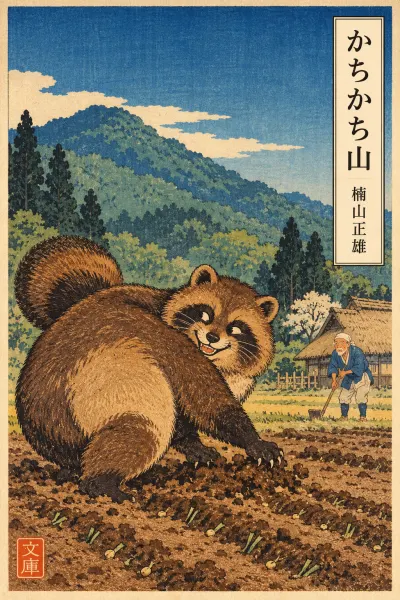
かちかち山 Kachikachi Yama, part 3: Pepper Salve and a Clay Boat
In this part
The burned tanuki escapes into his hole, and the next day the rabbit pretends to bring medicine but smears red-pepper miso on his burns. A few days later the rabbit takes the tanuki to sea, where the tanuki builds a boat of clay. The clay boat dissolves, and the rabbit names the tanuki's crime against the old woman as the tanuki sinks.
AI translation · independently checked
「あつい、あつい、助けてくれ。」"Hot! Hot! Help me!"
とさけびながら、夢中でかけ出しますと、山風がうしろからどっと吹きつけて、よけい火が大きくなりました。he screamed, and as he ran off in a frenzy, a mountain wind came blasting from behind and made the fire grow even bigger.
たぬきはひいひい泣き声を上げて、苦しがって、ころげまわって、やっとのことで燃えるしばをふり落として、穴の中にかけ込みました。The tanuki let out wailing cries, writhed in pain and rolled around on the ground. At long last he managed to shake off the burning brushwood, and he ran into his hole.
うさぎはわざと大きな声で、In a deliberately loud voice, the rabbit called out,
「やあ、たいへん。火事だ。火事だ。」"Oh dear, how awful! Fire! Fire!"
と言いながら帰っていきました。and he went off home, still calling out like that as he went.
三Three
そのあくる日、うさぎはおみその中に唐がらしをすり込んでこうやくをこしらえて、それを持ってたぬきのところへお見舞いにやって来ました。The next day the rabbit ground red pepper into some miso and made it into a salve. Then he brought it along to the tanuki's place to visit him and see how he was.
たぬきは背中中大やけどをして、うんうんうなりながら、まっくらな穴の中にころがっていました。The tanuki had terrible burns all over his back. He lay in his pitch-dark hole, groaning and moaning.
「たぬきさん、たぬきさん。ほんとうにきのうはひどい目にあったねえ。」"Mr. Tanuki, Mr. Tanuki. What a dreadful time you had yesterday."
「ああ、ほんとうにひどい目にあったよ。この大やけどはどうしたらなおるだろう。」"Ah, it really was dreadful. I wonder what I can do to heal these terrible burns."
「うん、それでね、あんまり気の毒だから、わたしがやけどにいちばん利くこうやくをこしらえて持って来たのだよ。」"Yes, well, I felt so sorry for you that I made the salve that works best on burns, and I've brought it along."
「そうかい。それはありがたいな。さっそくぬってもらおう。」"Have you? That's very kind of you. Put it on me right away, please."
こういってたぬきが火ぶくれになって、赤肌にただれている背中を出しますと、うさぎはその上に唐がらしみそをところかまわずこてこてぬりつけました。With that, the tanuki showed his back, which was blistered and raw and red. The rabbit smeared the pepper miso thickly all over it, without caring where it went.
すると背中はまた火がついたようにあつくなって、At once his back grew as hot as if it had caught fire again,
「いたい、いたい。」"Ow, it hurts! It hurts!"
と言いながら、たぬきは穴の中をころげまわっていました。cried the tanuki, rolling about inside his hole.
うさぎはその様子を見てにこにこしながら、The rabbit watched him with a broad smile and said,
「なあにたぬきさん、ぴりぴりするのははじめのうちだけだよ。じきになおるから、少しの間がまんおし。」"Oh, come now, Mr. Tanuki, it only stings at first. It'll heal soon enough, so just put up with it for a little while."
と言って帰っていきました。Then he went off home.
四Four
それから四、五日たちました。After that, four or five days went by.
ある日うさぎは、One day the rabbit was saying to himself,
「たぬきのやつどうしたろう。こんどはひとつ海に連れ出して、ひどい目にあわせてやろう。」"I wonder how that tanuki is getting on. This time I'll take him out to sea and give him a really hard time."
と独り言を言っているところへ、ひょっこりたぬきがたずねて来ました。Just then the tanuki suddenly turned up at his door.
「おやおや、たぬきさん、もうやけどはなおったかい。」"Well, well, Mr. Tanuki, have your burns healed already?"
「ああ、お陰でたいぶよくなったよ。」"Yes, thanks to you, they're a good deal better."
「それはいいな。じゃあまたどこかへ出かけようか。」"That's good to hear. Shall we go off somewhere together again, then?"
「いやもう、山はこりごりだ。」"Oh no, I've had quite enough of mountains."
「それなら山はよして、こんどは海へ行こうじゃないか、海はおさかながとれるよ。」"Then let's leave the mountains alone and go to the sea this time, shall we? You can catch fish in the sea."
「なるほど、海はおもしろそうだね。」"I see. The sea does sound like fun."
そこでうさぎとたぬきは連れだって海へ出かけました。So the rabbit and the tanuki set off for the sea together.
うさぎが木の舟をこしらえますと、たぬきはうらやましがって、まねをして土の舟をこしらえました。When the rabbit built a boat out of wood, the tanuki grew envious, copied him, and built a boat out of clay.
舟ができ上がると、うさぎは木の舟に乗りました。When the boats were finished, the rabbit got into the wooden boat.
たぬきは土の舟に乗りました。The tanuki got into the clay boat.
べつべつに舟をこいで沖へ出ますと、Each rowed his own boat out into the open sea,
「いいお天気だねえ。」"What lovely weather!"
「いいけしきだねえ。」"What a lovely view!"
とてんでんに言いながら、めずらしそうに海をながめていましたが、うさぎは、they each said, gazing at the sea as if they had never seen anything like it. Then the rabbit
「ここらにはまだおさかなはいないよ。もっと沖の方までこいで行こう。さあ、どっちが早いか競争しよう。」"There aren't any fish around here yet. Let's row farther out. Come on, let's race and see who's faster."
と言いました。said.
たぬきは、The tanuki
「よし、よし、それはおもしろかろう。」"All right, all right, that should be fun."
と言いました。said.
そこで一、二、三とかけ声をして、こぎ出しました。So they counted "One, two, three!" and started rowing.
うさぎはかんかん舟ばたをたたいて、The rabbit banged clang-clang on the side of his boat and
「どうだ、木の舟は軽くって速かろう。」"How about that? A wooden boat is light and fast, isn't it!"
と言いました。said.
するとたぬきも負けない気になって、舟ばたをこんこんたたいて、The tanuki was not going to be outdone, so he knocked clonk-clonk on the side of his own boat and
「なあに、土の舟は重くって丈夫だ。」"Ha! A clay boat is heavy and sturdy!"
と言いました。said.
そのうちにだんだん水がしみて土の舟は崩れ出しました。Meanwhile, water slowly seeped in, and the clay boat began to crumble.
「やあ、たいへん。舟がこわれてきた。」"Oh no, this is terrible! My boat is falling apart!"
とたぬきがびっくりして、大さわぎをはじめました。The tanuki was startled and started making a great commotion.
「ああ、沈む、沈む、助けてくれ。」"Oh, I'm sinking, I'm sinking! Help me!"
うさぎはたぬきのあわてる様子をおもしろそうにながめながら、The rabbit watched the tanuki's panic with amusement and
「ざまを見ろ。おばあさんをだまして殺して、おじいさんにばばあ汁を食わせたむくいだ。」"Serves you right! This is your punishment for tricking and killing the old woman and feeding the old man old-woman soup."
と言いますと、たぬきはもうそんなことはしないから助けてくれと言って、うさぎをおがみました。said. At this the tanuki pressed his paws together and begged the rabbit to save him, saying he would never do such a thing again.
そのうちどんどん舟は崩れて、あっぷあっぷいうまもなく、たぬきはとうとう沈んでしまいました。Meanwhile the boat crumbled away faster and faster. The tanuki barely had time to gasp and splutter before he finally sank.
Vocabulary
| Word | Meaning | JLPT |
|---|---|---|
| 夢中むちゅう | frantically; beside oneself夢中で means doing something without thinking, as if in a dream. It can also mean 'absorbed in' something you enjoy. | N3 |
| こうやくこうやく | salve, ointment (often spread on a plaster)dictionary form: 膏薬An old-fashioned word for medicine put on the skin. Today 軟膏 (なんこう) is more usual. | — |
| お見舞いみまい | a visit to someone who is sick or injureddictionary form: 見舞いお見舞いに行く/来る means to go or come to see a sick person. | N3 |
| うなりうなる | to groan, to moandictionary form: うなるOften used together with the sound word うんうん. | N3 |
| ひどい目にあったひどいめにあう | to have a terrible experiencedictionary form: ひどい目にあうThe causative form ひどい目にあわせる means 'to give someone a hard time'. It appears in the rabbit's plan to take the tanuki to sea. | — |
| 利くきく | to work, to be effective (of medicine)This is usually written 効く for medicine. The writer uses 利く here. | N3 |
| ところかまわずところかまわず | everywhere, without caring wheredictionary form: 所構わずLiterally 'not minding the place'. | — |
| がまんがまん | putting up with something, enduringdictionary form: 我慢我慢する means 'to bear' pain or discomfort. | N3 |
| ひょっこりひょっこり | suddenly, unexpectedly (of someone appearing) | — |
| こりごりこりごり | fed up; having learned one's lessondictionary form: 懲り懲りYou say this after a bad experience has put you off something for good. | — |
| 沖おき | the open sea, offshore | N3 |
| てんでんにてんでん | each (separately), each on their own, individuallydictionary form: てんでんAn old-fashioned or colloquial form of てんでに (各自に). | — |
| 崩れ出しましたくずれる | to crumble, to fall apartdictionary form: 崩れる | N2 |
| むくいむくい | retribution, just desertsdictionary form: 報いThis means something you deserve because of what you did, usually something bad. | — |
Grammar
〜ながら N4 while doing
The verb stem plus ながら shows two actions done by the same person at the same time. Here the tanuki screams while he runs.
とさけびながら、夢中でかけ出しますと
he screamed, and as he ran off in a frenzy
〜がる N3 to show signs of feeling ~
がる is added to the stem of a feeling adjective. It describes the feelings of someone else as they appear from outside. うらやましい becomes うらやましがる, 'to act envious'.
たぬきはうらやましがって、まねをして土の舟をこしらえました。
the tanuki grew envious, copied him, and built a boat out of clay.
お+verb stem+し N1 soft, familiar command
〜おし is a casual, old-fashioned, gentle imperative, a shortened form of お〜なさい (here おしなさい, from する). It attaches to a suru-verb noun, as in がまんおし ('put up with it'). With ordinary verbs the parallel form is お+stem, as in お行き. The rabbit sounds kind and caring, though he is actually being cruel.
少しの間がまんおし。
just put up with it for a little while.
〜ているところへ N2 just as (someone) was doing ~, (something happened)
ところへ marks the moment when someone or something arrives in the middle of an ongoing action. The rabbit is talking to himself when the tanuki turns up.
と独り言を言っているところへ、ひょっこりたぬきがたずねて来ました。
Just then the tanuki suddenly turned up at his door.
〜ようじゃないか N2 let's ~, shall we?
The volitional form plus じゃないか makes a strong, friendly invitation. The speaker urges the listener to agree.
こんどは海へ行こうじゃないか
let's go to the sea this time, shall we?
い-adjective+かろう N1 probably ~ / surely ~ (literary)
かろう is an old conjecture form of い-adjectives, equal to 〜だろう in modern Japanese. 速かろう means 'surely fast' and おもしろかろう means 'should be fun'.
どうだ、木の舟は軽くって速かろう。
How about that? A wooden boat is light and fast, isn't it!