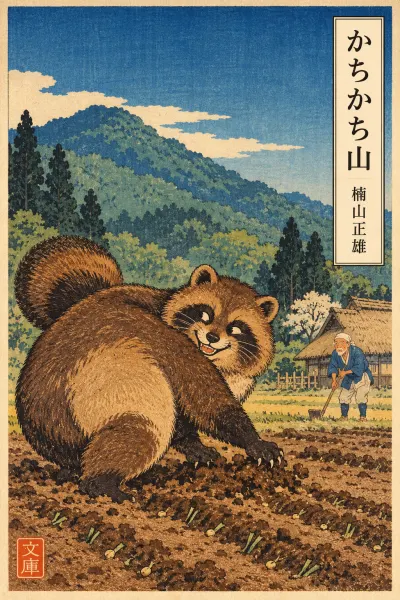
Part 2 of 3 · JLPT N2
かちかち山 Kachikachi Yama, part 2: The Rabbit Plots Revenge
In this part
The tanuki mocks the old man and runs away, and a kind white rabbit promises to avenge the old woman. The rabbit tempts the tanuki with chestnuts and gets it to carry brushwood over the mountains. Then the rabbit secretly sets the load on fire, explaining away the strange sounds with made-up mountain names.
AI translation · independently checked
「ばばあくったじじい、“Old man, you've eaten your old woman!
流しの下の骨を見ろ。」Look at the bones under the sink!”
とたぬきは言いながら、大きなしっぽを出して、裏口からついと逃げていきました。As the raccoon dog said this, it showed its big bushy tail and slipped swiftly out of the back door.
おじいさんはびっくりして、がっかり腰をぬかしてしまいました。The old man was so shocked that his legs gave way, and he sank down in despair.
そして流しの下のおばあさんの骨をかかえて、おいおい泣いていました。Then he picked up the old woman's bones from under the sink and held them in his arms, sobbing and sobbing.
すると、Just then,
「おじいさん、おじいさん、どうしたのです。」“Old man, old man, what's the matter?”
と言って、これも裏の山にいる白うさぎが入って来ました。In came a white rabbit, which also lived on the mountain behind the house, saying these words.
「ああ、うさぎさんか。よく来ておくれだ。まあ聞いておくれ。ひどい目にあったよ。」“Ah, it's you, Rabbit. How good of you to come. Just listen to this. Something terrible has happened to me.”
とおじいさんは言って、これこれこういうわけだとすっかり話をしました。So the old man spoke, and he told the whole story of how it had all happened.
うさぎはたいそう気の毒がって、The rabbit felt very sorry for him,
「まあ、それはとんだことでしたね。けれどかたきはわたしがきっととって上げますから、安心していらっしゃい。」“Oh, what a dreadful thing! But I'll get revenge for you, I promise, so don't you worry.”
とたのもしそうに言いました。it said, sounding very sure of itself.
おじいさんはうれし涙をこぼしながら、Shedding tears of joy, the old man
「ああ、どうか頼みますよ。ほんとうにわたしはくやしくってたまらない。」“Oh, please, I'm counting on you. Truly, I'm so bitter I can hardly bear it.”
と言いました。said.
「大丈夫。あしたはさっそくたぬきを誘い出して、ひどい目に合わしてやります。しばらく待っていらっしゃい。」“Don't worry. Tomorrow I'll lure the raccoon dog out right away and give it a hard time. Just wait a little while.”
とうさぎは言って、帰っていきました。With these words the rabbit went home.
二II
さてたぬきはおじいさんのうちを逃げ出してから、何だかこわいものですから、どこへも出ずに穴にばかり引っ込んでいました。Now, after it had escaped from the old man's house, the raccoon dog felt somehow afraid, so it didn't go out anywhere and just stayed shut away in its den.
するとある日、うさぎはかまを腰にさして、わざとたぬきのかくれている穴のそばへ行って、かまを出してしきりにしばを刈っていました。Then one day the rabbit tucked a sickle into its belt, went on purpose close to the den where the raccoon dog was hiding, took out the sickle and busily cut brushwood.
そしてしばを刈りながら、袋へ入れて持って来たかち栗を出して、ばりばり食べました。And while it was cutting the brushwood, it took out some dried chestnuts that it had brought along in a bag and munched them, crunch, crunch.
するとたぬきはその音を聞きつけて、穴の中からのそのそはい出してきました。Hearing the sound, the raccoon dog came crawling slowly out of its den.
「うさぎさん、うさぎさん。何をうまそうに食べているのだね。」“Rabbit, Rabbit. What's that you're eating that looks so tasty?”
「栗の実さ。」“Chestnuts, of course.”
「少しわたしにくれないか。」“Won't you give me a few?”
「上げるから、このしばを半分向こうの山までしょっていっておくれ。」“I will, if you carry half of this brushwood on your back to the mountain over there.”
たぬきは栗がほしいものですから、しかたなしにしばを背負って、先に立って歩き出しました。The raccoon dog wanted the chestnuts, so it had no choice but to load the brushwood on its back, and it set off walking in front.
向こうの山まで行くと、たぬきはふり返って、When they reached the mountain over there, the raccoon dog turned around and said,
「うさぎさん、うさぎさん。かち栗をくれないか。」“Rabbit, Rabbit. Won't you give me the chestnuts?”
「ああ、上げるよ、もう一つ向こうの山まで行ったら。」“Oh, I'll give them to you, once we get to the next mountain over.”
しかたがないので、またたぬきはずんずん先に立って歩いていきました。There was nothing else for it, so the raccoon dog strode on ahead again.
やがてもう一つ向こうの山まで行くと、たぬきはふり返って、Before long they reached the next mountain over, and the raccoon dog turned around and said,
「うさぎさん、うさぎさん。かち栗をくれないか。」“Rabbit, Rabbit. Won't you give me the chestnuts?”
「ああ、上げるけれど、ついでにもう一つ向こうの山まで行っておくれ。こんどはきっと上げるから。」“Oh, I'll give them to you, but while you're at it, go on to one more mountain. This time I'll give them to you for sure.”
しかたがないので、たぬきはまた先に立って、こんどは何でも早く向こうの山まで行きつこうと思って、うしろもふり向かずにせっせと歩いていきました。There was nothing else for it, so the raccoon dog went ahead again, and this time, determined to reach the mountain over there quickly no matter what, it plodded busily on without even looking back.
うさぎはそのひまに、ふところから火打ち石を出して、「かちかち。」と火をきりました。Meanwhile the rabbit took a flint from the fold of its kimono and struck a spark: click-clack!
たぬきはへんに思って、The raccoon dog thought this was strange and said,
「うさぎさん、うさぎさん、かちかちいうのは何だろう。」“Rabbit, Rabbit, what's that click-clacking?”
「この山はかちかち山だからさ。」“That's because this mountain is Kachikachi-yama, Click-Clack Mountain.”
「ああ、そうか。」“Oh, I see.”
と言って、たぬきはまた歩き出しました。With that, the raccoon dog started walking again.
そのうちにうさぎのつけた火が、たぬきの背中のしばにうつって、ぼうぼう燃え出しました。Before long, the fire the rabbit had lit caught the brushwood on the raccoon dog's back, and it began to burn with a roar.
たぬきはまたへんに思って、Again the raccoon dog thought this was strange and said,
「うさぎさん、うさぎさん、ぼうぼういうのは何だろう。」“Rabbit, Rabbit, what's that roaring?”
「向こうの山はぼうぼう山だからさ。」“That's because the mountain over there is Bōbō-yama, Roaring Mountain.”
「ああ、そうか。」“Oh, I see.”
とたぬきが言ううちに、もう火はずんずん背中に燃えひろがってしまいました。But even as the raccoon dog was saying this, the fire had already spread right across its back.
たぬきは、The raccoon dog
Vocabulary
| Word | Meaning | JLPT |
|---|---|---|
| 流しながし | kitchen sink; washing area of a kitchenFrom 流す (to let flow). In old houses this was the area where water drained away. | N1 |
| たぬきたぬき | raccoon dog (tanuki)dictionary form: 狸A wild canine of Japan. In folktales it is a trickster that can change its shape. | — |
| 腰をぬかしてこしをぬかす | to have one's legs give way (from shock or fear)dictionary form: 腰を抜かすLiterally 'to have one's hips pulled out'. It is used for being so shocked that you cannot stand. | — |
| 気の毒がってきのどくがる | to feel sorry for someone; to show pitydictionary form: 気の毒がるFrom 気の毒 (pitiful, unfortunate) + 〜がる. | — |
| かたきかたき | enemy, foe (someone one seeks to avenge oneself on); かたきをとる = to take revenge, avengedictionary form: 敵かたきをとる / かたきを討つ means 'to take revenge'. | N1 |
| たのもしそうたのもしい | reliable, reassuringdictionary form: 頼もしいWith 〜そう it means 'in a confident, dependable-seeming way'. | N2 |
| くやしくってくやしい | bitter, frustrated, mortifieddictionary form: 悔しいくやしくって is a casual, emphatic form of くやしくて. | N2 |
| 誘い出してさそいだす | to lure out; to coax someone outdictionary form: 誘い出す誘う (to invite, tempt) + 出す (out). | — |
| しばしば | brushwood; small sticks for firewooddictionary form: 柴A key word in folktales. しばを刈る means 'to gather brushwood'. | — |
| かち栗かちぐり | dried, shelled chestnutsdictionary form: 搗ち栗They are hard and crunchy, which explains the sound ばりばり. The word also echoes 'kachi-kachi' later in the story. | — |
| しょってしょう | to carry on one's backdictionary form: 背負うしょう is a colloquial reading of 背負う (standard: せおう). Both readings appear in this passage. | N2 |
| ふところふところ | the fold of a kimono at the chest, used as a pocketdictionary form: 懐People kept small items there. | — |
| 火打ち石ひうちいし | flint (for striking sparks) | — |
| せっせとせっせと | busily, diligently, without stopping | N2 |
Grammar
〜ておくれ N2 please do ~ (old-fashioned, familiar request)
おくれ is the old imperative of くれる. It makes a warm, slightly old-fashioned request to someone close or of lower status. よく来ておくれだ expresses thanks: 'how kind of you to come'.
まあ聞いておくれ。
Just listen to this.
〜てたまらない N3 unbearably ~; so ~ one can't stand it
This pattern attaches to the て-form of an adjective of feeling. It means the feeling is overwhelming. Here the old man is unbearably bitter.
ほんとうにわたしはくやしくってたまらない。
Truly, I'm so bitter I can hardly bear it.
〜てやる N4 do ~ (to/for someone, often aggressively)
やる is the plain giving verb for giving to an equal or inferior. With a harmful action like ひどい目に合わす, it shows the speaker intends to do something to someone. It sounds determined and a little rough.
ひどい目に合わしてやります。
I'll give it a hard time.
〜ものですから N3 because ~ (giving a reason or excuse)
This adds a reason, often an emotional one or a justification. It is a polite form of ものだから. It explains why the tanuki stayed in its den, and later why it agreed to carry the brushwood.
何だかこわいものですから、どこへも出ずに穴にばかり引っ込んでいました。
It felt somehow afraid, so it didn't go out anywhere and just stayed shut away in its den.
〜ずに N3 without doing ~
ず is the classical negative. 〜ずに works like 〜ないで. ふり向かずに means 'without turning around'.
うしろもふり向かずにせっせと歩いていきました。
It plodded busily on without even looking back.
〜うちに N3 while ~; before one knows it
This attaches to a verb in plain form. It shows that something else happens during that time, often unnoticed. Here the fire spreads even as the tanuki is still speaking.
とたぬきが言ううちに、もう火はずんずん背中に燃えひろがってしまいました。
But even as the raccoon dog was saying this, the fire had already spread right across its back.