Upper intermediate · JLPT N2
かちかち山Kachikachi Yama — Click-Clack Mountain
- JLPT N2
- 4,177 characters
- 3 parts
- about 35 minutes
- 3 easier versions
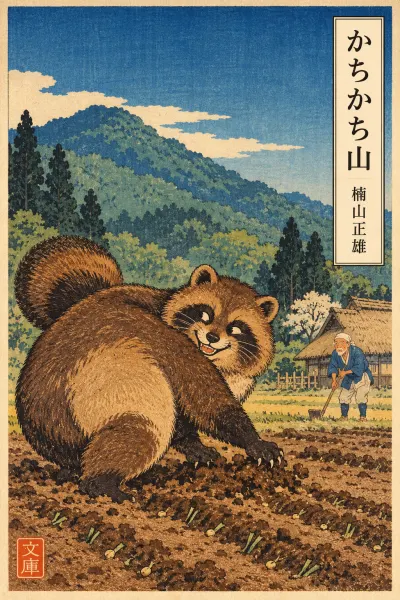
かちかち山 is one of Japan's best-known folktales, told here in a retelling by Kusuyama Masao. It opens like a typical 'mukashi mukashi' story: an old man, his wife, and a raccoon dog (tanuki) who keeps ruining the old man's field. It quickly turns dark. The tanuki commits a shocking crime against the old woman, and a white rabbit sets out to make him pay through a series of tricks, each bolder than the last. The narration stays calm and polite, in です/ます past tense, which makes both the cruelty and the comedy stand out. For learners, the story's clear, repeating structure is a real help. Each trick follows the same pattern of bait, deception and a quick excuse, so you can often predict what comes next and focus on the language. The harder parts are the dialogue, which is casual and somewhat old-fashioned, and the many sound words, some of which the rabbit turns into puns. Be aware that the violence in the first part is not softened for children.
Contents
Easier versions
This story is also retold in simpler Japanese. Reading an easier version first makes the original much more approachable.
Before you read
- The puns rest on onomatopoeia. かちかち is the click of flint and ぼうぼう is the roar of flames. The rabbit invents かちかち山 and ぼうぼう山 from these sounds to explain away the noises, so notice each sound word before you read the tanuki's question and the rabbit's answer.
- Learn these patterns first, because they carry much of the dialogue and the scheming: 〜てやる (doing something to someone, often with a sense of payback), 〜ふりをする (pretending), 〜ものか ("as if I would…!"), 〜ておくれ (an old-fashioned, familiar "please do… for me") and 〜てたまらない ("unbearably…").
- Watch how the characters speak. The rabbit talks plainly, while the tanuki switches to feigned politeness whenever it wants something. That shift in register is a clue to its intentions. Expect colloquial, dated forms such as おかいんなさい and どうしてどうして that differ from textbook Japanese.
- Each trick follows the same rhythm: an offer, the tanuki's greed, an odd sound or sensation, a question, and the rabbit's glib excuse. Use this repetition to your advantage. Once you've worked through the brushwood scene carefully, the later scenes become much easier.
- Useful vocabulary to preview: たぬき, うさぎ, 畑 (field), 柴 (brushwood), 栗 (chestnuts), 薬 (medicine), 唐辛子 (red pepper), みそ, 舟 (boat) and 泥 (clay/mud).
Words to know
The most useful words from the notes across the story.
| Word | Meaning | JLPT |
|---|---|---|
| 番ばん | watch, guard番をする = to keep watch. Compare 晩 (evening) in the same sentence, which has the same reading. | N3 |
| 夢中むちゅう | frantically; beside oneself夢中で means doing something without thinking, as if in a dream. It can also mean 'absorbed in' something you enjoy. | N3 |
| お見舞いみまい | a visit to someone who is sick or injureddictionary form: 見舞いお見舞いに行く/来る means to go or come to see a sick person. | N3 |
| うなりうなる | to groan, to moandictionary form: うなるOften used together with the sound word うんうん. | N3 |
| 利くきく | to work, to be effective (of medicine)This is usually written 効く for medicine. The writer uses 利く here. | N3 |
| がまんがまん | putting up with something, enduringdictionary form: 我慢我慢する means 'to bear' pain or discomfort. | N3 |
| 沖おき | the open sea, offshore | N3 |
| こしらえたこしらえる | to make, to prepare (here: to grow crops; later: to cook soup)dictionary form: こしらえるA colloquial, slightly old-fashioned word for つくる. | N2 |
| くたびれたくたびれる | to be tired out, to be worn outdictionary form: くたびれるA colloquial near-synonym of 疲れる. | N2 |
| たのもしそうたのもしい | reliable, reassuringdictionary form: 頼もしいWith 〜そう it means 'in a confident, dependable-seeming way'. | N2 |
| くやしくってくやしい | bitter, frustrated, mortifieddictionary form: 悔しいくやしくって is a casual, emphatic form of くやしくて. | N2 |
| しょってしょう | to carry on one's backdictionary form: 背負うしょう is a colloquial reading of 背負う (standard: せおう). Both readings appear in this passage. | N2 |
| せっせとせっせと | busily, diligently, without stopping | N2 |
| 崩れ出しましたくずれる | to crumble, to fall apartdictionary form: 崩れる | N2 |
| 荒らしたあらす | to ruin, to ravage, to lay waste todictionary form: 荒らす | N1 |
Plot summary
Show the full summary (contains spoilers)
An old raccoon dog keeps wrecking an old man's field until the man traps it, hangs it from the ceiling, and tells his wife to make tanuki soup. The tanuki tricks the old woman into untying it, kills her, cooks her into soup and disguises itself as her. The old man eats the soup, and the tanuki reveals itself, mocks him and runs off. A white rabbit vows revenge. It lures the tanuki with chestnuts into carrying brushwood, then secretly sets the load on fire. It explains the clicking and roaring with made-up mountain names. Pretending to bring medicine, the rabbit then smears red-pepper miso on the burns. Finally it takes the tanuki to sea, where the tanuki builds a boat of clay. The boat dissolves, and as the tanuki sinks, the rabbit names his crime against the old woman.
About the author
Kusuyama Masao (1884–1950) was a Japanese writer, editor and translator who did much to shape children's literature in modern Japan. He studied at Waseda University and was also active in theatre, working as a critic and translator of Western drama. He is best remembered for his retellings of Japanese folk tales and legends for young readers. His retellings are written in clear, rhythmic Japanese meant to be read aloud.