 N5 · easy
Simplified retelling · JLPT N5
かちかち山 Kachikachi Yama in easy Japanese (N5)
This is our own simplified retelling of Click-Clack Mountain, written for N5 learners and checked word by word against the N5 vocabulary list. A few story words and grammar patterns go beyond N5; the notes below give each one's level. It keeps the characters, events and ending of the original. When it feels easy, move on to the N4 version or the original text.
The story in brief
An old man catches a tanuki that has been eating his vegetables, but the tanuki tricks the old woman, kills her, and fools the old man into eating her. A white rabbit takes revenge: it sets fire to the tanuki's back, rubs hot medicine into the burns, and finally lures it out to sea in a boat made of mud, which sinks.
AI translation · independently checked
あるところに、おじいさんとおばあさんがいました。Once, in a certain place, there lived an old man and an old woman.
おじいさんは毎日はたけではたらいていました。Every day the old man worked in his field.
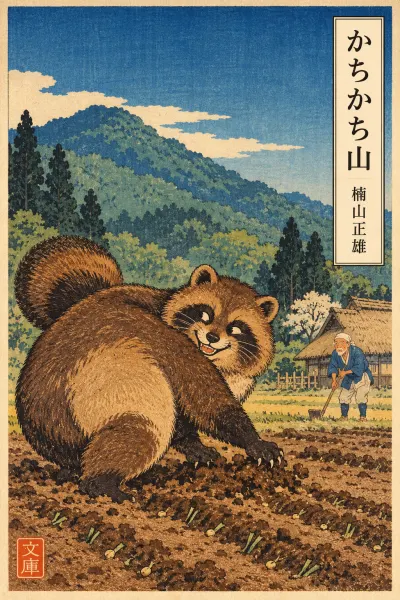
でも、山からたぬきが来て、はたけのやさいを食べました。But a tanuki came down from the mountain and ate the vegetables in the field.
おじいさんはとてもこまりました。The old man did not know what to do.
あるあさ、おじいさんはたぬきをとりました。One morning the old man caught the tanuki.
そして、なわでうちの中にかけました。Then he tied it up with rope and hung it inside the house.
「ばんごはんに、たぬきじるをつくってください。」とおばあさんにいって、またはたけへ行きました。"Please make tanuki soup for dinner," he told the old woman, and he went back to the field.
おばあさんは一人ではたらいて、つかれました。The old woman worked all by herself and grew tired.
すると、上からたぬきがいいました。Then the tanuki spoke to her from up above.
「おばあさん、わたしがやります。なわをとってください。」おばあさんはなわをとりました。"Old woman, I'll do that for you. Please untie the rope." The old woman untied the rope.
すると、たぬきは木でおばあさんのあたまをたたきました。At once the tanuki hit the old woman on the head with a piece of wood.
おばあさんはしにました。The old woman died.
たぬきはおばあさんでりょうりをつくりました。The tanuki cooked a meal out of the old woman.
そして、おばあさんになって、まっていました。Then it turned itself into the old woman and waited.
よる、おじいさんが来ました。At night, the old man came.
「たぬきじるですよ。」おじいさんは「おいしい、おいしい。」といって食べました。"Here's your tanuki soup." The old man ate it, saying, "Delicious, delicious!"
たぬきは「それはおばあさんだよ。」といって、山へはしって行きました。"That was the old woman!" said the tanuki, and it ran off to the mountain.
おじいさんは何もいえませんでした。The old man could not say a single word.
そこへ、山の白いうさぎが来ました。Just then, a white rabbit from the mountain came by.
おじいさんはうさぎに話しました。The old man told the rabbit what had happened.
うさぎは「わたしがやりますから、まっていてください。」といいました。"I'll take care of it, so please wait," said the rabbit.
うさぎは山で木をきって、くりを食べていました。Up on the mountain, the rabbit was cutting wood and eating chestnuts.
たぬきが来て、「くりをください。」といいました。The tanuki came along and said, "Give me some chestnuts."
「この木をもって、むこうの山まで行ってください。そのあとであげます。」"Carry this wood to the mountain over there. After that, I'll give you some."
たぬきは木をもって、先にあるきました。The tanuki picked up the wood and walked on ahead.
うさぎはうしろで木に火をつけました。Behind it, the rabbit set fire to the wood.
「かちかち。」Kachi-kachi! Click-clack!
「うさぎさん、かちかちは何ですか。」"Mr. Rabbit, what's that kachi-kachi sound?"
「ここはかちかち山ですから。」"That's because this is Kachikachi-yama, Click-Clack Mountain."
火は大きくなりました。The fire grew bigger.
「ぼうぼうは何ですか。」"What's that bō-bō roaring sound?"
「むこうはぼうぼう山ですから。」"That's because over there is Bōbō-yama, Roaring Mountain."
たぬきの背はとてもあつくなりました。The tanuki's back got very hot.
たぬきは「あつい、あつい。」といって、うちへはしって行きました。"Hot! Hot!" cried the tanuki, and it ran off home.
つぎのあさ、うさぎはからいくすりをつくって、たぬきのうちへ行きました。The next morning the rabbit made some hot, stinging medicine and went to the tanuki's house.
「このくすりをつけると、よくなりますよ。」うさぎはたぬきの背にくすりをつけました。"If you put this medicine on, you'll get better." The rabbit rubbed the medicine onto the tanuki's back.
背はもっといたくなりました。Its back hurt even more.
「いたい、いたい。」"Ouch! Ouch!"
少しあとで、うさぎとたぬきはうみへ行きました。A little while later, the rabbit and the tanuki went to the sea.
うさぎは木のふねをつくりました。The rabbit made a boat out of wood.
たぬきは土のふねをつくりました。The tanuki made a boat out of mud.
二人はふねにのって、うみのとおくへ行きました。The two of them got into their boats and went far out to sea.
「どちらがはやいですか。」"Which one is faster?"
でも、土のふねはだんだん水の中へ入りました。But little by little, the mud boat sank into the water.
「だれか、だれか。」"Somebody! Somebody help!"
うさぎはいいました。The rabbit spoke.
「あなたはおばあさんをたたきましたね。」"You hit the old woman, didn't you?"
たぬきは「もうしません。」といいました。"I won't do it again," said the tanuki.
でも、ふねは水の中へ入りました。But the boat went down into the water.
たぬきも入って、もう出て来ませんでした。The tanuki went down too, and it never came up again.
Vocabulary
| Word | Meaning | JLPT |
|---|---|---|
| はたけはたけ | field (for vegetables)dictionary form: 畑A dry field for vegetables, not a rice paddy (田 た). | N3 |
| はたらいてはたらく | to workdictionary form: 働くTe-form of はたらく. | N5 |
| たぬきたぬき | tanuki, Japanese raccoon dogdictionary form: 狸A real wild animal. In folktales it is a trickster that can change its shape. English has no exact word, so 'tanuki' is used. | — |
| こまりましたこまる | to be in trouble; not know what to dodictionary form: 困る | N5 |
| なわなわ | ropedictionary form: 縄In なわをとる it means 'take off the rope', that is, untie it. | N3 |
| たぬきじるたぬきじる | tanuki soupdictionary form: 狸汁汁 しる (soup) becomes じる after another word (rendaku). | — |
| つかれましたつかれる | to get tireddictionary form: 疲れる | N5 |
| たたきましたたたく | to hit, to strikedictionary form: 叩く | N3 |
| 火をつけましたひをつける | to set fire to, to lightdictionary form: 火をつける | — |
| 背せ | back (of the body)Also means 'height'. 背中 せなか is the more common word for 'back'. | N5 |
| からいからい | hot, spicy, stingingdictionary form: 辛いHere it describes a medicine that burns. It is the spicy-food kind of 'hot', not あつい. | N5 |
| くすりくすり | medicinedictionary form: 薬Medicine you put on the skin uses つける. | N5 |
| ふねふね | boat, shipdictionary form: 船 | N4 |
| だんだんだんだん | little by little, graduallydictionary form: 段々 | N1 |
Grammar
〜ていました N5 was doing; used to do (habit)
て-form + いました describes an ongoing or repeated action in the past. With 毎日 it shows the old man's daily routine.
おじいさんは毎日はたけではたらいていました。
Every day the old man worked in his field.
〜てください N5 please do ~
て-form + ください makes a polite request or instruction. In the example, the old man politely asks the old woman to make tanuki soup for dinner.
「ばんごはんに、たぬきじるをつくってください。」
"Please make tanuki soup for dinner."
何も〜ません N5 nothing; not anything
何も (なにも) with a negative verb means 'not ... anything'. Here it is combined with the potential いえる: he could not say anything at all.
おじいさんは何もいえませんでした。
The old man could not say a single word.
〜から (reason) N5 because ~
から after a sentence gives a reason. The rabbit ends its answer with から and leaves the rest unsaid: 'Because this is Kachikachi-yama (that's why).'
「ここはかちかち山ですから。」
"That's because this is Kachikachi-yama, Click-Clack Mountain."
い-adj (〜く) + なる N5 to become ~
Change the final い of an い-adjective to く and add なる to show a change of state. 大きい becomes 大きくなる, 'to get bigger'.
火は大きくなりました。
The fire grew bigger.
〜と (conditional) N4 if / when ~ (then naturally ~)
Dictionary form + と shows that one thing always or naturally follows another. The rabbit uses it to promise that the medicine will surely help.
「このくすりをつけると、よくなりますよ。」
"If you put this medicine on, you'll get better."