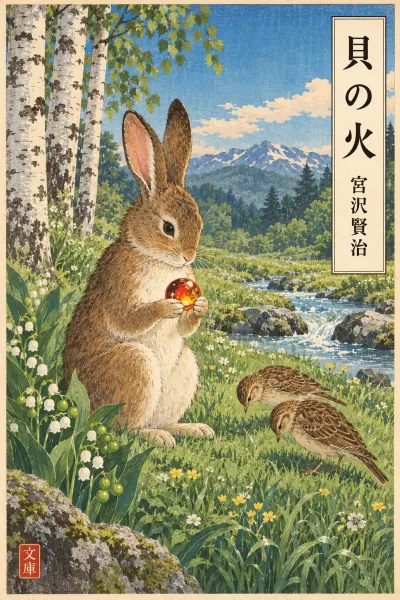
 N3 · easy
Simplified retelling · JLPT N3
貝の火 Kai no Hi in easy Japanese (N3)
This is our own simplified retelling of Homoi and the Shell-Fire Jewel, written for N3 learners and checked word by word against the N3 vocabulary list. A few story words and grammar patterns go beyond N3; the notes below give each one's level. It keeps the characters, events and ending of the original. When it feels easy, move on to the original text.
The story in brief
A young rabbit, Homoi, saves a lark chick from a stream, and the larks' king gives him the precious jewel called the Shell Fire. The gift makes him proud, and he bullies the mole and lets a fox do cruel things, until the jewel clouds over and loses its fire. The jewel shatters, the dust blinds Homoi, and his father comforts him and promises to make his eyes well again.
AI translation · independently checked
春の野原に、うさぎの子のホモイがいました。In the spring meadow there lived a little rabbit called Homoi.
ホモイは草の上を楽しそうに走っていました。Homoi was running happily over the grass.
ある日、ホモイは小さな川の近くに来ました。One day, Homoi came near a little stream.
すると、川の上の方から、鳥の子が鳴きながら流れてきました。Just then, from upstream, a baby bird came floating down, crying as it went.
ひばりの子です。It was a baby lark.
ホモイは急いで川に入って、ひばりの子をしっかり捕まえました。Homoi hurried into the stream and caught hold of the lark chick tightly.
ひばりの子は大きな声で鳴きました。The lark chick cried out in a loud voice.
その子は少しこわい形をしていました。The chick was a little frightening to look at.
でも、ホモイは決して手をはなしませんでした。But Homoi never once let go.
二人は水の中をどんどん流されました。The two of them were swept rapidly on and on through the water.
ホモイは水をたくさん飲みました。Homoi swallowed a great deal of water.
それでも木のえだをかんで、やっときしに上がりました。Even so, he bit onto a tree branch and at last climbed up onto the bank.
そこへ、母親のひばりが空から降りてきて、子供を強く抱きました。Just then the mother lark came down out of the sky and held her child close.
ホモイは家に帰りました。Homoi went home.
でも、そのあと、ひどい病気になってしまいました。But afterwards he fell terribly ill.
ホモイの病気がよくなったころ、ある静かな夜に、ひばりの母と子が来ました。Around the time Homoi was getting better, on one quiet night, the mother lark and her chick came to visit.
「ホモイさま、子供の命を助けてくださって、ありがとうございました。これは私たちの王様からのおくり物です。」"Master Homoi, we thank you most humbly for saving our child's life. This is a gift from our king."
それはまるいたまで、中で赤い火がもえていました。It was a round jewel, and inside it a red fire was burning.
「貝の火」という有名なほうせきです。It was the famous jewel called the "Shell Fire."
ホモイは「いりません」と言いました。"I don't need it," said Homoi.
でも、ひばりたちはたまを置いて、飛んで行ってしまいました。But the larks left the jewel behind and flew away.
お父さんはたまを見て言いました。Father looked at the jewel and said:
「これは大変なたまだ。一生この光を守れた者は、今までに鳥が二人と魚が一人だけだそうだ。悪いことをしないように気をつけるんだぞ。」ホモイは「大丈夫です。毎日百回息をかけて、みがきます」と答えました。"This is an extraordinary jewel. They say that so far only two birds and one fish have managed to keep this light safe for their whole lives. Be careful not to do anything bad, you hear?" Homoi answered, "It'll be all right. Every day I'll breathe on it and polish it a hundred times."
次の朝、ホモイが外に出ると、年をとった馬がていねいにおじぎをしました。The next morning, when Homoi went outside, an old horse bowed to him very politely.
りすたちは、ホモイを見ると、こわがって逃げてしまいました。When the squirrels saw Homoi, they took fright and ran away.
お母さんは「お前はもう立派な人になったのですよ」と言いました。Mother said, "You have already become a fine and important person, you know."
ホモイはうれしくなりました。Homoi felt very pleased.
それから、ホモイは、いつも自分をいじめていたきつねに会いました。After that, Homoi met the fox who had always bullied him.
「待て。僕は立派な人になったんだぞ」と言うと、きつねはおじぎをして「何でもします」と言いました。When he said, "Wait! I've become an important person now, you know," the fox bowed and said, "I'll do anything at all for you."
次の日、ホモイはもぐらに仕事を頼みました。The next day, Homoi gave the mole a job to do.
もぐらは「日の光の下では働けません」と言いました。The mole said, "I cannot work in the light of the sun."
ホモイは怒って、「あとで、ひどい目にあわせるぞ」と言いました。Homoi grew angry and said, "I'll make you sorry for this later!"
もぐらの家族は泣きました。The mole's family wept.
お父さんはホモイをしかりました。Father scolded Homoi.
「お前はもうだめだ。たまを見てごらん。」でも、たまは前よりもっと赤くもえていました。"You're no good any more. Just look at the jewel." But the jewel was burning even redder than before.
次の朝、きつねがおいしいパンを持ってきました。The next morning, the fox brought some delicious bread.
ホモイは喜んで、家に持って帰りました。Homoi was delighted and carried it home.
でも、お父さんは「これは盗んできたものだ」と言って、パンを土に投げて、足でふみました。But Father said, "This has been stolen," threw the bread on the ground, and stamped on it.
それでも、たまはきれいにもえていました。Even so, the jewel went on burning beautifully.
次の日、きつねはもぐらをいじめました。The next day, the fox tormented the mole.
ホモイは止めないで、見ていました。Homoi did not stop him; he just watched.
お父さんが来て、もぐらを助けました。Father came and rescued the mole.
でも、たまは今までで一番美しく光っていました。But the jewel was shining more beautifully than it ever had before.
ホモイは「僕はこのたまとずっといっしょです。何をしても大丈夫です」と言いました。Homoi said, "This jewel and I will always be together. Whatever I do, it'll be all right."
その次の朝、きつねはあみで小鳥を捕まえて、ガラスの箱に入れました。The morning after that, the fox caught some little birds in a net and put them in a glass box.
小鳥たちは「助けてください」と言いました。The little birds said, "Please help us!"
ホモイは箱を開けようとしました。Homoi tried to open the box.
でも、きつねが「さわったら、食べるぞ」と大きな声で言いました。But the fox said in a loud voice, "Touch it and I'll eat you!"
ホモイはこわくなって、家に逃げて帰りました。Homoi grew frightened and ran away home.
家でたまを見ると、小さな白いくもりがありました。When he looked at the jewel at home, there was a small white cloudy spot on it.
家族みんなで一生けんめいみがきましたが、くもりはだんだん大きくなりました。The whole family polished it as hard as they could, but the cloudiness grew bigger and bigger.
夜、あぶらに入れておきました。At night, they left it soaking in oil.
でも、夜中に見ると、もう赤い火はありませんでした。But when they looked in the middle of the night, the red fire was already gone.
お父さんは言いました。Father spoke.
「お前は、ひばりの子の命を助けて、このたまをもらったのだ。さあ、きつねと戦いに行こう。」三人は野原へ行きました。"You were given this jewel because you saved the lark chick's life. Come now, let's go and fight the fox." The three of them set off for the meadow.
お父さんがガラスの箱を手でしっかり持つと、きつねは逃げて行きました。When Father took a firm hold of the glass box, the fox ran away.
箱の中には、ひばりの母と子や、ふくろうなど、百ぐらいの鳥が入っていました。Inside the box were about a hundred birds, among them the mother lark and her chick, and an owl.
鳥たちは家に来て、たまを見ました。The birds came to the house and looked at the jewel.
そのとき、たまは二つに割れて、煙のようにこなになりました。At that moment the jewel split in two and crumbled into dust, like smoke.
こなはホモイの目に入りました。The dust went into Homoi's eyes.
それから、こなはまた一つのまるいたまに戻って、窓から飛んで行きました。Then the dust came together again into one round jewel and flew away out of the window.
ふくろうは「たった六日だったな」と笑って、出て行きました。"Only six days, eh?" laughed the owl, and he went out.
ホモイの目は白くなって、何も見えなくなりました。Homoi's eyes turned white, and he could not see anything at all.
お母さんは泣いてばかりいました。Mother did nothing but cry.
お父さんはホモイの背中を静かにたたいて言いました。Father gently patted Homoi on the back and said:
「泣くな。こんなことはどこにでもあるのだ。それがよく分かったお前は、いちばん幸せなのだ。目はきっとよくなる。お父さんがよくしてやるから。」"Don't cry. Things like this happen everywhere. And you, who have come to understand that well, are the luckiest of all. Your eyes will surely get better. Your father will make them well."
窓の外では、きりが晴れて、朝の光の中で草の葉が光っていました。Outside the window the mist was clearing, and the blades of grass were shining in the morning light.
Vocabulary
| Word | Meaning | JLPT |
|---|---|---|
| 捕まえましたつかまえる | to catch, to seizedictionary form: 捕まえるTransitive verb. Its intransitive partner is 捕まる (to be caught; to hold on to). | N4 |
| 流されましたながす | to let flow, to wash or sweep away (here in the passive: 流される, to be swept away)dictionary form: 流すPassive of 流す. Compare 流れる (to flow) in the earlier line about the chick. | N3 |
| きしきし | bank (of a river), shoredictionary form: 岸Written in kana here. The kanji is 岸. | N3 |
| 命いのち | life命を助ける means 'to save someone's life'. | N3 |
| ほうせきほうせき | jewel, precious stonedictionary form: 宝石宝 means 'treasure' and 石 means 'stone'. | N3 |
| 一生いっしょう | one's whole life, for a lifetimeAlso appears in 一生けんめい (with all one's might). | N3 |
| 立派りっぱ | fine, splendid, respectableA な-adjective. 立派な人 is someone admirable or of high standing, which is how Homoi starts to see himself. | N5 |
| いじめていたいじめる | to bully, to tormentdictionary form: いじめるThe noun form いじめ means 'bullying'. | N4 |
| ひどい目にあわせるひどいめにあわせる | to make someone suffer, to give someone a hard timeSet phrase used as a threat. ひどい目にあう means 'to have a terrible experience'. | — |
| しかりましたしかる | to scolddictionary form: 叱るUsed of parents or teachers scolding children. Compare 怒る (to get angry). | N3 |
| 盗んでぬすむ | to stealdictionary form: 盗む盗んできたもの means 'something that has been stolen and brought here'. | N4 |
| くもりくもり | cloudiness, a cloudy spotdictionary form: 曇りUsually means 'cloudy weather'. Here it is a dull spot on the jewel's surface. | N5 |
| 割れてわれる | to break, to splitdictionary form: 割れるIntransitive verb. Its transitive partner is 割る (to break something). | N4 |
| 晴れてはれる | to clear up (mist, weather)dictionary form: 晴れるきりが晴れる means 'the mist lifts'. | N5 |
Grammar
〜ながら N4 while doing
Attached to the verb stem, ながら shows that two actions happen at the same time. Here the chick is crying while it floats downstream.
鳥の子が鳴きながら流れてきました
a baby bird came floating down, crying as it went
決して〜ない N3 never, not at all
決して always appears with a negative verb and strongly emphasises it. It shows how firmly Homoi held on to the chick.
ホモイは決して手をはなしませんでした。
Homoi never once let go.
〜てしまう N4 to do completely; to end up doing (often with regret)
This pattern shows that an action is finished and cannot be undone, often with a feeling of surprise or regret. The larks are gone before Homoi can return the jewel.
ひばりたちはたまを置いて、飛んで行ってしまいました。
the larks left the jewel behind and flew away.
〜そうだ (hearsay) N4 I hear that; they say that
The plain form plus そうだ reports information heard from others. Father is passing on what is said about the jewel.
今までに鳥が二人と魚が一人だけだそうだ。
They say that until now, it has only been two birds and one fish.
〜ようとする N3 to try to do; to be about to do
The volitional form plus とする describes an attempt that may not succeed. Homoi tries to open the box, but the fox's threat stops him.
ホモイは箱を開けようとしました。
Homoi tried to open the box.
〜てばかりいる N3 to do nothing but ~
The te-form plus ばかりいる means someone keeps doing one thing and nothing else. It is often slightly critical or sad, as with Mother's endless crying here.
お母さんは泣いてばかりいました。
Mother did nothing but cry.