 N5 · easy
Simplified retelling · JLPT N5
貝の火 Kai no Hi in easy Japanese (N5)
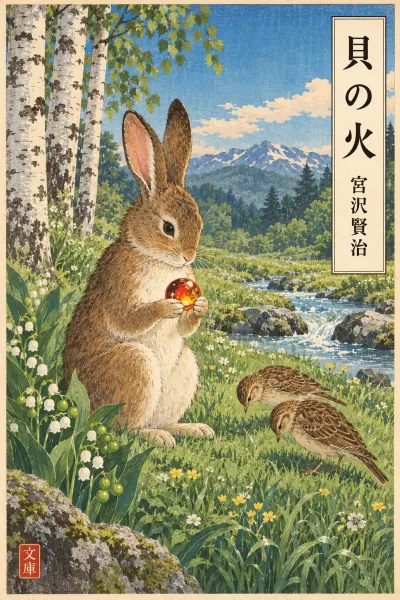
This is our own simplified retelling of Homoi and the Shell-Fire Jewel, written for N5 learners and checked word by word against the N5 vocabulary list. A few story words and grammar patterns go beyond N5; the notes below give each one's level. It keeps the characters, events and ending of the original. When it feels easy, move on to the N4 version or the original text.
The story in brief
Homoi, a little rabbit, saves a baby lark from a river, and the larks thank him with a beautiful red jewel called the Shell-Fire. Homoi grows proud, bosses the other animals around and does nothing when the fox bullies the mole, until the jewel clouds over and turns completely white. After the family rescues the birds the fox has trapped, the jewel flies away and Homoi loses his sight, but his father comforts him and promises his eyes will get better.
AI translation · independently checked
ホモイは小さなうさぎの男の子です。Homoi is a little boy rabbit.
あるあさ、川の中で、ひばりの子どもがないていました。One morning, a baby lark was crying in the river.
ホモイは川に入って、子どもをたすけました。Homoi went into the river and saved the baby.
でも、とてもつかれて、びょうきになりました。But he became very tired, and he fell ill.
びょうきがよくなったよる、ひばりのお母さんと子どもが来ました。On the night he got better, the mother lark and her baby came.
「子どもをたすけてくれて、ほんとうにどうも。これはおうさまからの、かいの火というたまです。」それは、あかくてきれいなたまでした。"Thank you so very much for saving my child. This is a jewel from the King, called the Shell-Fire." It was a beautiful red jewel.
お父さんはいいました。Homoi's father said:
「これはゆうめいなたまだ。わるい子になると、たまはくもるよ。」ホモイは毎日たまをみがきました。"This is a famous jewel. If you become a bad child, the jewel will grow cloudy." Every day, Homoi polished the jewel.
つぎのあさから、どうぶつたちはみんな、ホモイの話をよく聞きました。From the next morning on, all the animals listened carefully to what Homoi said.
ホモイは「ぼくはみんなの上だ」といいました。Homoi said, "I am above everyone."
きつねには「ぼくの下ではたらけ」といいました。To the fox he said, "Work under me."
もぐらが「あかるいところでははたらけません」というと、ホモイは大きなこえで、いやなことばをいいました。When the mole said, "I can't work in bright places," Homoi said nasty words in a loud voice.
でも、たまは前よりきれいでした。But the jewel was more beautiful than before.
きつねがぬすんだパンをもって来ました。The fox brought some bread that he had stolen.
お父さんは「これはぬすんだパンだ」といって、食べませんでした。Father said, "This is stolen bread," and he did not eat it.
つぎに、きつねがもぐらをいじめました。Next, the fox bullied the mole.
ホモイは見ていました。Homoi was watching.
お父さんがもぐらをたすけました。Father saved the mole.
それでも、たまはきれいでした。Even so, the jewel was still beautiful.
ホモイは「ぼくとたまは、いつもいっしょです」といいました。Homoi said, "The jewel and I will always be together."
またつぎのあさ、きつねはとりをたくさんとって、大きなはこに入れました。The morning after that, the fox caught lots of birds and put them in a big box.
「ホモイさん、たすけてください。」でも、きつねが「食べるぞ」と大きなこえでいったので、ホモイはいえへはしってかえりました。"Mr. Homoi, please help us!" But the fox said in a loud voice, "I'll eat you!" so Homoi ran back home.
たまの中に、小さな白いところがありました。Inside the jewel there was a small white spot.
かぞくでみがきましたが、白いところはだんだん大きくなりました。The family polished it together, but the white spot grew bigger and bigger.
よる、たまはまっ白になりました。That night, the jewel turned pure white.
ホモイは大きなこえでなきました。Homoi cried out loud.
お父さんはいいました。Father said:
「ホモイ、ひばりをたすけたから、たまをもらったんだよ。さあ、とりをたすけに行こう。」三人が行くと、きつねははしって行きました。"Homoi, you got the jewel because you saved the lark. Now, let's go and save the birds." When the three of them went, the fox ran away.
はこの中には、とりが百ぐらいいました。Inside the box there were about a hundred birds.
とりたちはいえに来て、たまを見ました。The birds came to the house and looked at the jewel.
その時、たまは小さく小さくなりました。At that moment, the jewel broke into tiny, tiny pieces.
でも、また一つになって、あかくきれいになって、まどから外へとんで行きました。But then it became one again, turned a beautiful red, and flew out of the window.
ホモイのめは白くなって、もう何も見られません。Homoi's eyes turned white, and he could not see anything anymore.
お母さんもなきました。Mother cried too.
お父さんはホモイのせにておいて、いいました。Father put his hand on Homoi's back and said:
「なくな。よくわかったね。めはまたよくなるよ。お父さんがよくするから。」"Don't cry. You understand now, don't you? Your eyes will get better. Father will make them well."
外は天気がよくなって、はながきれいでした。Outside, the weather had cleared, and the flowers were beautiful.
Vocabulary
| Word | Meaning | JLPT |
|---|---|---|
| たすけましたたすける | to save, to help, to rescuedictionary form: 助けるA key word in this story: who helps whom, and who doesn't. | N3 |
| つかれてつかれる | to get tireddictionary form: 疲れるつかれています = 'I am tired' (the state after getting tired). | N5 |
| びょうきびょうき | illness; sickdictionary form: 病気びょうきになる = to fall ill. | N5 |
| たまたま | jewel, ball, round gemdictionary form: 玉Any round object; here a precious gem. | N3 |
| かいの火かいのひ | the Shell-Fire (name of the jewel)dictionary form: 貝の火貝 (かい) = shell, 火 (ひ) = fire: a jewel that glows like fire inside. | — |
| ゆうめいゆうめい | famousdictionary form: 有名A な-adjective: ゆうめいなたま. | N5 |
| くもるくもる | to become cloudy, to dimdictionary form: 曇るUsually used for the sky; here the jewel loses its shine. | N5 |
| みがきましたみがく | to polishdictionary form: 磨くAlso used for brushing teeth: はをみがく. | N5 |
| ぬすんだぬすむ | to stealdictionary form: 盗むぬすんだパン = bread that was stolen (past form before a noun). | N4 |
| いじめましたいじめる | to bully, to pick ondictionary form: いじめる | N4 |
| はこはこ | boxdictionary form: 箱 | N5 |
| だんだんだんだん | gradually, little by littledictionary form: 段々Often used with 〜くなる / 〜になる to describe change. | N1 |
| まっ白まっしろ | pure white, completely whitedictionary form: 真っ白まっ〜 makes a colour stronger: まっ赤 (bright red), まっ黒 (pitch black). | N2 |
Grammar
〜てくれる N4 someone does something for me / us
The て-form plus くれる shows that someone did an action that benefits the speaker. The mother lark is thanking Homoi for something he did for her family.
子どもをたすけてくれて、ほんとうにどうも。
Thank you so very much for saving my child.
〜と (conditional) N4 if / when (natural result)
Dictionary form + と shows that one thing always or naturally leads to another. If Homoi becomes bad, the jewel will automatically cloud over.
わるい子になると、たまはくもるよ。
If you become a bad child, the jewel will grow cloudy.
AはBより〜 N5 A is more ~ than B
より marks the thing being compared against. Here the jewel is compared with how it looked before.
でも、たまは前よりきれいでした。
But the jewel was more beautiful than before.
〜ので N4 because, so
ので gives a reason, and the result follows. Because the fox threatened him, Homoi ran home.
きつねが「食べるぞ」と大きなこえでいったので、ホモイはいえへはしってかえりました。
The fox said in a loud voice, "I'll eat you!" so Homoi ran back home.
verb stem + に行く N5 go (in order) to do
The masu-stem of a verb plus に before 行く shows the purpose of going. たすけに行こう means 'let's go to save'.
さあ、とりをたすけに行こう。
Now, let's go and save the birds.
dictionary form + な (prohibition) N4 don't ~
Adding な to the dictionary form makes a short, strong command not to do something. A parent can use it to a child, as Father does here.
なくな。
Don't cry.