Upper intermediate · JLPT N2
貝の火Kai no Hi — Homoi and the Shell-Fire Jewel
- JLPT N2
- 14,297 characters
- 11 parts
- about 119 minutes
- 3 easier versions
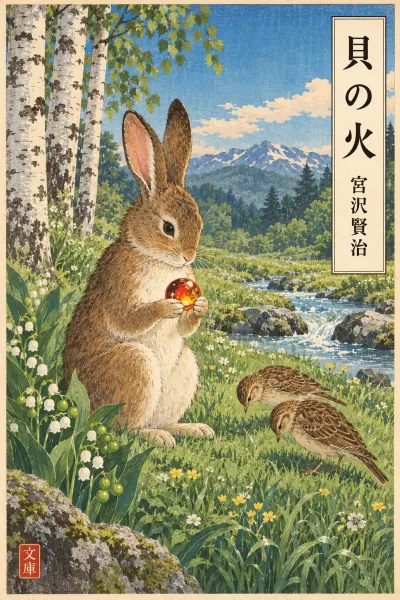
Kai no Hi is a fairy tale set in a meadow of birches and lilies of the valley, where the animals talk. A young rabbit, Homoi, jumps into a stream to save a lark chick that is being swept away. Soon afterwards the larks bring him the Shell-Fire, a glowing jewel sent by their king. His parents explain that very few owners have kept it perfect all their lives. As the other animals begin to bow to him, Homoi must decide what kind of rabbit he will be, and a flattering fox is never far away. The story is a fable about pride and responsibility that takes place over six days, and much of its tension comes from watching the fire inside the jewel. The narration is gentle and polite, full of onomatopoeia and vivid descriptions of light and colour. The main challenge for a learner is the range of speech styles. The larks and an old horse use stiff, old-fashioned honorifics, while the fox swings from servile へい-speech to rough threats. Noticing who speaks in which style is a large part of understanding the characters.
Contents
- A Rabbit Rescues a Lark Chick
- A Fever, and a Gift from the Larks
- The Treasure Comes Home
- Homoi Becomes a General
- Homoi Begins to Give Orders
- Pride, Threats, and a Still-Bright Jewel
- The Fox's Stolen Bread
- Moles Bullied, a Jewel Shining Brighter
- The Fox's Zoo and a Clouded Jewel
- The Jewel Goes Dark, the Fox Flees
- The Jewel Shatters and Flies Away
Easier versions
This story is also retold in simpler Japanese. Reading an easier version first makes the original much more approachable.
Before you read
- The narrator tells the story in polite です/ます form and often introduces speech with the humble verb 申しました, sometimes also with 言いました. 申す is a humble verb and belongs to the storyteller's courteous voice. In translation, 'said' usually works, but notice the polite, old-fashioned tone it gives the narration.
- The larks and the old horse speak in elaborate, archaic keigo. The horse uses forms like ござります (an older form of ございます) and 存じまする (an older form of 存じます). Read them as their modern equivalents, and enjoy how stiff and ceremonious they sound next to Homoi's boyish speech.
- Track the fox's register. He starts with servile へい-speech and flattery, then switches to rough, menacing plain speech. The shift in his language signals the shift in his intentions.
- Several grammar patterns recur in this text: 〜てしまう (things done completely or with regret), 〜てやる (doing something to or for someone, often from a position of power, which suits Homoi's growing pride), 〜ておくれ (a parent's gentle request), 〜ておく, 〜たまま, 〜そうになる and 〜ものですから.
- Learn a few key words before you start: 貝の火 (the jewel), 雲雀 (ひばり, lark), 狐 (きつね, fox), もぐら (mole), 鈴蘭 (すずらん, lily of the valley), 磨く (みがく, to polish) and 曇る (くもる, to cloud over). Whether the jewel 曇る is the question the whole story keeps returning to.
Words to know
The most useful words from the notes across the story.
| Word | Meaning | JLPT |
|---|---|---|
| 砕けてくだける | to break into pieces, to shatterdictionary form: 砕けるIntransitive. The transitive form is 砕く. | N2 |
| いちもくさんいちもくさん | at full speed, headlong (running without looking back)dictionary form: 一目散Usually written 一目散に and used with verbs like 走る or 逃げる. | — |
| むぐらむぐら | moleDialect or old form of もぐら; むぐらもち (sentence 26) is another old name for the same animal. | — |
| 露つゆ | dew | N1 |
| 見とれましたみとれる | to gaze at something, entranceddictionary form: 見とれるAlso written 見惚れる. Often paired with うっとり. | — |
| すかしてすかす | to look through (something held up to the light)dictionary form: 透かすRelated to すきとおる (to be transparent) later in the same sentence. | — |
| 大将たいしょう | general; leader, bossAlso a casual word for a boss or chief. 少将 = major general, 大佐 = colonel. | — |
| 曇ってくもる | to cloud over, to become dulldictionary form: 曇るAlso used for weather. Here it describes the jewel losing its shine. | N5 |
| 曇りくもり | cloudiness, a cloudy spotAlso 'cloudy weather'; the verb 曇る appears in the father's speech. | N5 |
| みがきみがく | to polishdictionary form: 磨くAlso 'to brush (teeth)' and 'to improve (a skill)'. | N5 |
| 着物きもの | clothes; here, the rabbits' fur coatUsually means kimono. Here it is used playfully for the animals' summer fur. | N4 |
| 盗んでぬすむ | to stealdictionary form: 盗む | N4 |
| いじめますいじめる | to torment, to bullydictionary form: いじめる | N4 |
| 硝子がらす | glassOld kanji spelling of ガラス; today usually written in katakana. | N4 |
| 熱心ねっしん | eager, earnest熱心に = earnestly, with great effort. | N4 |
Plot summary
Show the full summary (contains spoilers)
Homoi rescues a lark chick from a stream and falls ill with a fever. When he recovers, the larks give him the Shell-Fire jewel on behalf of their king. The other animals flatter him and he grows proud. He appoints 'officers', bullies a mole, and accepts stolen bread from the fox, which his father tramples. He then joins the fox in tormenting a family of moles. Each time, the jewel only shines brighter, and Homoi becomes convinced that nothing can harm it. Then the fox nets birds for a 'zoo' and threatens Homoi, and a white cloud appears in the jewel. Soaking it in oil overnight does not help, and by midnight it looks like lead. Homoi confesses, and his father drives off the fox and frees the birds. In front of the gathered birds the jewel cracks, its smoke blinds Homoi, and it flies away whole again. His father comforts him: his eyes will heal, and understanding what happened makes him truly fortunate.
About the author
Miyazawa Kenji was a poet and writer of children's stories from Hanamaki in Iwate Prefecture. He studied agricultural science in Morioka and later taught at an agricultural school. He devoted much of his life to helping local farmers improve their methods and their cultural lives. He was a devout Buddhist, and his faith, love of nature and interest in science run through his writing. His fame came after his death, with works such as 銀河鉄道の夜, 風の又三郎 and the poem 雨ニモマケズ.