Part 1 of 11 · JLPT N2
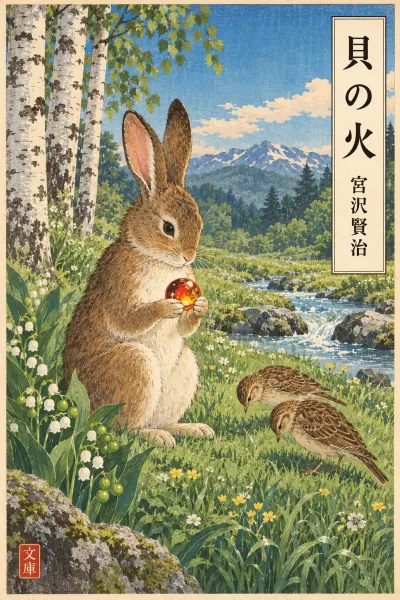
貝の火 Kai no Hi, part 1: A Rabbit Rescues a Lark Chick
In this part
On a fragrant early-summer day, the young rabbit Homoi bounds happily through the meadow to a small stream. A struggling lark chick comes tumbling down the current, and although its wrinkled, lizard-like face frightens him, Homoi jumps in, holds on to it, and drags it to safety by biting a willow branch. When the chick looks up at him he runs away in fright, and the chick's mother swoops down from the sky and hugs her baby tight.
AI translation · independently checked
今は兎たちは、みんなみじかい茶色の着物です。By now the rabbits were all wearing their short brown coats.
野原の草はきらきら光り、あちこちの樺の木は白い花をつけました。The grass of the meadow sparkled and shone, and the birch trees here and there had put out white blossoms.
実に野原はいいにおいでいっぱいです。Truly, the meadow was full of sweet smells.
子兎のホモイは、悦んでぴんぴん踊りながら申しました。Homoi, a young rabbit, was so delighted that he danced and hopped about as he spoke.
「ふん、いいにおいだなあ。うまいぞ、うまいぞ、鈴蘭なんかまるでパリパリだ」"Mmm, what a lovely smell! Delicious, delicious! And the lilies of the valley are perfectly crisp!"
風が来たので鈴蘭は、葉や花を互いにぶっつけて、しゃりんしゃりんと鳴りました。A breeze came along, and the lilies of the valley knocked their leaves and flowers against one another, ringing shalin, shalin.
ホモイはもううれしくて、息もつかずにぴょんぴょん草の上をかけ出しました。Homoi was so happy that, without stopping for breath, he went bounding off, hop, hop, across the grass.
それからホモイはちょっと立ちどまって、腕を組んでほくほくしながら、Then Homoi stopped for a moment, folded his arms, and, beaming with pleasure,
「まるで僕は川の波の上で芸当をしているようだぞ」と言いました。said, "Why, it's just as if I were doing tricks on the waves of a river!"
本当にホモイは、いつか小さな流れの岸まで来ておりました。And it was true: before he knew it, Homoi had come all the way to the bank of a little stream.
そこには冷たい水がこぼんこぼんと音をたて、底の砂がピカピカ光っています。There the cold water went burbling along, kobon, kobon, and the sand at the bottom glittered and gleamed.
ホモイはちょっと頭を曲げて、Homoi tilted his head a little to one side
「この川を向こうへ跳び越えてやろうかな。なあに訳ないさ。けれども川の向こう側は、どうも草が悪いからね」とひとりごとを言いました。and said to himself, "Shall I jump right across this stream to the other side? Pooh, that's nothing! But the grass on the far bank doesn't look much good, you know."
すると不意に流れの上の方から、Just then, all of a sudden, from upstream
「ブルルル、ピイ、ピイ、ピイ、ピイ、ブルルル、ピイ、ピイ、ピイ、ピイ」とけたたましい声がして、うす黒いもじゃもじゃした鳥のような形のものが、ばたばたばたばたもがきながら、流れて参りました。came a shrill cry, "Brrrr, peep, peep, peep, peep, brrrr, peep, peep, peep, peep!", and something dark and shaggy, shaped like a bird, came floating down the stream, flapping and flailing and struggling.
ホモイは急いで岸にかけよって、じっと待ちかまえました。Homoi hurried to the bank and waited there, watching closely.
流されるのは、たしかにやせたひばりの子供です。The thing being swept along was certainly a scrawny baby lark.
ホモイはいきなり水の中に飛び込んで、前あしでしっかりそれをつかまえました。Without a moment's hesitation Homoi leapt into the water and caught hold of it firmly with his front paws.
するとそのひばりの子供は、いよいよびっくりして、黄色なくちばしを大きくあけて、まるでホモイのお耳もつんぼになるくらい鳴くのです。At that the baby lark became even more frightened, opened its yellow beak wide, and screamed so loudly that it nearly deafened Homoi's ears.
ホモイはあわてて一生けん命、あとあしで水をけりました。In a panic, Homoi kicked at the water with his hind legs as hard as he could.
そして、And then,
「大丈夫さ、 大丈夫さ」と言いながら、その子の顔を見ますと、ホモイはぎょっとしてあぶなく手をはなしそうになりました。saying, "It's all right, it's all right," he looked at the chick's face, and he got such a shock that he very nearly let go.
それは顔じゅうしわだらけで、くちばしが大きくて、おまけにどこかとかげに似ているのです。Its face was covered all over with wrinkles, its beak was huge, and what was more, it looked somehow like a lizard.
けれどもこの強い兎の子は、決してその手をはなしませんでした。But this strong little rabbit never let go.
怖ろしさに口をへの字にしながらも、それをしっかりおさえて、高く水の上にさしあげたのです。Though his mouth was twisted into a frown with fear, he held on to it firmly and lifted it high above the water.
そして二人は、どんどん流されました。And the two of them were swept farther and farther downstream.
ホモイは二度ほど波をかぶったので、水をよほどのみました。Twice the waves washed over Homoi's head, and he swallowed a great deal of water.
それでもその鳥の子ははなしませんでした。Even so, he did not let go of the baby bird.
するとちょうど、小流れの曲がりかどに、一本の小さな楊の枝が出て、水をピチャピチャたたいておりました。Then, just at a bend in the little stream, a small willow branch was sticking out, slapping at the water, pitcha-pitcha.
ホモイはいきなりその枝に、青い皮の見えるくらい深くかみつきました。At once Homoi bit into the branch, so deeply that the green inner bark showed.
そして力いっぱいにひばりの子を岸の柔らかな草の上に投げあげて、自分も一とびにはね上がりました。Then, with all his strength, he flung the baby lark up onto the soft grass of the bank, and sprang up after it himself in a single leap.
ひばりの子は草の上に倒れて、目を白くしてガタガタ顫えています。The baby lark lay collapsed on the grass, its eyes rolled back, shivering and shaking.
ホモイも疲れでよろよろしましたが、無理にこらえて、楊の白い花をむしって来て、ひばりの子にかぶせてやりました。Homoi was staggering with exhaustion too, but he forced himself to keep going, plucked some white willow catkins, and laid them over the baby lark to cover it.
ひばりの子は、ありがとうと言うようにその鼠色の顔をあげました。The baby lark lifted its mouse-grey face as if to say thank you.
ホモイはそれを見るとぞっとして、いきなり跳び退きました。The moment Homoi saw it, a shiver ran down his spine and he sprang back.
そして声をたてて逃げました。And he ran away, crying out.
その時、空からヒュウと矢のように降りて来たものがあります。Just then, something came swooping down from the sky like an arrow, whoosh.
ホモイは立ちどまって、ふりかえって見ると、それは母親のひばりでした。Homoi stopped and turned around to look, and it was the mother lark.
母親のひばりは、物も言えずにぶるぶる顫えながら、子供のひばりを強く強く抱いてやりました。The mother lark, trembling all over and unable to say a word, hugged her baby tightly, tightly.
Vocabulary
| Word | Meaning | JLPT |
|---|---|---|
| 着物きもの | clothes; here, the rabbits' fur coatUsually means kimono. Here it is used playfully for the animals' summer fur. | N4 |
| 樺かば | birch treeAlso called 白樺 (しらかば), white birch. | — |
| 互いにたがいに | against one another; mutually | — |
| 芸当げいとう | trick; stunt; feat of skill | — |
| 岸きし | bank (of a river); shore | N3 |
| 訳ないわけない | easy; nothing to itLiterally 'there is no reason (for difficulty)'. Often written 訳無い. | — |
| 不意にふいに | suddenly; unexpectedly | — |
| けたたましいけたたましい | shrill; piercing; alarmingly loud | — |
| もがきもがく | to struggle; to flail aboutdictionary form: もがく | N1 |
| 待ちかまえまちかまえる | to wait in readiness; to lie in waitdictionary form: 待ち構える待つ plus 構える (to get into position). | — |
| ひばりひばり | skylarkdictionary form: 雲雀A key story word: the larks are central to the tale. | — |
| しわだらけしわだらけ | covered in wrinkles〜だらけ means 'full of / covered in' and usually has a negative feel (泥だらけ, 'covered in mud'). | — |
| への字へのじ | a downturned mouth (shaped like the kana へ)口をへの字にする: to turn down the corners of the mouth in displeasure or tension. | — |
| ぞっとぞっと | with a shudder; feeling a chill of fearUsed in ぞっとする, 'to shudder; to get the creeps'. | — |
Grammar
〜ながら N4 while doing ~
Attached to the verb stem, ながら shows that two actions happen at the same time. Here Homoi speaks while he is dancing.
悦んでぴんぴん踊りながら申しました
he danced and hopped about joyfully as he spoke
〜ずに N3 without doing ~
ず is a written negative form attached to the negative stem, and ずに means 'without ~ing'. 息もつかずに literally means 'without even taking a breath'.
息もつかずにぴょんぴょん草の上をかけ出しました
without stopping for breath, he went bounding off across the grass
まるで〜ようだ N4 just as if ~; exactly like ~
まるで strengthens a comparison made with ようだ. Homoi imagines that his hopping over the rippling grass is like performing on river waves. The ぞ at the end adds boyish emphasis.
まるで僕は川の波の上で芸当をしているようだぞ
Why, it's just as if I were doing tricks on the waves of a river!
〜そうになる N3 to almost ~; to nearly ~
The verb stem plus そうになる describes something that nearly happened but did not. Combined with あぶなく ('dangerously close'), it stresses how close Homoi came to letting go.
ホモイはぎょっとしてあぶなく手をはなしそうになりました
Homoi got such a shock that he very nearly let go
〜くらい N3 to the extent that ~; so … that ~
A clause plus くらい expresses degree. Here it shows how deeply Homoi bit into the branch: deep enough for the green under the bark to show.
青い皮の見えるくらい深くかみつきました
he bit into it so deeply that the green under the bark showed
〜てやる N4 to do ~ for someone (of lower status or an animal)
てやる marks an action done for someone else's benefit, usually someone younger, weaker or of lower status. Homoi covers the chick for its sake, and the mother lark later hugs her baby in the same way (抱いてやりました).
ひばりの子にかぶせてやりました
he laid them over the baby lark to cover it