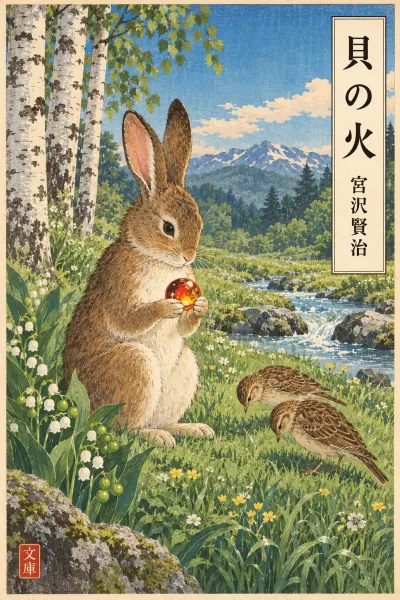
 N4 · easy
Simplified retelling · JLPT N4
貝の火 Kai no Hi in easy Japanese (N4)
This is our own simplified retelling of Homoi and the Shell-Fire Jewel, written for N4 learners and checked word by word against the N4 vocabulary list. A few story words and grammar patterns go beyond N4; the notes below give each one's level. It keeps the characters, events and ending of the original. When it feels easy, move on to the N3 version or the original text.
The story in brief
Homoi, a young rabbit, saves a lark chick from a stream, and the grateful larks give him a precious glowing jewel called the Shell-Fire. Proud of his new status, he frightens a mole and lets the fox bully the mole's family; when he is too afraid to save birds the fox has trapped, the jewel clouds over and turns into a white stone. After his father frees the birds, the jewel breaks, and its powder gets into Homoi's eyes and blinds him; the pieces re-form into the Shell-Fire and fly out the window, and his father comforts him and promises to heal his eyes.
AI translation · independently checked
ホモイは小さなうさぎの男の子です。Homoi was a little rabbit boy.
春の朝、ホモイはのはらで楽しくあそんでいました。One spring morning, Homoi was happily playing in the meadow.
すると、川の中から「ピイ、ピイ」となくこえが聞こえました。Then, from the stream, he heard a voice crying, "Peep, peep!"
ひばりの子どもが川におちていたのです。A baby lark had fallen into the stream.
ホモイはすぐに水に入って、その子をつかまえました。Homoi jumped straight into the water and caught hold of the little one.
水はつめたくて、ホモイは水をたくさん飲みました。The water was cold, and Homoi swallowed a great deal of it.
でも、ひばりの子を強く持っていました。But he held on tight to the baby lark.
そして、木の枝を口でかんで、ひばりの子をくさの上になげました。Then he bit onto a tree branch with his mouth and tossed the baby lark up onto the grass.
そこへ母親のひばりが来て、子どもを強くだきしめました。Just then the mother lark arrived and hugged her child tightly.
ホモイは家に帰ると、ねつを出して、たおれました。When Homoi got home, he came down with a fever and collapsed.
病気がなおったころ、ある夜、ひばりの母と子が来ました。Around the time he got well again, one night, the mother lark and her child came to visit.
「子どもをたすけてくださったお礼です。鳥の国からの大切なものです」母親のひばりは、まるいたまを出しました。"This is our thanks for saving my child. It is a precious thing from the land of the birds," said the mother lark, and she took out a round jewel.
中で赤い火がきれいにひかっています。Inside it, a red fire was shining beautifully.
このたまの名前は「かいのひ」です。The name of this jewel was "Shell-Fire."
お父さんはたまを見て、話しました。Father looked at the jewel and spoke.
「これは有名なたまだ。大切にしなさい。そして、人をいじめてはいけないよ」"This is a famous jewel. Take good care of it. And you must never bully anyone."
つぎの朝、りすはホモイを見ると、こわがってにげました。The next morning, when a squirrel saw Homoi, it got frightened and ran away.
お母さんは「お前はもう立派な人になったのですよ」と答えました。Mother answered, "You've become a fine person now, you know."
ホモイはうれしくなりました。Homoi felt happy.
いつもホモイをいじめるきつねも、あたまを下げました。Even the fox, who always bullied Homoi, bowed his head.
つぎの日、ホモイはもぐらに「くさのみを集めて」とたのみました。The next day, Homoi told a mole, "Gather grass seeds for me."
もぐらはできないと答えました。The mole answered that he couldn't.
ホモイはおこって、もぐらをこわがらせました。Homoi got angry and frightened the mole.
お父さんはホモイをしかりました。Father scolded Homoi.
でも、たまを見ると、前よりもっときれいにひかっていました。But when Homoi looked at the jewel, it was shining even more beautifully than before.
それから、きつねはぬすんだパンを毎日ホモイに持って来ました。After that, the fox brought Homoi stolen bread every day.
お父さんはおこって、パンをすてました。Father got angry and threw the bread away.
きつねがもぐらの家族をいじめた時、ホモイは止めないで見ていました。When the fox bullied the mole's family, Homoi just watched and did not stop him.
お父さんがもぐらをたすけました。Father rescued the moles.
それでも、たまはきれいにひかっていました。Even so, the jewel was still shining beautifully.
ホモイは「このたまは、何があってもきえないよ」と思いました。Homoi thought, "This jewel will never go out, no matter what happens."
ある朝、きつねはあみで鳥をつかまえて、ガラスのはこに入れました。One morning, the fox caught some birds in a net and put them into a glass box.
鳥たちは「ホモイさん、たすけてください」となきました。The birds cried, "Mr. Homoi, please save us!"
でも、きつねがこわかったので、ホモイは家ににげて帰りました。But Homoi was afraid of the fox, so he ran away home.
たまを見ると、小さな白いくもりがありました。When he looked at the jewel, there was a small white cloudy spot in it.
家族みんなで一日じゅうみがきましたが、くもりは大きくなりました。The whole family polished it all day long, but the cloudy spot only grew bigger.
その夜、たまは白いいしのようになって、赤い火はきえました。That night, the jewel became like a white stone, and the red fire went out.
ホモイはないて、お父さんにあみの話をしました。Homoi cried and told Father about the net.
お父さんは「お前も悪かった。私も悪かった。さあ、行こう」と話しました。Father said, "You did wrong, too. I did wrong, too. Come now, let's go."
三人はのはらへ走りました。The three of them ran to the meadow.
きつねはにげて、お父さんはガラスのはこを開けました。The fox ran away, and Father opened the glass box.
百ぐらいの鳥が外に出ました。About a hundred birds came out.
その中に、あのひばりの母と子もいました。Among them were that same mother lark and her child.
お父さんは鳥たちを家に案内して、あやまりました。Father led the birds to the house and apologised to them.
すると、白いたまはカチッとなって、小さくわれました。Then the white jewel went *click* and broke into tiny pieces.
そのこなのようなものがホモイの目に入って、ホモイはたおれました。Some of that powdery stuff got into Homoi's eyes, and Homoi collapsed.
小さくなったたまは、また集まって、もとのかいのひになりました。The little pieces of the jewel came together again and became the Shell-Fire just as it had been.
そして、赤くひかりながら、まどから外へとんで行きました。And, shining red, it flew out through the window.
鳥たちは一人ずつ帰りました。The birds went home one by one.
さいごにふくろうが「たった六日だったな」とわらって、出て行きました。Last of all, the owl laughed, "Only six days, eh?" and went out.
ホモイの目は白くなって、何も見えなくなりました。Homoi's eyes turned white, and he could not see anything anymore.
お母さんはずっとないていました。Mother kept on crying.
お父さんはホモイのせなかをやさしくなでて、話しました。Father gently stroked Homoi's back and spoke.
「なくな。こんなことは、どこにでもあるのだ。それがよくわかったお前は、いちばんいいのだ。目はきっとまたよくなる。お父さんがなおしてやるから」"Don't cry. Things like this happen everywhere. And you, who have truly understood that, are the best of all. Your eyes will surely get better again. Your father will make them well for you."
まどの外では、朝の空が晴れていました。Outside the window, the morning sky was clear.
Vocabulary
| Word | Meaning | JLPT |
|---|---|---|
| ひばりひばり | lark, skylarkdictionary form: 雲雀Usually written in kana; a small bird famous for singing high in the spring sky. | — |
| つかまえましたつかまえる | to catch, to grab hold ofdictionary form: 捕まえる | N4 |
| だきしめましただきしめる | to hug tightlydictionary form: 抱きしめる抱く (to hold in one's arms) + 締める (to tighten). | — |
| ねつねつ | feverdictionary form: 熱熱を出す = to come down with a fever. | N4 |
| お礼おれい | thanks; a gift given in thanks | N4 |
| いじめていじめる | to bully, to pick ondictionary form: いじめる | N4 |
| 立派りっぱ | fine, splendid, admirableA な-adjective; here it means Homoi now has high standing. | N5 |
| しかりましたしかる | to scolddictionary form: 叱る | N3 |
| ぬすんだぬすむ | to stealdictionary form: 盗む | N4 |
| くもりくもり | cloudiness, a cloudy spotdictionary form: 曇りAlso the word for cloudy weather; here a dull patch in the jewel. | N5 |
| みがきましたみがく | to polishdictionary form: 磨くAlso used for brushing teeth (歯を磨く). | N5 |
| あやまりましたあやまる | to apologisedictionary form: 謝る | N4 |
| われましたわれる | to break, to crack (by itself)dictionary form: 割れるIntransitive; the transitive form is 割る (to break something). | N4 |
| なでてなでる | to stroke, to pat gentlydictionary form: 撫でる | N2 |
Grammar
〜てはいけない N5 must not ~
The て-form plus はいけない forbids an action. The father uses it to warn Homoi never to bully others.
人をいじめてはいけないよ
You must never bully anyone.
Causative 〜させる N4 to make someone (do / feel) ~
こわがる (to be afraid) becomes こわがらせる, "to make someone afraid." The person who is made to feel it is marked with を.
ホモイはおこって、もぐらをこわがらせました。
Homoi got angry and frightened the mole.
何があっても N3 no matter what happens
A question word plus the て-form plus も means "no matter what/who/where." Here it shows Homoi's overconfidence that the jewel can never go out.
このたまは、何があってもきえないよ
This jewel will never go out, no matter what happens.
Noun + のようになる N4 to become like ~
のように means "like ~" and なる means "become," so together they describe something changing until it looks like something else. The bright jewel turns dull, like a plain white stone.
たまは白いいしのようになって
the jewel turned like a white stone
〜ながら N4 while ~ing
The ます-stem plus ながら links two actions done at the same time by the same subject. The jewel shines red as it flies away.
赤くひかりながら、まどから外へとんで行きました。
Shining red, it flew out through the window.
Verb + な (prohibition) / 〜てやる N4 don't ~! / do ~ for someone (lower in status)
Verb dictionary form + な is a blunt prohibition ("don't ~"), used here by a father to his child, e.g. なくな。 — Don't cry. Separately, 〜てやる means doing something for someone of lower status, so お父さんがなおしてやる is the father promising to heal Homoi himself.
なくな。
Don't cry.