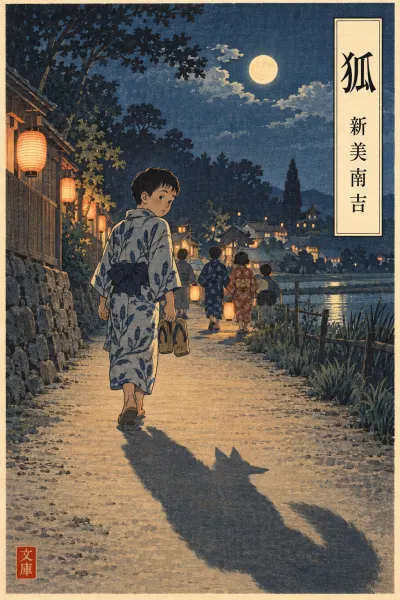
 N4 · easy
Simplified retelling · JLPT N4
狐 Kitsune in easy Japanese (N4)
This is our own simplified retelling of The Fox in the New Clogs, written for N4 learners and checked word by word against the N4 vocabulary list. A few story words and grammar patterns go beyond N4; the notes below give each one's level. It keeps the characters, events and ending of the original. When it feels easy, move on to the original text.
The story in brief
Seven children walk to a festival in the next town, and on the way they buy new clogs for Bunroku. An old woman warns that wearing new clogs at night lets a fox get into your body, and when Bunroku coughs 'kon' on the way home, the other children are afraid of him and leave him to walk home alone. In bed, Bunroku asks his mother what she would do if he became a fox, and she answers that she would give her own life to let him escape.
AI translation · independently checked
月のきれいな夜でした。It was a night with a lovely moon.
七人の子どもが、となりの町のおまつりを見に、道を歩いていました。Seven children were walking along the road to see the festival in the next town.
一人の子どもが、おくれました。One of the children fell behind.
文六ちゃんです。It was little Bunroku.
「文六ちゃん、早く来い。」"Bunroku, hurry up and come on!"
「でも、ぼく、お母ちゃんのげただもん。」"But I'm wearing my mom's clogs!"
文六ちゃんの足には、大人の大きなげたがありました。On Bunroku's feet were a grown-up's big wooden clogs.
町に入って、みんなはげたの店に入りました。When they reached the town, everyone went into the clog shop.
文六ちゃんのお母さんに、新しいげたを買うようにたのまれていたのです。Bunroku's mother had asked them to buy him a new pair of clogs.
よしのりくんが、お父さんのように、文六ちゃんの足にげたをあわせてあげました。Yoshinori fitted the clogs to Bunroku's feet for him, just like a father would.
文六ちゃんは一人っ子で、みんなの中で小さい子でした。Bunroku was an only child, and he was the little one of the group.
そのとき、おばあさんが店に入ってきて、言いました。Just then, an old woman came into the shop and said:
「夜に新しいげたをはくと、きつねが体の中に入るよ。」"If you put on new clogs at night, a fox will get into your body."
みんなはびっくりしました。Everyone was startled.
「うそだ。」とよしのりくんが言いました。"That's a lie," said Yoshinori.
でも、みんな少ししんぱいなかおでした。But everyone looked a little worried.
店のおばさんがわらいました。The woman who ran the shop laughed.
「じゃあ、おまじないをしてあげよう。」おばさんはマッチをするまねをして、げたにちょっとさわりました。"Well then, I'll say a charm for you." She pretended to strike a match and touched the clogs lightly.
「さあ、これでだいじょうぶ。」"There now, that'll keep you safe."
おまつりはにぎやかでした。The festival was lively and full of noise.
夜おそく、子どもたちはにんぎょうのおどりを見ました。Late at night, the children watched the puppets dance.
にんぎょうは目をぱちぱちしました。The puppet blinked its eyes.
それから急に赤い口を開けて、したを出しました。Then all at once it opened its red mouth and stuck out its tongue.
うしろの人がいとをひいているのです。A person behind it was pulling the strings.
みんなそれを知っていました。Everyone knew that.
でも、くらいあかりの中で、にんぎょうは生きているようで、こわかったです。But in the dim light, the puppet seemed to be alive, and it was frightening.
みんなは、文六ちゃんのげたのことを思い出しました。Everyone remembered Bunroku's clogs.
帰りの道は、みんなだまって歩きました。On the way home, they all walked in silence.
一人の子が、となりの子のみみに何か話しました。One child whispered something into the ear of the child next to him.
その子はまた、ほかの子に話しました。That child passed it on to another.
文六ちゃんのほかは、みんな聞きました。Everyone heard it except Bunroku.
「おばさんは、ほんとうにマッチをすらなかった。まねをしただけだ。」"The shop lady didn't really strike a match. She only pretended to."
いけのそばで、文六ちゃんが「コン」と小さいせきをしました。Beside the pond, Bunroku gave a small cough: "Kon."
「コン。」またしました。"Kon." He did it again.
それはきつねのこえのようでした。It sounded just like a fox's cry.
文六ちゃんはきつねになった、とみんなは思いました。Bunroku has turned into a fox, everyone thought.
いつもは、みんながすいしゃのところから、文六ちゃんを家まで送ってあげます。Usually, the others walked Bunroku home from the water mill.
でも、今夜はだれも送りませんでした。But tonight, nobody went with him.
文六ちゃんがこわかったのです。They were afraid of Bunroku.
文六ちゃんは、やさしいよしのりくんは来てくれると思って、何度もうしろを見ました。Bunroku kept looking back again and again, thinking that kind Yoshinori would surely come with him.
でも、だれも来ませんでした。But nobody came.
いつもなら、よしのりくんはさむいとき上着を貸してくれます。Usually, when it was cold, Yoshinori would lend him his jacket.
でも今夜は、文六ちゃんがせきをしても、貸してくれませんでした。But tonight, even when Bunroku coughed, he did not lend it to him.
文六ちゃんは、みんなの話がわかっていました。Bunroku understood what the others had been whispering about.
一人で道を下りながら、さびしくなりました。As he went down the road all by himself, he grew lonely.
「ぼくはほんとうにきつねになったのかな。そうしたら、お父さんとお母さんはどうするだろう。」"Did I really turn into a fox? If I did, what will Dad and Mom do?"
その夜、お父さんはまだ帰っていませんでした。That night, his father had not come home yet.
文六ちゃんはお母さんといっしょにねました。Bunroku went to bed together with his mother.
「お母ちゃん、夜に新しいげたをはくと、きつねが入るの?」"Mom, if you put on new clogs at night, does a fox get into you?"
「うそだよ。むかしの人がそう言っただけ。」"That's not true. It's only something people said in the old days."
「もし、ぼくがきつねになったら、どうする?」"What if I turned into a fox? What would you do?"
お母さんはわらって、少し考えました。His mother laughed and thought for a moment.
「そうしたら、家にはおけないね。お父さんとお母さんも新しいげたをはいて、きつねになるよ。三人で山へ行こう。」"Well then, we couldn't keep you in the house, could we? Your father and I would put on new clogs too and turn into foxes. The three of us would go off to the hills."
「りょうしが来たら?」"What if a hunter came?"
「ふかいあなの中で、三人で小さくなっていよう。」"The three of us would curl up small inside a deep hole."
「食べ物をさがしに出て、犬に見つかったら?」"What if we went out looking for food and a dog found us?"
「走ってにげよう。お父さんとお母さんが手をひいてあげるよ。」"We'd run away. Your father and I would hold your hands and pull you along."
「それでも犬がすぐうしろに来たら?」"But what if the dog got right behind us?"
お母さんは少しだまりました。His mother was quiet for a little while.
それから、まじめなこえで言いました。Then she spoke in a serious voice.
「そうしたら、お母さんは足をひきずって、ゆっくり歩くよ。犬とりょうしがお母さんをつかまえる間に、あなたとお父さんはにげるのよ。」"Then I'd drag my leg and walk slowly. While the dog and the hunter were catching me, you and your father would get away."
「いやだよ。お母ちゃんがいなくなるじゃないか。」"No! Then you'd be gone, Mom!"
「でも、そうするしかないよ。お母さんはゆっくり、ゆっくり……」"But there'd be nothing else to do. I'd walk slowly, slowly..."
「いやだ、いやだ、いやだ!」"No, no, no!"
文六ちゃんはなきながら、お母さんにしがみつきました。Crying, Bunroku clung tightly to his mother.
お母さんの目にも、なみだがありました。There were tears in his mother's eyes too.
お母さんは、文六ちゃんのまくらをひろって、あたまの下に入れてあげました。His mother picked up Bunroku's pillow and tucked it back under his head.
Vocabulary
| Word | Meaning | JLPT |
|---|---|---|
| げたげた | geta, traditional wooden clogsdictionary form: 下駄Japanese sandals with a wooden sole raised on two supports. They are held on by a cloth thong between the toes. Usually written in kana. | N2 |
| おくれましたおくれる | to fall behind; to be latedictionary form: 遅れるHere it means to lag behind the group. | N4 |
| たのまれていたたのむ | to ask (someone to do something)dictionary form: 頼むPassive form here: they had been asked. | N5 |
| あわせてあわせる | to fit, to match (one thing to another)dictionary form: 合わせるAにBをあわせる: to fit B to A. | N3 |
| 一人っ子ひとりっこ | only child | — |
| おまじないおまじない | charm, good-luck spellA small magic act or word said for protection or luck. | — |
| まねまね | pretending, imitationdictionary form: 真似〜まねをする means to pretend to do something, or to copy it. | N3 |
| にぎやかにぎやか | lively, busy, full of people and noisedictionary form: 賑やかA na-adjective. | N5 |
| だまってだまる | to be silent, to say nothingdictionary form: 黙るだまって歩く means to walk without talking. | N3 |
| 送っておくる | to see (someone) home, to walk someone somewheredictionary form: 送る送る means to send, but with a person as the object it means to take or walk them somewhere. | N4 |
| 上着うわぎ | jacket, outer garment | N5 |
| りょうしりょうし | hunterdictionary form: 猟師Don't confuse it with 漁師 (fisherman), which has the same reading. | — |
| にげようにげる | to run away, to escapedictionary form: 逃げる | N4 |
| しがみつきましたしがみつく | to cling to, to hold on tightlydictionary form: しがみつくTakes に: お母さんにしがみつく. | — |
Grammar
〜ように頼まれる N3 to be asked to do something
Verb (dictionary form) + ように + 頼む means 'ask someone to do'. Here 頼む is in the passive, so the children are the ones who were asked, by Bunroku's mother (に).
文六ちゃんのお母さんに、新しいげたを買うようにたのまれていたのです。
Bunroku's mother had asked them to buy him a new pair of clogs.
〜と (conditional) N4 when / if (then always ...)
Dictionary form + と shows a result that always or naturally follows. It is often used for rules, habits and sayings like this superstition.
夜に新しいげたをはくと、きつねが体の中に入るよ。
If you put on new clogs at night, a fox will get into your body.
〜てくれる / 〜てあげる N4 to do something for someone
てくれる is used when someone does something for the speaker's side, here for Bunroku. てあげる is used when the subject does something for another person, as in 足にげたをあわせてあげました.
いつもなら、よしのりくんはさむいとき上着を貸してくれます。
Usually, when it was cold, Yoshinori would lend him his jacket.
〜ようだ / 〜ようで N4 seems like, looks as if
Plain form + ようだ expresses an impression: the puppet seemed alive. ようで is the connecting (te-like) form, and it links to the next part of the sentence, こわかった.
くらいあかりの中で、にんぎょうは生きているようで、こわかったです。
In the dim light, the puppet seemed to be alive, and it was frightening.
〜ながら N4 while doing
Verb masu-stem + ながら means that one person does two actions at the same time. The main action comes at the end of the sentence.
文六ちゃんはなきながら、お母さんにしがみつきました。
Crying, Bunroku clung tightly to his mother.
〜しかない N3 there is no choice but to ...
Dictionary form + しかない means that this is the only possible thing to do. The mother is saying that she would have no other choice.
でも、そうするしかないよ。
But there'd be nothing else to do.