Intermediate · JLPT N3
狐Kitsune — The Fox in the New Clogs
- JLPT N3
- 6,230 characters
- 5 parts
- about 52 minutes
- 2 easier versions
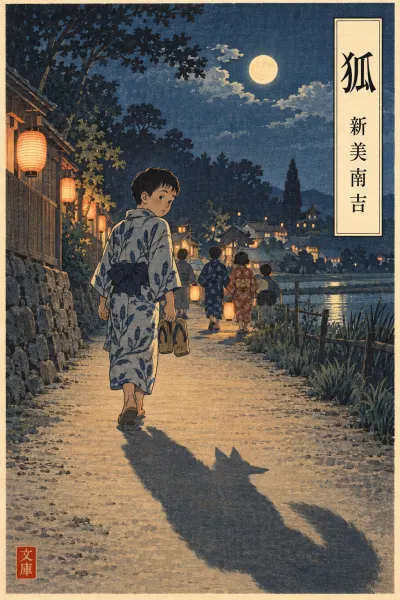
"Fox" is a short story for children by Niimi Nankichi, told in five brief parts. On a moonlit spring evening, a group of village children walk to a night festival in the neighbouring town of Hongō. On the way, little Bunroku, who has been stumbling along in his mother's oversized clogs, gets a new pair. An old woman remarks that a fox will possess anyone who puts on new clogs at night. That remark follows the children through the lantern-lit festival and down the long road home, until a small cough turns a superstition into something that genuinely hurts. The story is quiet and closely observed. Its drama lies in what the children whisper to each other and in what Bunroku understands without being told, and its closing scene between a boy and his mother is quietly moving. For learners, the narration is gentle and regular, in polite です/ます with the storyteller's 〜ておりました. The harder part is the dialogue. The children speak a rural dialect with forms such as げな, だに and a negative ending in 〜しん. These are not in textbooks, but they recur often enough to become familiar.
Contents
Easier versions
This story is also retold in simpler Japanese. Reading an easier version first makes the original much more approachable.
Before you read
- Separate the two voices. The narration is standard polite Japanese, often ending in 〜ておりました (a humble, storytelling form of 〜ていました). The dialogue is rural dialect. When a line of speech is hard to follow, read the surrounding narration first, because it usually tells you what is happening.
- Learn the dialect markers before you start. げな and 〜というだに mean 'they say' or 'apparently', which matters in a story driven by rumour. だに is roughly だよ. 〜で can mean から ('because'). 晩げ means 晩 ('evening'). Negatives such as 〜しん and 〜しやしん correspond to 〜しない and 〜しはしない.
- Watch for expressions of uncertainty and appearance: 〜とも〜ともつかぬ ('neither quite A nor B'), 〜としか思えない ('can only seem like') and 〜がち ('tending to'). The story is about what the children think they see, so these phrases carry much of its tension.
- Learn a few key words first: 下駄 (げた, clogs), 狐 (きつね, fox), 狐につかれる / 憑く (つく, to be possessed), 祭 (まつり, festival), 提灯 (ちょうちん, lantern), 水車 (すいしゃ, water mill) and 猟師 (りょうし, hunter). They recur throughout and anchor each scene.
- In parts 4 and 5, follow the mother's replies closely. She answers Bunroku's fears by playing along rather than denying them. The meaning of the ending depends on noticing the shift from her teasing tone to something more serious.
Words to know
The most useful words from the notes across the story.
| Word | Meaning | JLPT |
|---|---|---|
| おろすおろす | to use or wear something new for the first timedictionary form: 下ろすThis is a special sense of the verb. Compare 新しい靴をおろす, 'to break in new shoes'. | N3 |
| 月夜つきよ | moonlit nightA common literary word; the story is set under the moon from the very first line. | — |
| 半里はんり | half a ri (about 2 km)里 is an old unit of distance of roughly 3.9 km. | — |
| 甘えん坊あまえんぼう | a spoiled, clingy child; a big babyFrom 甘える, to depend on someone's indulgence. | — |
| 稚児ちご | a child in costume who takes part in a festival or ceremonyHere, a festival dancer; さん is added affectionately. | — |
| いっしょうけんめいいっしょうけんめい | with all one's might, as hard as one candictionary form: 一生懸命 | N4 |
| 影かげ | shadowCan also mean silhouette or reflection, depending on context. | N3 |
| つくつく | (of a spirit) to possess someoneOften written 憑く. 狐がつく means 'to be possessed by a fox'. | N3 |
| 組合くみあい | guild, association, union | N3 |
| 餌えさ | food (for animals), feedUsed for animals' food or for bait. It is not used for human meals. | N3 |
| なしなし | gone, nothingdictionary form: 無しなしになる means "to be lost" or "to cease to exist". | N3 |
| 下駄げた | geta, wooden clogsTraditional wooden sandals raised on two teeth; counted with 足 (いっそく, にそく). | N2 |
| 迷信めいしん | superstition | N2 |
| とりまかれたとりまく | to surround, to ringdictionary form: 取り巻くPassive here: the pond is 'surrounded' by peach trees. | N1 |
| かえりみてかえりみる | to look back at; to pay attention to, care aboutdictionary form: 顧みるLiterary; here both literally looking back and showing concern. | N1 |
Plot summary
Show the full summary (contains spoilers)
Seven village children walk by moonlight to a night festival in Hongō, stopping to buy new clogs for Bunroku. An old woman warns that new clogs worn at night invite a fox to possess you, and the shopkeeper performs a playful charm. At the festival, a puppet that suddenly sticks out its red tongue unsettles the children, and on the way home they whisper that the charm was only pretend. When Bunroku gives a cough that sounds like a fox's "kon", they decide he is possessed. At the water mill nobody walks him home, not even kind Yoshinori. Hurt, Bunroku goes home alone and asks his mother what she would do if he became a fox. She says she and his father would become foxes too, and that if a hunter's dog chased them she would limp behind so the others could escape. Bunroku clings to her in tears, and she quietly wipes her own eyes.
About the author
Niimi Nankichi was a Japanese writer of children's stories, poems and songs from Handa in Aichi Prefecture. The countryside of that area is widely thought to lie behind the village and hills of Gongitsune. He began writing as a young man. Gongitsune appeared in the children's magazine Akai Tori (The Red Bird), edited by Suzuki Miekichi. Niimi later worked as a teacher at a girls' school while continuing to write. His health was poor, and he died of tuberculosis while still in his twenties. Many of his works were published and became widely known only after his death. Besides Gongitsune, he is especially remembered for Tebukuro wo Kai ni (Buying Mittens).