Part 1 of 5 · JLPT N3
狐 Kitsune, part 1: New Clogs on a Festival Night
In this part
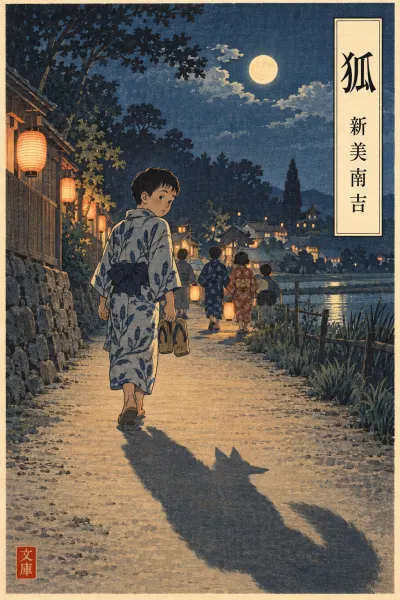
On a moonlit spring night, seven village children walk to the night festival in the town of Hongō. On the way they stop at a clog shop to buy new clogs for little Bunroku, who has been stumbling along in his mother's big ones. An old woman warns that a fox will possess anyone who puts on new clogs at night, and the shopkeeper performs a playful charm to protect him before the children go on to watch the festival dances.
AI translation · independently checked
一One
月夜に七人の子供が歩いておりました。On a moonlit night, seven children were walking along.
大きい子供も小さい子供もまじっておりました。There were big children and little children among them.
月は、上から照らしておりました。The moon was shining down from overhead.
子供たちの影は短かく地べたにうつりました。The children's shadows fell short upon the bare ground.
子供たちはじぶんじぶんの影を見て、ずいぶん大頭で、足が短いなあと思いました。Looking at their own shadows, the children thought, "What big heads we have, and what short legs!"
そこで、おかしくなって、笑い出す子もありました。Some of them found it so funny that they burst out laughing.
あまりかっこうがよくないので二、三歩はしって見る子もありました。Others, since the shapes did not look very handsome, tried running a few steps to see what happened.
こんな月夜には、子供たちは何か夢みたいなことを考えがちでありました。On moonlit nights like this, the children tended to think dreamlike thoughts.
子供たちは小さい村から、半里ばかりはなれた本郷へ、夜のお祭を見にゆくところでした。The children were on their way from their little village to Hongō, about half a ri away, to see the night festival.
切通しをのぼると、かそかな春の夜風にのって、ひゅうひゃらりゃりゃと笛の音が聞えて来ました。As they climbed up through the cutting, the sound of flutes, hyuu-hyara-rya-rya, came to them on the faint spring night breeze.
子供たちの足はしぜんにはやくなりました。Of their own accord, the children's steps quickened.
すると一人の子供がおくれてしまいました。Then one of the children fell behind.
「文六ちゃん、早く来い」"Bunroku, hurry up!"
とほかの子供が呼びました。called the other children.
文六ちゃんは月の光でも、やせっぽちで、色の白い、眼玉の大きいことのわかる子供です。Bunroku was a child who, even by moonlight, you could tell was skinny and pale, with great big eyes.
できるだけいそいでみんなに追いつこうとしました。He tried as hard as he could to hurry and catch up with the others.
「んでも俺、おっ母ちゃんの下駄だもん」"But I've got my mum's clogs on!"
と、とうとう鼻をならしました。he said at last, sniffling.
なるほど細長いあしのさきには大きな、大人の下駄がはかれていました。Sure enough, on the ends of his long thin legs he was wearing a pair of big, grown-up clogs.
二Two
本郷にはいるとまもなく、道ばたに下駄屋さんがあります。Soon after you enter Hongō, there is a clog shop by the side of the road.
子供たちはその店にはいってゆきました。The children went into that shop.
文六ちゃんの下駄を買うのです。They were going to buy clogs for Bunroku.
文六ちゃんのお母さんに頼まれたのです。Bunroku's mother had asked them to.
「あののイ、小母さん」"Say, ma'am, listen,"
と、義則君が口をとがらして下駄屋の小母さんにいいました。said Yoshinori to the woman who kept the clog shop, pushing out his lips.
「こいつのイ、樽屋の清さの子供だけどのイ、下駄を一足やっとくれや。あとから、おっ母さんが銭もってくるげなで」"This one here, see, he's the kid of Sei-sa the barrel-maker, and, see, could you give him a pair of clogs? His mum says she'll bring the money round later."
みんなは、樽屋の清さの子供がよく見えるように、まえへ押しだしました。Everyone pushed the barrel-maker Sei-sa's child to the front, so that she could get a good look at him.
それは文六ちゃんでした。It was Bunroku.
文六ちゃんは二つばかり眼ばたきしてつっ立っていました。Bunroku blinked a couple of times and stood there stock-still.
小母さんは笑い出して、下駄を棚からおろしてくれました。The woman burst out laughing and took some clogs down from the shelf for him.
どの下駄が足によくあうかは、足にあてて見なければわかりません。You cannot tell which clogs fit a foot well unless you hold them up against it.
義則君が、お父さんか何ぞのように、文六ちゃんの足に下駄をあてがってくれました。Yoshinori, just as if he were Bunroku's father or someone like that, fitted the clogs to Bunroku's feet for him.
何しろ文六ちゃんは、一人きりの子供で、甘えん坊でした。After all, Bunroku was an only child, and a bit of a baby.
ちょうど文六ちゃんが、新しい下駄をはいたときに、腰のまがったお婆さんが下駄屋さんにはいって来ました。Just as Bunroku had put on his new clogs, an old woman with a bent back came into the clog shop.
そしてお婆さんはふとこんなことをいうのでした。And the old woman happened to say something like this:
「やれやれ、どこの子だか知らんが、晩げに新しい下駄をおろすと狐がつくというだに」"Oh dear, oh dear, I don't know whose child that is, but they do say if you put on new clogs at night, a fox will get into you."
子供たちはびっくりしてお婆さんの顔を見ました。The children were startled and looked at the old woman's face.
「嘘だい、そんなこと」"That's a lie, that is!"
とやがて義則君がいいました。said Yoshinori after a moment.
「迷信だ」"It's a superstition."
とほかの一人がいいました。said another of them.
それでも子供たちの顔には何か心配な色がただよっていました。Even so, a look of worry hung about the children's faces.
「ようし、そいじゃ、小母さんがまじないしてやろう」"All right then, I'll do a charm for him!"
と、下駄屋の小母さんが口軽くいいました。said the woman of the clog shop lightly.
小母さんは、マッチを一本するまねして、文六ちゃんの新しい下駄のうらに、ちょっと触りました。She pretended to strike a match and touched it for a moment to the soles of Bunroku's new clogs.
「さあ、これでよし。これでもう、狐も狸もつきゃしん」"There, that's done it. Now no fox or tanuki will ever get into you."
そこで子供たちは下駄屋さんを出ました。And so the children left the clog shop.
三Three
子供たちは綿菓子を喰べながら、稚児さんが二つの扇を、眼にもとまらぬ速さでまわしながら、舞台の上で舞うのを見ていました。Eating cotton candy, the children watched a festival child dancing on the stage, twirling two fans so fast the eye could not follow them.
その稚児さんは、お白粉をぬりこくって顔をいろどっているけれど、よく見ると、お多福湯のトネ子でありましたので、That dancer had her face thickly painted with white powder, but when they looked closely, it was Toneko from the Otafuku-yu bathhouse, and so,
Vocabulary
| Word | Meaning | JLPT |
|---|---|---|
| 月夜つきよ | moonlit nightA common literary word; the story is set under the moon from the very first line. | — |
| 影かげ | shadowCan also mean silhouette or reflection, depending on context. | N3 |
| 地べたじべた | the bare groundColloquial word for the ground's surface, often with a homely feel. | — |
| 半里はんり | half a ri (about 2 km)里 is an old unit of distance of roughly 3.9 km. | — |
| 切通しきりどおし | a cutting; a road cut through a hillFrom 切る (cut) + 通す (pass through). | — |
| かそかなかそか | faint, dim (literary variant of かすか)dictionary form: かそかOld-fashioned variant of かすか. | — |
| 下駄げた | geta, wooden clogsTraditional wooden sandals raised on two teeth; counted with 足 (いっそく, にそく). | N2 |
| 口をとがらしてくちをとがらす | to push out one's lips; to pout (here, speaking insistently or with a pout)dictionary form: 口をとがらすOften shows sulking, but here it suggests a child speaking earnestly and importantly. | — |
| 甘えん坊あまえんぼう | a spoiled, clingy child; a big babyFrom 甘える, to depend on someone's indulgence. | — |
| つくつく | (of a spirit) to possess someoneOften written 憑く. 狐がつく means 'to be possessed by a fox'. | N3 |
| 迷信めいしん | superstition | N2 |
| まじないまじない | a charm, a spellまじないをする = to perform a charm to ward off bad luck. | — |
| 稚児ちご | a child in costume who takes part in a festival or ceremonyHere, a festival dancer; さん is added affectionately. | — |
| 白粉おしろい | white face powderUsually written お白粉 or おしろい; the お is part of the word. | — |
Grammar
〜ておりました N4 was doing (humble or polite progressive, past)
おる is the humble or formal equivalent of いる. The narrator uses 〜ておりました instead of 〜ていました, which gives the story a gentle, old-fashioned storytelling tone.
月夜に七人の子供が歩いておりました。
On a moonlit night, seven children were walking along.
〜がち N3 tend to; be apt to
Added to a verb stem, がち shows that something happens often or easily. Here the children are prone to dreamy thoughts on moonlit nights.
子供たちは何か夢みたいなことを考えがちでありました。
The children tended to think dreamlike thoughts.
〜ところでした N4 was in the middle of / on the way to doing
When it follows a dictionary-form verb, ところ describes the point in time when an action is about to happen or is under way. 見にゆくところ means 'on their way to go and see'.
夜のお祭を見にゆくところでした。
They were on their way to see the night festival.
〜げなで / 〜というだに N1 they say, so… (dialect hearsay)
In this dialect, げな reports something the speaker has heard, like standard そうだ, and the で that follows means 'so' (standard から). In the old woman's というだに, だに is a dialect sentence ending that means roughly 'you know'.
あとから、おっ母さんが銭もってくるげなで
His mum says she'll bring the money round later.
〜なければわかりません N4 you can't tell unless you…
The negative conditional 〜なければ followed by わからない means that knowing something depends on doing the action first.
足にあてて見なければわかりません。
You cannot tell unless you hold them up against the foot.
〜きゃしん N1 will certainly not (dialect emphatic negative)
つきゃしん is a contraction of つきはしない. The は adds emphasis, and しん is the local form of しない.
これでもう、狐も狸もつきゃしん
Now no fox or tanuki will ever get into you.