 N5 · easy
Simplified retelling · JLPT N5
狐 Kitsune in easy Japanese (N5)
This is our own simplified retelling of The Fox in the New Clogs, written for N5 learners and checked word by word against the N5 vocabulary list. A few story words and grammar patterns go beyond N5; the notes below give each one's level. It keeps the characters, events and ending of the original. When it feels easy, move on to the N4 version or the original text.
The story in brief
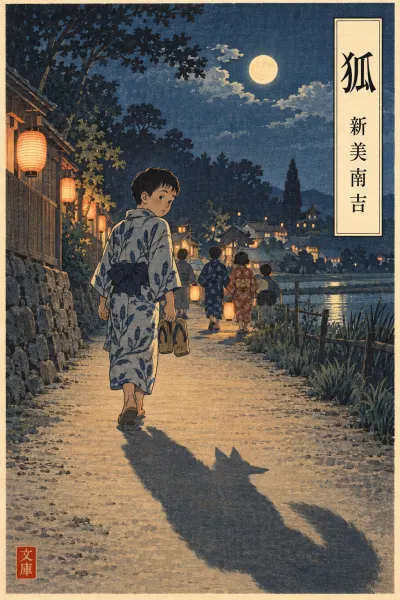
Seven children go to a night festival in the next town, and on the way they buy new clogs for Bunroku. An old woman warns that children who put on new clogs at night turn into foxes, and when Bunroku coughs "kon" on the way home, the frightened children leave him to walk home alone. In bed, Bunroku asks his mother what she would do if he became a fox, and she says she would become a fox too and even let the dogs catch her so that he could escape, and they both cry.
AI translation · independently checked
はるの よるです。It is a spring night.
七人の 子どもが、となりの まちの おまつりに 行きます。Seven children are going to the festival in the next town.
そとは とても あかるいです。Outside, it is very bright.
ぶんろくちゃんは 一人だけ おそいです。Only Bunroku is slow.
「はやく 来て。」と、みんなが よびました。"Hurry up and come!" everyone called.
「でも、これは お母さんの げただから。」ぶんろくちゃんの あしには、大人の 大きな げたが ありました。"But these are my mom's clogs." On Bunroku's feet were a grown-up's big clogs.
まちの げたの みせで、みんなは ぶんろくちゃんの あたらしい げたを かいました。At the clog shop in town, everyone bought new clogs for Bunroku.
ぶんろくちゃんの お母さんが たのんだからです。That was because Bunroku's mother had asked them to.
そこへ、おばあさんが 入って 来て、いいました。Just then an old woman came in and said,
「よる、あたらしい げたを はく 子どもは、きつねに なりますよ。」子どもたちは すこし こわく なりました。"Children who put on new clogs at night turn into foxes, you know." The children grew a little scared.
みせの おばさんは マッチを 出して、げたの 下に ちょっと つけました。The woman who kept the shop took out a match and touched it lightly to the bottom of the clogs.
「さあ、これで だいじょうぶ。」"There now, that'll make it all right."
おまつりは たのしかったです。The festival was great fun.
でも、よる おそく、大きな にんぎょうが あかい くちを あけました。But late in the night, a big puppet opened its red mouth.
子どもたちは また こわく なりました。The children grew scared again.
みんな、あの おばあさんの 話を まだ わすれて いませんでした。None of them had forgotten what the old woman had said.
かえる みちでは、みんな しずかでした。On the way home, everyone was quiet.
一人の 子どもが、ほかの 子どもに 小さい こえで いいました。One of the children spoke to the others in a small voice.
「おばさんは、ほんとうは マッチを つけませんでしたよ。」ぶんろくちゃんの ほかは、みんな この 話を 聞きました。"You know, the shop lady didn't really put the match to them." Everyone except Bunroku heard this.
いけの そばで、ぶんろくちゃんが 「コン。」と せきを しました。Beside the pond, Bunroku gave a cough: "Kon."
「コン。」また いいました。"Kon." He did it again.
「きつねの こえだ。ぶんろくちゃんは もう きつねだ。」みんな、とても こわく なりました。"That's a fox's voice. Bunroku's already a fox!" Everyone became very frightened.
いつも みんなは、ぶんろくちゃんと いっしょに いえの 前まで 行きます。Usually they all walked with Bunroku as far as the front of his house.
でも、今日は だれも 行きませんでした。But today, nobody went with him.
さむい 日に うわぎを かす よしのりくんも、来ませんでした。Even Yoshinori, who lends his jacket on cold days, did not come.
ぶんろくちゃんは 一人で ほそい みちを かえりました。Bunroku went home alone along the narrow path.
ぶんろくちゃんは、みんなの 話を 知って いました。Bunroku knew what the others had been saying.
その よる、お父さんは まだ かえりません。That night, his father had not come home yet.
ぶんろくちゃんは お母さんと いっしょに ねました。Bunroku went to bed with his mother.
「お母さん、よる あたらしい げたを はく 子どもは、きつねに なりますか。」"Mom, do children who put on new clogs at night turn into foxes?"
「いいえ、それは うそですよ。」"No, that's just a made-up story."
「でも、ぼくが ほんとうに きつねに なったら、どう しますか。」"But if I really did turn into a fox, what would you do?"
「お父さんと お母さんも あたらしい げたを かって、きつねに なりますよ。そして、三人で 山へ 行きましょう。」"Your father and I would buy new clogs too, and we'd turn into foxes as well. And then the three of us would go off to the mountains together."
「りょうしが 来たら?」"What if a hunter came?"
「山の 中で 小さく なって いましょう。」"We'd keep ourselves small in the mountains."
「いぬが 来たら?」"What if a dog came?"
「三人で はしって にげましょう。」"The three of us would run away."
「でも、ぼくは 小さいから、おそいです。」"But I'm little, so I'm slow."
「お父さんと お母さんが てを ひきますよ。」"Your father and I will take you by the hand."
「でも、いぬが すぐに うしろに 来たら?」"But what if the dogs came right up behind us?"
お母さんは すこし しずかでした。His mother was quiet for a little while.
それから、しずかな こえで いいました。Then she spoke in a soft voice.
「お母さんは ゆっくり あるきます。いぬは お母さんを かみます。でも、お父さんと ぶんろくちゃんは にげますよ。」"I would walk slowly. The dogs would bite me. But your father and you would get away."
ぶんろくちゃんは 大きな めで お母さんを 見ました。Bunroku looked at his mother with his big eyes.
「いやだ。お母さんが いなく なるよ。」"No! Then you'd be gone!"
「でも、お母さんは ゆっくり、ゆっくり あるきます。」"But I would walk slowly, ever so slowly."
「いやだ、いやだ、いやだ!」"No, no, no!"
ぶんろくちゃんは お母さんの からだに あたまを つけました。Bunroku pressed his head against his mother.
なみだが たくさん 出ました。Tears poured out.
お母さんの めにも、なみだが ありました。There were tears in his mother's eyes, too.
Vocabulary
| Word | Meaning | JLPT |
|---|---|---|
| げたげた | geta, wooden clogsTraditional Japanese wooden sandals raised on two wooden teeth. Kanji: 下駄. | N2 |
| おまつりおまつり | festivalお is a polite prefix. Kanji: お祭り. | N4 |
| よびましたよぶ | to call (out to someone)dictionary form: よぶ | N5 |
| たのんだたのむ | to ask (someone to do something)dictionary form: たのむThe plain past of たのむ is たのんだ. | N5 |
| こわくこわい | scared; scarydictionary form: こわいIt can mean both 'afraid' and 'frightening'. | N4 |
| わすれてわすれる | to forgetdictionary form: わすれる | N5 |
| せきせき | a coughIt is used as せきを する, 'to cough'. コン is both a cough sound and the cry of a fox. | N3 |
| うそうそ | a lie; not true | N4 |
| りょうしりょうし | hunterKanji: 猟師. | N2 |
| にげましょうにげる | to run away, to escapedictionary form: にげる | N4 |
| ひきますひく | to pull; (てを ひく) to lead by the handdictionary form: ひく | N5 |
| かみますかむ | to bitedictionary form: かむ | N4 |
| なみだなみだ | tearsIt is used as なみだが 出る, 'tears come out'. | N3 |
Grammar
い-adjective(〜く)+ なる N5 to become ~
To use なる with an い-adjective, change the final い to く. こわい becomes こわく なりました, 'became scared'.
子どもたちは すこし こわく なりました。
The children grew a little scared.
〜から(です) N5 because ~
から gives a reason. Ending a sentence with 〜からです explains the reason for what came just before it.
ぶんろくちゃんの お母さんが たのんだからです。
That was because Bunroku's mother had asked them to.
〜だけ N5 only ~
だけ comes right after a noun and limits the sentence to it. 一人だけ means 'only one person'.
ぶんろくちゃんは 一人だけ おそいです。
Only Bunroku is slow.
〜て いる / 〜て いません N5 state or ongoing action
The て-form plus いる shows a continuing state. The negative form まだ わすれて いませんでした means 'still had not forgotten'.
みんな、あの おばあさんの 話を まだ わすれて いませんでした。
None of them had forgotten what the old woman had said.
〜ましょう N5 let's ~
The ます-stem plus ましょう makes a suggestion to do something together. Here the mother uses it to describe what the family would do.
三人で はしって にげましょう。
The three of us would run away.
〜たら? N4 what if ~?
たら means 'if' or 'when'. When a sentence stops after たら with a question tone, it means 'What if ~ (happens)?', and the rest of the question is left out.
「りょうしが 来たら?」
"What if a hunter came?"