Advanced · JLPT N1
蜘蛛の糸Kumo no Ito — A Thread of Spider Silk
- JLPT N1
- 2,865 characters
- 3 parts
- about 24 minutes
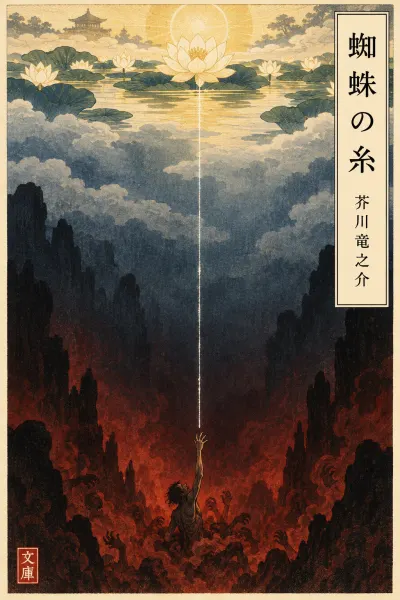
"A Thread of Spider Silk" (蜘蛛の糸) is a short Buddhist fable by Akutagawa Ryūnosuke, written in 1918 for the children's magazine Akai Tori. One morning the Buddha strolls beside the lotus pond of Paradise and looks down through the clear water to the bottom of Hell. There he sees Kandata, a robber and murderer, and remembers that this cruel man once did a single small kindness: he spared a spider. The story then follows a thin spider's thread stretched between the two worlds, and what Kandata does with it. The tone is calm and measured, like a tale told aloud. The quiet beauty of Paradise stands against the darkness of the Pool of Blood and the Mountain of Needles. For learners, the text is short and the plot easy to follow, but the language is demanding. The narrator uses very polite storyteller Japanese (でございます, 居ります), the Buddha is always spoken of with honorifics, and Kandata's few lines are coarse and blunt. Working through it trains you to recognise several registers of Japanese in a single compact text.
Contents
Before you read
- Get used to the narrator's formal storytelling endings before you start: でございます (= です), 居ります (= いる, polite), 致す (= する, humble), 申す (= 言う, humble). They appear on almost every line, and once you recognise them the sentences become much simpler.
- Watch for honorifics whenever the Buddha is the subject: 御覧になる (= 見る), 思召す (= 思う), and the pattern 御〜になる. These often replace an explicit subject, so they tell you who is acting.
- Kandata speaks in a completely different register. 己 is read おれ here (not おのれ). He also uses rough words like こら and 罪人ども, and bare imperatives such as 下りろ. Compare his lines with the narrator's to feel the contrast.
- Learn the setting vocabulary first, because it recurs throughout: 極楽 (Paradise), 地獄 (Hell), 蓮 / 蓮池 (lotus / lotus pond), 蜘蛛 (spider), 糸 (thread), 罪人 (sinner), 血の池 (Pool of Blood), 針の山 (Mountain of Needles).
- The text uses older kanji spellings and many onomatopoeic words. Keep the furigana on at first, and treat sound words (for example ぷつり for a snapping sound) as part of the imagery rather than skipping them.
Words to know
The most useful words from the notes across the story.
| Word | Meaning | JLPT |
|---|---|---|
| 絶間なくたえまない | without a break, ceaselesslydictionary form: 絶え間ないUsually written 絶え間なく today; 間 is the gap or pause that never comes. | — |
| 罪人ざいにん | sinner, criminal罪 = sin, crime. | — |
| 午ひる | noonThe kanji comes from the hour of the Horse, which was midday. Compare 午前 (a.m.) and 午後 (p.m.). | N5 |
| 泥坊どろぼう | thief, robberdictionary form: 泥棒Older spelling; today written 泥棒. | N4 |
| 容子ようす | state of things, appearance, scenedictionary form: 様子Older spelling of 様子. | N3 |
| 沈んでしずむ | to sinkdictionary form: 沈むIt is also used for the sun setting and for low spirits. | N3 |
| 相当そうとう | fitting, corresponding toIn 心相当な罰, it means 'a punishment matching that heart'. In modern speech it also often means 'considerably'. | N3 |
| 早速さっそく | at once, immediately | N2 |
| 溢れてあふれる | to overflow, to spill outdictionary form: 溢れるIt can be used for water, tears, feelings, or, as here, a fragrance. | N2 |
| ぶらぶらぶらぶら | (walking) idly, leisurely, without a set purposeMimetic word, often used with 歩く. | N1 |
| 地獄じごく | HellKey story word, the opposite of 極楽 (Paradise). | N1 |
| 遥かはるか | far, far away遥か下 = far below. | N1 |
| 心細さこころぼそい | loneliness and unease; a forlorn feelingdictionary form: 心細いLiterally 'heart-thin'. The suffix 〜さ turns the adjective into a noun. | N1 |
| 焦ってあせる | to be in a hurry; to push oneself impatientlydictionary form: 焦る | N1 |
| 肝腎かんじん | most important; essentialAlso written 肝心. Literally 'liver and kidneys', the vital organs. Here it is ironic: Kandata thinks of himself as the one who matters. | N1 |
Plot summary
Show the full summary (contains spoilers)
Walking by the lotus pond of Paradise one morning, the Buddha looks down into Hell and sees Kandata, a great robber. He recalls that Kandata once chose not to step on a small spider. He takes a spider's thread and lets it down to the bottom of Hell. Kandata seizes it and climbs out of the Pool of Blood. Partway up he stops to rest and sees countless other sinners climbing the thread below him. Afraid it will break, he shouts that the thread is his and orders them to get off. At that moment the thread snaps at the point where Kandata is hanging, and he falls back into the darkness. The Buddha watches with a sorrowful face, then walks on. The lotus flowers keep blooming, untroubled, as noon approaches.
About the author
Akutagawa Ryūnosuke (1892–1927) was one of the most important writers of modern Japanese short fiction. Born in Tokyo, he studied English literature at Tokyo Imperial University, and his early story 鼻 (The Nose) won praise from Natsume Sōseki. Many of his works retell older Japanese and Chinese tales with modern psychological insight, including 羅生門 (Rashōmon) and 藪の中 (In a Grove), which later inspired Kurosawa Akira's film Rashomon. He died by suicide at the age of 35. The Akutagawa Prize was named in his honour by his friend Kikuchi Kan.