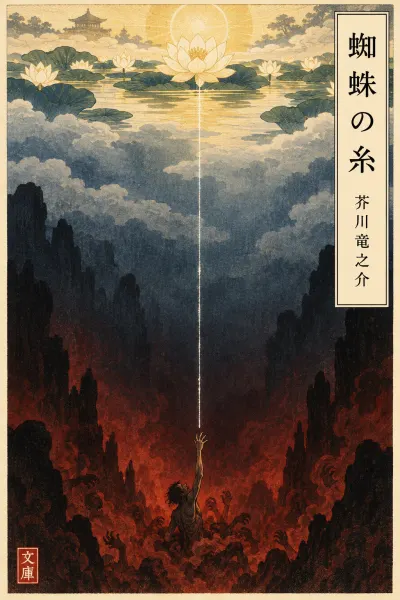
Part 1 of 3 · JLPT N1
蜘蛛の糸(一) Kumo no Ito, part 1: The Buddha at the Lotus Pond
In this part
One morning in Paradise, the Buddha strolls beside the lotus pond and looks down through the clear water into Hell. There he sees Kandata, a robber and murderer, and remembers the one good deed Kandata once did: he spared a small spider instead of crushing it. To reward him, the Buddha lowers a silver spider's thread from Paradise down to the bottom of Hell.
AI translation · independently checked
ある日の事でございます。It happened one day.
御釈迦様は極楽の蓮池のふちを、独りでぶらぶら御歩きになっていらっしゃいました。The Buddha was strolling alone, at his leisure, along the edge of the lotus pond in Paradise.
池の中に咲いている蓮の花は、みんな玉のようにまっ白で、そのまん中にある金色の蕊からは、何とも云えない好い匂が、絶間なくあたりへ溢れて居ります。The lotus flowers blooming in the pond were all as white as pearls, and from the golden stamens at their very centres a fragrance sweeter than words can tell flowed out endlessly all around.
極楽は丁度朝なのでございましょう。In Paradise, it must be morning just now.
やがて御釈迦様はその池のふちに御佇みになって、水の面を蔽っている蓮の葉の間から、ふと下の容子を御覧になりました。Presently the Buddha came to a stop at the edge of the pond and, through a gap in the lotus leaves that covered the surface of the water, happened to glance at what lay below.
この極楽の蓮池の下は、丁度地獄の底に当って居りますから、水晶のような水を透き徹して、三途の河や針の山の景色が、丁度覗き眼鏡を見るように、はっきりと見えるのでございます。Directly beneath this lotus pond of Paradise lies the very bottom of Hell, so through the crystal-clear water the Sanzu River and the Mountain of Needles can be seen quite distinctly, just as if one were peering into a peep-show.
するとその地獄の底に、犍陀多と云う男が一人、ほかの罪人と一しょに蠢いている姿が、御眼に止まりました。Then, at the bottom of that Hell, his eye fell upon a man named Kandata, writhing along with the other sinners.
この犍陀多と云う男は、人を殺したり家に火をつけたり、いろいろ悪事を働いた大泥坊でございますが、それでもたった一つ、善い事を致した覚えがございます。This man Kandata was a great robber who had done all manner of wicked deeds, killing people and setting houses on fire, and yet there was just one good deed that he could remember having done.
と申しますのは、ある時この男が深い林の中を通りますと、小さな蜘蛛が一匹、路ばたを這って行くのが見えました。It was this: once, as he was passing through a deep forest, he saw a tiny spider crawling along the side of the path.
そこで犍陀多は早速足を挙げて、踏み殺そうと致しましたが、「いや、いや、これも小さいながら、命のあるものに違いない。その命を無暗にとると云う事は、いくら何でも可哀そうだ。」と、こう急に思い返して、とうとうその蜘蛛を殺さずに助けてやったからでございます。Kandata at once raised his foot to stamp it to death, but then he suddenly thought better of it: "No, no. Tiny as it is, it's a living thing all the same. Snuffing out its life for nothing — that's too cruel, whatever you say." And so, in the end, instead of killing the spider, he let it live.
御釈迦様は地獄の容子を御覧になりながら、この犍陀多には蜘蛛を助けた事があるのを御思い出しになりました。As he looked upon the scene in Hell, the Buddha remembered that this Kandata had once saved a spider.
そうしてそれだけの善い事をした報には、出来るなら、この男を地獄から救い出してやろうと御考えになりました。And he thought that, as a reward for having done even that much good, he would rescue this man from Hell if it could be done.
幸い、側を見ますと、翡翠のような色をした蓮の葉の上に、極楽の蜘蛛が一匹、美しい銀色の糸をかけて居ります。Fortunately, when he looked beside him, a spider of Paradise was spinning a beautiful silver thread upon a lotus leaf the colour of jade.
御釈迦様はその蜘蛛の糸をそっと御手に御取りになって、玉のような白蓮の間から、遥か下にある地獄の底へ、まっすぐにそれを御下しなさいました。The Buddha gently took the spider's thread in his hand and, from between the pearl-white lotuses, lowered it straight down toward the bottom of Hell, far, far below.
Vocabulary
| Word | Meaning | JLPT |
|---|---|---|
| ぶらぶらぶらぶら | (walking) idly, leisurely, without a set purposeMimetic word, often used with 歩く. | N1 |
| 絶間なくたえまない | without a break, ceaselesslydictionary form: 絶え間ないUsually written 絶え間なく today; 間 is the gap or pause that never comes. | — |
| 佇みたたずむ | to stand still, to pause and standdictionary form: 佇むLiterary verb; here in the honorific 御〜になる form. | — |
| 容子ようす | state of things, appearance, scenedictionary form: 様子Older spelling of 様子. | N3 |
| 地獄じごく | HellKey story word, the opposite of 極楽 (Paradise). | N1 |
| 蠢いているうごめく | to writhe, to squirmdictionary form: 蠢くSuggests insect-like crawling movement; the kanji contains 虫 twice. | — |
| 罪人ざいにん | sinner, criminal罪 = sin, crime. | — |
| 悪事あくじ | evil deed, crime悪事を働く = to commit wrongdoing. | — |
| 泥坊どろぼう | thief, robberdictionary form: 泥棒Older spelling; today written 泥棒. | N4 |
| 早速さっそく | at once, immediately | N2 |
| 無暗むやみ | recklessly, without good reasondictionary form: 無闇Now usually written 無闇 or むやみ; 無暗に = thoughtlessly. | — |
| 報むくい | reward, recompense (for a deed)dictionary form: 報いCan be a reward or a punishment. Both senses matter in this story. | — |
| 救い出してすくいだす | to rescue (someone) out ofdictionary form: 救い出す救う (to save) + 出す (out). | — |
| 遥かはるか | far, far away遥か下 = far below. | N1 |
Grammar
〜でございます N4 very polite form of です
The narrator uses でございます (and 居ります, 致す, 申す) throughout, which gives the tale a courteous, storyteller-like voice.
ある日の事でございます。
It happened one day.
御〜になる N4 honorific verb form
お + verb stem + になる raises the subject's status. Every action of the Buddha is described this way, for example 御歩きになる and 御考えになる.
御釈迦様は極楽の蓮池のふちを、独りでぶらぶら御歩きになっていらっしゃいました。
The Buddha was strolling alone, at his leisure, along the edge of the lotus pond in Paradise.
〜ながら (concessive) N2 although, even though
After an adjective or noun, ながら means 'although' rather than 'while'. Here it means 'small as it is'.
これも小さいながら、命のあるものに違いない。
Tiny as it is, it's a living thing all the same.
〜に違いない N3 must be, surely is
This pattern expresses strong conviction. Kandata is certain that even a spider is a living thing.
これも小さいながら、命のあるものに違いない。
Tiny as it is, it's a living thing all the same.
〜ずに N3 without doing
ず is a literary negative, and ずに means the same as 〜ないで. 殺さずに means 'without killing'.
とうとうその蜘蛛を殺さずに助けてやったからでございます。
And so, in the end, instead of killing the spider, he let it live.
〜(よ)うとする/致す N4 to try to, to be about to
The volitional form + とする shows an action that was attempted or about to happen. Here the humble 致す replaces する. Kandata was on the point of crushing the spider.
踏み殺そうと致しましたが
was about to stamp it to death, but