Part 3 of 3 · JLPT N1
蜘蛛の糸(三) Kumo no Ito, part 3: The Lotus Blossoms Care Nothing
In this part
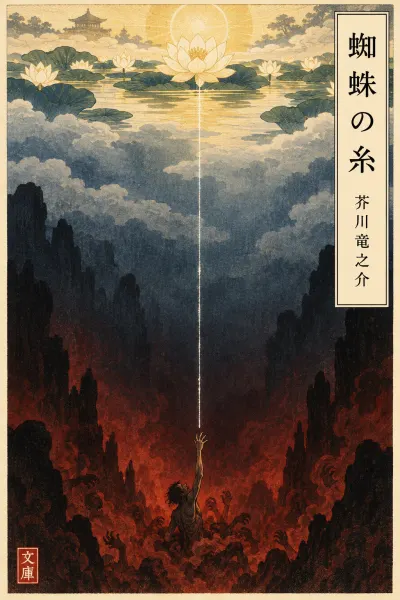
The Buddha watches Kandata sink back to the bottom of the Pool of Blood, and with a sorrowful face he begins to stroll about again. Kandata's selfish wish to escape alone brought on its own punishment. The lotuses of Paradise keep blooming and giving off their fragrance, untroubled, as noon draws near.
AI translation · independently checked
御釈迦様は極楽の蓮池のふちに立って、この一部始終をじっと見ていらっしゃいましたが、やがて犍陀多が血の池の底へ石のように沈んでしまいますと、悲しそうな御顔をなさりながら、またぶらぶら御歩きになり始めました。The Buddha stood at the edge of the lotus pond in Paradise and watched all of this closely from beginning to end. When at last Kandata sank like a stone to the bottom of the Pool of Blood, the Buddha began once more to stroll slowly about, a sorrowful look on his face.
自分ばかり地獄からぬけ出そうとする、犍陀多の無慈悲な心が、そうしてその心相当な罰をうけて、元の地獄へ落ちてしまったのが、御釈迦様の御目から見ると、浅間しく思召されたのでございましょう。Kandata had wanted to escape from Hell by himself alone. That merciless heart received the punishment it deserved and fell back into the Hell it had come from, and in the Buddha's eyes this must have seemed a wretched and shameful thing.
しかし極楽の蓮池の蓮は、少しもそんな事には頓着致しません。But the lotuses of the lotus pond in Paradise do not trouble themselves about such things in the least.
その玉のような白い花は、御釈迦様の御足のまわりに、ゆらゆら萼を動かして、そのまん中にある金色の蕊からは、何とも云えない好い匂が、絶間なくあたりへ溢れて居ります。Their white blossoms, like jewels, gently sway their calyxes about the Buddha's feet, and from the golden stamens at their centres an indescribably sweet fragrance flows out endlessly all around.
極楽ももう午に近くなったのでございましょう。In Paradise, too, it must by now be close to noon.
(大正七年四月十六日)(April 16, Taishō 7 [1918])
Vocabulary
| Word | Meaning | JLPT |
|---|---|---|
| 一部始終いちぶしじゅう | the whole story, everything from beginning to endA four-character idiom. It is often used with 見る or 話す. | — |
| 沈んでしずむ | to sinkdictionary form: 沈むIt is also used for the sun setting and for low spirits. | N3 |
| ぬけ出そうぬけだす | to escape, to slip out ofdictionary form: 抜け出すHere it is in the volitional form + とする: 'try to escape'. | N1 |
| 無慈悲むじひ | merciless, without compassion無 (without) + 慈悲 (compassion, mercy). 慈悲 is a key Buddhist virtue. | — |
| 相当そうとう | fitting, corresponding toIn 心相当な罰, it means 'a punishment matching that heart'. In modern speech it also often means 'considerably'. | N3 |
| 罰ばつ | punishment罰を受ける means 'to receive punishment'. | N1 |
| 浅間しくあさましい | wretched, shameful, despicabledictionary form: 浅ましいToday it is usually written 浅ましい. Here 浅間 is an old phonetic spelling. | N1 |
| 思召されおぼしめす | to think, to feel (honorific)dictionary form: 思召すThis is a very respectful verb, used here for the Buddha. The noun form is 思し召し, meaning 'someone's wishes'. | — |
| 頓着とんじゃく | concern, caring aboutIt is also read とんちゃく. It is mostly used in the negative: 〜に頓着しない means 'not to care about'. | — |
| 萼うてな | calyx, the cup at the base of a flowerThe usual botanical reading is がく. うてな is a literary word and also means 'lotus seat'. | — |
| 蕊ずい | stamen, pistil (the flower's centre)In modern Japanese it is usually しべ (おしべ, めしべ). | — |
| 絶間なくたえまない | without a break, ceaselesslydictionary form: 絶え間ないIt is usually written 絶え間なく. 絶える means 'to cease' and 間 means 'interval'. | — |
| 溢れてあふれる | to overflow, to spill outdictionary form: 溢れるIt can be used for water, tears, feelings, or, as here, a fragrance. | N2 |
| 午ひる | noonThe kanji comes from the hour of the Horse, which was midday. Compare 午前 (a.m.) and 午後 (p.m.). | N5 |
Grammar
お〜になる N3 honorific form of a verb
お + verb stem + になる raises the subject, here the Buddha. お歩きになる is simply a respectful 'walks'. Adding 始める gives お歩きになり始めました, 'began to walk'.
またぶらぶら御歩きになり始めました
he began once more to stroll slowly about
〜てしまう N4 to end up doing / to do completely (often with regret)
〜てしまう marks an action as finished and final, often with a sense of loss. Here it stresses that Kandata's sinking back into Hell is complete and cannot be undone.
犍陀多が血の池の底へ石のように沈んでしまいますと
when Kandata sank like a stone to the bottom of the Pool of Blood
〜そうな N4 looking ~, seeming ~
An adjective stem + そう describes how something looks from outside. It becomes な before a noun. So 悲しそうな顔 means 'a sad-looking face'.
悲しそうな御顔をなさりながら
with a sorrowful look on his face
〜ながら N4 while doing ~
Verb stem + ながら shows two actions happening at the same time by one subject. なさる is the honorific form of する.
悲しそうな御顔をなさりながら
while wearing a sorrowful look
〜ばかり N4 only ~, nothing but ~
ばかり after a noun limits the action to that one thing. 自分ばかり means Kandata thought of himself alone, and that selfishness is the moral point of the story.
自分ばかり地獄からぬけ出そうとする
trying to escape from Hell by himself alone
〜のでございましょう N2 it must be that ~ / surely ~ (very polite conjecture)
This is the very polite form of 〜のでしょう, with ございます (teineigo, polite language) replacing です. It means 'it must be that ~' and makes a gentle conjecture. That fits the formal, courteous voice of the storyteller. (example: 極楽ももう午に近くなったのでございましょう。)
極楽ももう午に近くなったのでございましょう。
In Paradise, too, it must by now be close to noon.