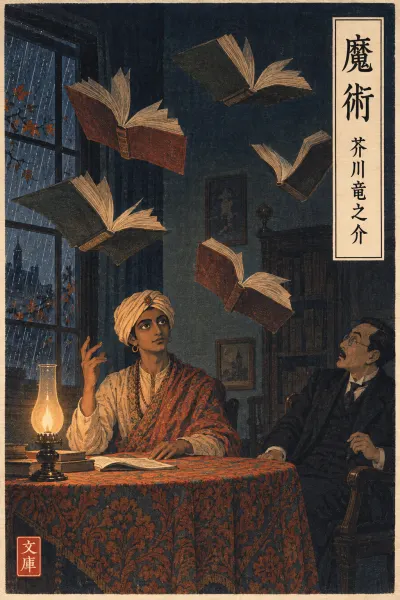
 N4 · easy
Simplified retelling · JLPT N4
魔術 Majutsu in easy Japanese (N4)
This is our own simplified retelling of The Sorcerer of Ōmori, written for N4 learners and checked word by word against the N4 vocabulary list. A few story words and grammar patterns go beyond N4; the notes below give each one's level. It keeps the characters, events and ending of the original. When it feels easy, move on to the N3 version or the original text.
The story in brief
On a rainy night the narrator visits Misra, a young Indian magician living on the lonely outskirts of Tokyo, and sees astonishing tricks with flowers, a lamp and flying books. Misra agrees to teach him on one condition: he must give up all greed. A month later, at a card game with his friends, greed overcomes him, and he finds himself back in Misra's room, where he learns the whole month was a dream of a single moment.
AI translation · independently checked
雨が降るばんのことです。It happened one rainy night.
私は車に乗って、東京の近くのさびしい町へ行きました。I took a rickshaw and went out to a lonely district near Tokyo.
林の中に、古くて小さな西洋の家がありました。In a grove of trees there stood an old, small Western-style house.
げんかんには「インドの人 ミスラ」と書いてありました。On the front entrance was written: "Misra, of India."
ミスラさんはインドで生まれたわかい男の人です。Mr Misra was a young man who had been born in India.
国のためにはたらいていて、有名な先生からまじゅつを習いました。He worked for the sake of his country, and he had learned magic from a famous master.
私は一月前に、友だちといっしょにミスラさんに会いました。I had met Mr Misra a month before, together with a friend.
でも、まじゅつを見たことはまだありませんでした。But I had not yet seen any of his magic.
それで「まじゅつを見せてください」と手紙でたのんで、今夜来たのです。So I had written him a letter asking, "Please show me your magic," and that is why I had come tonight.
私がベルをおすと、せのひくい日本人のおばあさんが出て来ました。When I pressed the bell, a short Japanese old woman came out.
ミスラさんの世話をしている人です。She was the one who looked after Mr Misra.
おばあさんは私をミスラさんのへやへあんないしました。The old woman showed me to Mr Misra's room.
ミスラさんは色が黒くて、目の大きい人です。Mr Misra was a dark-skinned man with large eyes.
「雨の中、よく来てくださいました」と、元気にあいさつしました。"How good of you to come through all this rain," he greeted me cheerfully.
へやはせまくて、くらいランプが一つあるだけでした。The room was cramped, lit by nothing more than a single dim lamp.
テーブルの上には、赤い花の絵がある古いテーブルクロスがありました。On the table lay an old tablecloth with a pattern of red flowers.
ミスラさんは私にはまきを一本くれました。Mr Misra gave me a cigar.
私が「あなたのまじゅつはどんな物ですか」と聞くと、ミスラさんはわらって答えました。When I asked him, "What sort of thing is your magic?" Mr Misra smiled and answered.
「私のまじゅつは、あなたでも使おうと思えば使えますよ。見てください。」"My magic is something that even you could use, if you set your mind to it. Watch."
ミスラさんは私の目の前で、手を二、三度動かしました。Right before my eyes, Mr Misra moved his hand two or three times.
それから、テーブルクロスの花を手でとりました。Then he picked a flower from the tablecloth with his fingers.
絵の花が、本当の花になったのです。The painted flower had become a real one.
いいにおいもしました。It even had a sweet scent.
私はとてもびっくりしました。I was utterly astonished.
ミスラさんが花をおとすと、花はまた絵になりました。When Mr Misra let the flower fall, it turned back into a picture.
つぎに、ミスラさんがランプを少し動かすと、ランプは同じところでまわり始めました。Next, when Mr Misra moved the lamp slightly, it began to spin round on the very spot where it stood.
だんだんはやくなって、それからまた止まりました。It went faster and faster, and then it stopped once more.
火は一度もきえませんでした。The flame did not go out even once.
それからミスラさんが本だなの方へ手を動かすと、本がどんどんとんで来ました。Then, when Mr Misra moved his hand towards the bookshelf, books came flying out one after another.
本は開いて、鳥のように空をとびました。The books opened and flew through the air like birds.
そして、テーブルの上にきれいにならびました。Then they lined themselves up neatly on the table.
そのあと、また本だなへ帰って行きました。After that, they went back to the bookshelf again.
うすい本が一つ、私の手の中に来ました。One thin book came into my hands.
それは私が先週ミスラさんに貸したフランスの本でした。It was the French book I had lent Mr Misra the week before.
「本をどうも」とミスラさんは話しました。"Thank you for the book," said Mr Misra.
私はゆめを見ているような気持ちでした。I felt as though I were dreaming.
「私にも本当に使えますか」と聞くと、ミスラさんはまじめな目で私を見ました。When I asked, "Could I really use it too?" Mr Misra looked at me with serious eyes.
「使えます。でも、よくがある人には使えません。まず、よくをすてなければなりません。あなたにできますか。」"You could. But a person who has greed cannot use it. First you must throw away your greed. Can you do that?"
「できます」と私は答えました。"I can," I answered.
ミスラさんは「では教えます。今夜はここにとまってください」と話して、おばあさんを呼びました。"Then I will teach you. Please stay here tonight," said Mr Misra, and he called the old woman.
「おばあさん、今夜はおきゃくさんがとまるから、ふとんの用意をしておいてください。」"Old woman, our guest is staying the night, so please get the bedding ready."
それから一月ぐらいあとのことです。It was about a month after that.
その日も雨でした。That day, too, it was raining.
私は東京のある建物で、友だち五、六人とストーブの前で話していました。I was in a certain building in Tokyo, talking with five or six friends in front of the stove.
一人の友だちが「君はまじゅつが使えるそうだね。見せてくれないか」と聞きました。One of my friends asked, "I hear you can work magic. Won't you show us?"
「いいよ」と私は答えました。"All right," I answered.
私はストーブの中の赤いせきたんを手にとりました。I took a red-hot coal from the stove in my hand.
友だちはこわそうに見ていました。My friends watched as if frightened.
私はせきたんを下へなげました。I threw the coal down.
すると、せきたんはたくさんのきれいなきんかになって、雨のようにおちました。At once the coal turned into a great many beautiful gold coins, which fell like rain.
友だちはみんなびっくりして、何も話せませんでした。My friends were all so astonished that they could not say a word.
きんかを集めると、テーブルの上で山のようになりました。When the gold coins were gathered up, they made a heap on the table like a mountain.
二十万円より多そうでした。It looked to be worth more than two hundred thousand yen.
友だちは私のまじゅつをたくさんほめました。My friends praised my magic to the skies.
でも、私は答えました。But I answered them.
「僕のまじゅつは、よくが出るともう使えないんだ。だから、このきんかはまたストーブに入れるよ。」友だちはみんなはんたいしました。"My magic can't be used any more once greed comes into it. So I'm putting these coins back into the stove." My friends all objected.
一人の悪い友だちが、わらいながら話しました。One wicked friend spoke, laughing.
「では、このきんかでトランプをしよう。君がかったら、君のすきにしていい。僕たちがかったら、きんかは僕たちの物だ。しないなら、君はきんかがほしいんだね。よくをすてた心もうそだね。」"Then let's play cards for these coins. If you win, you may do as you please with them. If we win, the coins are ours. If you won't play, then you want the gold after all. And that heart of yours that's thrown away greed is a lie, too."
私は何度も「いやだ」と答えました。Again and again I answered, "No."
でも、とうとうトランプをすることになりました。But in the end it was settled that we would play cards.
その夜、私は何度もかちました。That night I won time after time.
初めは楽しくなかったのですが、だんだんおもしろくなりました。At first I took no pleasure in it, but little by little it began to grow interesting.
友だちはいっしょうけんめいしましたが、私は一度もまけませんでした。My friends played with all their might, but I did not lose even once.
すると、あの悪い友だちが、こわい目でトランプを出して話しました。Then that wicked friend, with a fearful look in his eyes, laid out the cards and spoke.
「さあ、ひいてくれ。僕は家も車もお金も、ぜんぶかける。君はきんかと、君がかったお金をぜんぶかけるんだ。」"Come, draw. I'll stake everything: my house, my motor car, my money. You'll stake the gold coins and all the money you've won."
ここで私によくが出ました。At that moment, greed rose up in me.
まけたら、ぜんぶなくなります。If I lost, I would lose everything.
かてば、あの人の物がぜんぶ私の物になります。If I won, all that man owned would be mine.
私はだれにも知られないように、まじゅつを使いました。I used my magic so that no one would know.
友だちのトランプは九でした。My friend's card was a nine.
私のトランプはおうさまでした。My card was a king.
私は大きなこえで、おうさまを見せました。In a loud voice, I showed the king.
すると、おうさまがトランプから体を出して、わらいました。Then the king leaned his body out of the card and laughed.
そして、よく知っているこえで話しました。And he spoke in a voice I knew well.
「おばあさん、おきゃくさんは帰るから、ふとんの用意はしなくていいよ。」"Old woman, our guest is going home, so there's no need to get the bedding ready."
すると、外の雨の音が、またあのさびしい町の音になりました。At that, the sound of the rain outside became once more the sound of that lonely district.
気がつくと、私はまだくらいランプの前にすわっていました。When I came to myself, I was still sitting in front of the dim lamp.
前には、おうさまと同じようにわらっているミスラさんがいました。Before me sat Mr Misra, smiling just as the king had smiled.
手のはまきも、まだ長いままでした。The cigar in my hand was still as long as ever.
一月は、ほんの少しの間に見たゆめだったのです。The month had been a dream, seen in the briefest moment.
私にはまじゅつを習うことができないと、私にもミスラさんにもわかりました。Both I and Mr Misra understood that I could never learn his magic.
私ははずかしくて、あたまを下げて、何も話せませんでした。I was so ashamed that I hung my head and could not say a word.
ミスラさんはテーブルクロスの上に手をおいて、しずかに話しました。Mr Misra laid his hand on the tablecloth and spoke quietly.
「私のまじゅつを使いたいなら、まずよくをすてなければなりません。あなたには、まだそれができないのです。」"If you wish to use my magic, you must first throw away your greed. That is something you still cannot do."
Vocabulary
| Word | Meaning | JLPT |
|---|---|---|
| まじゅつまじゅつ | magic, sorcerydictionary form: 魔術The story's title. Written 魔 (demon) + 術 (art, technique). | — |
| 世話せわ | care, looking after someone〜の世話をする = to look after ~. お世話になります is a common set phrase. | N4 |
| あんないあんない | guiding, showing someone the waydictionary form: 案内AをBへ案内する = to show A to B. | N4 |
| はまきはまき | cigardictionary form: 葉巻Literally 'rolled leaf'. Its length later shows how little time has passed. | — |
| においにおい | smell, scentdictionary form: 匂いにおいがする = to give off a smell. | N4 |
| よくよく | greed, desiredictionary form: 欲The key word of the story. よくが出る = greed rises up. | — |
| すてすてる | to throw away, give updictionary form: 捨てるUsed here for giving up a feeling, not just objects. | N4 |
| とまってとまる | to stay the nightdictionary form: 泊まるSame sound as 止まる (to stop) in the lamp scene; the kanji differ. | N4 |
| 用意ようい | preparation〜の用意をする = to get ~ ready. | N4 |
| せきたんせきたん | coaldictionary form: 石炭石 (stone) + 炭 (charcoal). | N3 |
| きんかきんか | gold coindictionary form: 金貨金 (gold) + 貨 (coin, money). | — |
| はんたいはんたい | objection, oppositiondictionary form: 反対はんたいする = to object. | N4 |
| かけるかける | to bet, stakedictionary form: 賭けるMany different verbs are read かける; the kanji 賭 means 'gamble'. | N1 |
| はずかしくてはずかしい | ashamed, embarrasseddictionary form: 恥ずかしいThe て-form here gives the reason for what follows. | N4 |
Grammar
〜てある N4 something has been done (and the result remains)
A transitive verb in the て-form plus ある describes a state left behind by someone's action. Here the name was written by someone and can still be read on the door.
げんかんには「インドの人 ミスラ」と書いてありました。
On the front entrance was written: "Misra, of India."
〜なければなりません N4 must, have to
The ない-form with ない changed to なければ, followed by なりません, expresses a duty or requirement. Misra states the one condition for learning magic.
まず、よくをすてなければなりません。
First you must throw away your greed.
〜ておく N4 do something in advance, in preparation
The て-form plus おく shows an action done ahead of time for a later need. Misra asks for the bedding to be ready before the guest sleeps.
ふとんの用意をしておいてください。
Please get the bedding ready.
〜ことになる N4 it is decided / it turns out that
Dictionary form plus ことになる shows that something was decided by circumstances or others, not by the speaker alone. The narrator suggests he was pushed into the game.
でも、とうとうトランプをすることになりました。
But in the end it was settled that we would play cards.
〜ないように N4 so that ... not
A verb in the ない-form plus ように states the purpose of an action, often something one hopes to avoid. Here it means he used the magic secretly.
私はだれにも知られないように、まじゅつを使いました。
I used my magic so that no one would know.
〜まま N3 still in the same state, unchanged
まま after an adjective or verb shows that a state has not changed. The cigar has not burned down, proving that almost no time has passed.
手のはまきも、まだ長いままでした。
The cigar in my hand was still as long as ever.