Part 1 of 5 · JLPT N2
魔術 Majutsu, part 1: A Rainy Night Visit to Ōmori
In this part
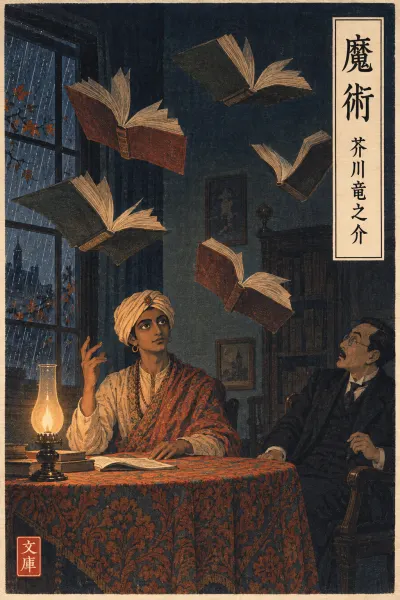
On a night of cold autumn rain, the narrator rides by rickshaw to the shabby Western-style house of Matiram Misra, an Indian patriot and young master of magic, to see his sorcery for the first time. An old Japanese servant shows him into a gloomy, sparsely furnished room, where Misra greets him warmly and offers him a cigar. When the narrator asks whether the magic depends on a spirit called a djinn, Misra laughs and says it is only an advanced form of hypnotism that anyone could learn.
AI translation · independently checked
ある時雨の降る晩のことです。It happened one evening when a cold late-autumn rain was falling.
私を乗せた人力車は、何度も大森界隈の険しい坂を上ったり下りたりして、やっと竹藪に囲まれた、小さな西洋館の前に梶棒を下しました。The rickshaw carrying me climbed up and down the steep slopes around Ōmori again and again, and at last set down its shafts in front of a small Western-style house enclosed by bamboo thickets.
もう鼠色のペンキの剥げかかった、狭苦しい玄関には、車夫の出した提灯の明りで見ると、印度人マティラム・ミスラと日本字で書いた、これだけは新しい、瀬戸物の標札がかかっています。In the light of the lantern the runner held out, I could see that the cramped little porch, its grey paint already beginning to peel, bore a porcelain nameplate, the one new thing about the place, on which was written in Japanese characters: "Matiram Misra, Indian."
マティラム・ミスラ君と云えば、もう皆さんの中にも、御存じの方が少くないかも知れません。Speaking of Mr Matiram Misra, a good many of you may already know of him.
ミスラ君は永年印度の独立を計っているカルカッタ生れの愛国者で、同時にまたハッサン・カンという名高い婆羅門の秘法を学んだ、年の若い魔術の大家なのです。Mr Misra is a patriot born in Calcutta who has worked for many years toward the independence of India, and at the same time a young master of magic who learned the secret arts of a famous Brahmin named Hassan Khan.
私はちょうど一月ばかり以前から、ある友人の紹介でミスラ君と交際していましたが、政治経済の問題などはいろいろ議論したことがあっても、肝腎の魔術を使う時には、まだ一度も居合せたことがありません。I had been acquainted with Mr Misra for just about a month, through an introduction from a certain friend, but although we had often argued over questions of politics and economics, I had never once been present when he used the thing that mattered most, his magic.
そこで今夜は前以て、魔術を使って見せてくれるように、手紙で頼んで置いてから、当時ミスラ君の住んでいた、寂しい大森の町はずれまで、人力車を急がせて来たのです。So tonight, having asked him by letter beforehand to be kind enough to show me some magic, I had hurried my rickshaw all the way to the lonely outskirts of Ōmori, where Mr Misra was living at that time.
私は雨に濡れながら、覚束ない車夫の提灯の明りを便りにその標札の下にある呼鈴の釦を押しました。Getting wet in the rain, and relying on the feeble light of the runner's lantern, I pressed the button of the bell beneath that nameplate.
すると間もなく戸が開いて、玄関へ顔を出したのは、ミスラ君の世話をしている、背の低い日本人の御婆さんです。Presently the door opened, and the face that appeared in the porch belonged to a short old Japanese woman who looked after Mr Misra.
「ミスラ君は御出でですか。」"Is Mr Misra at home?"
「いらっしゃいます。先ほどからあなた様を御待ち兼ねでございました。」"He is, sir. He has been waiting eagerly for you for some time now."
御婆さんは愛想よくこう言いながら、すぐその玄関のつきあたりにある、ミスラ君の部屋へ私を案内しました。Saying this pleasantly, the old woman at once showed me to Mr Misra's room, which lay at the far end of the entrance.
「今晩は、雨の降るのによく御出ででした。」"Good evening. How kind of you to come in all this rain."
色のまっ黒な、眼の大きい、柔な口髭のあるミスラ君は、テエブルの上にある石油ランプの心を撚りながら、元気よく私に挨拶しました。Mr Misra, a very dark-skinned man with large eyes and a soft moustache, greeted me heartily as he turned up the wick of the oil lamp on the table.
「いや、あなたの魔術さえ拝見出来れば、雨くらいは何ともありません。」"Not at all. So long as I may see your magic, a little rain is nothing to me."
私は椅子に腰かけてから、うす暗い石油ランプの光に照された、陰気な部屋の中を見廻しました。Once I had sat down on a chair, I looked around the gloomy room, lit by the dim glow of the oil lamp.
ミスラ君の部屋は質素な西洋間で、まん中にテエブルが一つ、壁側に手ごろな書棚が一つ、それから窓の前に机が一つ――ほかにはただ我々の腰をかける、椅子が並んでいるだけです。Mr Misra's room was a plain Western-style room: a single table in the middle, a single bookcase of modest size against the wall, and a single desk in front of the window; apart from these there were only the chairs we sat on, set in a row.
しかもその椅子や机が、みんな古ぼけた物ばかりで、縁へ赤く花模様を織り出した、派手なテエブル掛でさえ、今にもずたずたに裂けるかと思うほど、糸目が露になっていました。What was more, the chairs and desk were all old and worn, and even the showy tablecloth, its border woven with a pattern of red flowers, was so threadbare that it looked as if it might tear to shreds at any moment.
私たちは挨拶をすませてから、しばらくは外の竹藪に降る雨の音を聞くともなく聞いていましたが、やがてまたあの召使いの御婆さんが、紅茶の道具を持ってはいって来ると、ミスラ君は葉巻の箱の蓋を開けて、After we had finished our greetings, we sat for a while half-listening to the sound of the rain falling on the bamboo thicket outside; before long the old servant came in again with the tea things, and Mr Misra opened the lid of a box of cigars,
「どうです。一本。」と勧めてくれました。and offered one to me: "How about it? Have one."
「難有う。」"Thank you."
私は遠慮なく葉巻を一本取って、燐寸の火をうつしながら、Without ceremony I took a cigar, and as I lit it from a match I said,
「確かあなたの御使いになる精霊は、ジンとかいう名前でしたね。するとこれから私が拝見する魔術と言うのも、そのジンの力を借りてなさるのですか。」"If I remember rightly, the spirit you command is called something like a djinn, isn't it? Then will the magic I am about to see also be done by borrowing the power of this djinn?"
ミスラ君は自分も葉巻へ火をつけると、にやにや笑いながら、匀の好い煙を吐いて、Mr Misra lit a cigar of his own, and, grinning, blew out a puff of fragrant smoke:
「ジンなどという精霊があると思ったのは、もう何百年も昔のことです。アラビヤ夜話の時代のこととでも言いましょうか。私がハッサン・カンから学んだ魔術は、あなたでも使おうと思えば使えますよ。高が進歩した催眠術に過ぎないのですから。――御覧なさい。この手をただ、こうしさえすれば好いのです。」"The belief that there were spirits such as djinns belongs to a time many hundreds of years ago. The age of the Arabian Nights, you might say. The magic I learned from Hassan Khan is something even you could use, if you set your mind to it. After all, it is nothing more than an advanced kind of hypnotism. Look. All I need do is simply move my hand like this."
Vocabulary
| Word | Meaning | JLPT |
|---|---|---|
| 時雨しぐれ | cold, intermittent rain of late autumn or early winterA seasonal word often used in poetry; a special reading that does not follow the usual sounds of the kanji. | — |
| 人力車じんりきしゃ | rickshawLiterally 'human-power vehicle'. The runner is called 車夫 (しゃふ). | — |
| 梶棒かじぼう | the shafts of a rickshaw, held by the runnerLowering the shafts (梶棒を下ろす) means the rickshaw has stopped. | — |
| 界隈かいわい | neighbourhood, the area aroundFollows a place name: 大森界隈 'around Ōmori'. | — |
| 標札ひょうさつ | nameplate on a houseNow usually written 表札. | — |
| 大家たいか | great master, authority (in an art or field)Read おおや, the same kanji mean 'landlord'. | N3 |
| 肝腎かんじん | essential, the main thingAlso written 肝心. Here it marks the magic as the whole point of the friendship. | N1 |
| 覚束ないおぼつかない | unsteady, faint, unreliableDescribes the weak, flickering lantern light. | — |
| 御待ち兼ねまちかねる | to wait impatiently, be eager for someone to comedictionary form: 待ち兼ねるお〜兼ね is a humble, old-fashioned honorific form used by the servant. | — |
| 露あらわ | exposed, showing openlyUsually written あらわ or 露わ; read つゆ, it means 'dew'. | N1 |
| 葉巻はまき | cigar | — |
| 遠慮なくえんりょなく | without holding back, freely | — |
| 催眠術さいみんじゅつ | hypnotism | — |
Grammar
〜たり〜たりする N4 doing things such as A and B; alternating actions
Two verbs in the た-form plus り, followed by する, list actions that happen by turns. Here the rickshaw goes up and down the slopes over and over.
何度も大森界隈の険しい坂を上ったり下りたりして
going up and down the steep slopes around Ōmori again and again
〜かかる N3 to be starting to, be about to
Attached to the stem of a verb, かかる (or かける) shows an action that has begun but is not complete. 剥げかかった means the paint is starting to peel.
もう鼠色のペンキの剥げかかった、狭苦しい玄関
the cramped porch, its grey paint already beginning to peel
〜さえ〜ば N2 as long as, if only
さえ plus a conditional presents one condition as all that is needed. Seeing the magic is enough to make the rain unimportant.
あなたの魔術さえ拝見出来れば、雨くらいは何ともありません。
So long as I may see your magic, a little rain is nothing to me.
〜ともなく N1 without really meaning to; half-consciously
The same verb is repeated around ともなく to show an action done idly, without clear intention. They are only half-listening to the rain.
外の竹藪に降る雨の音を聞くともなく聞いていましたが
we sat half-listening to the sound of the rain falling on the bamboo thicket outside
お〜になる N4 respectful form of a verb
お + verb stem + になる raises the action of the person spoken about. The narrator uses it politely for Misra's use of the spirit.
確かあなたの御使いになる精霊は、ジンとかいう名前でしたね。
If I remember rightly, the spirit you command is called something like a djinn, isn't it?
〜に過ぎない N3 nothing more than, merely
Follows a noun or plain form to play something down. Together with 高が 'at most', Misra calls his magic nothing special.
高が進歩した催眠術に過ぎないのですから。
After all, it is nothing more than an advanced kind of hypnotism.