Upper intermediate · JLPT N2
魔術Majutsu — The Sorcerer of Ōmori
- JLPT N2
- 7,164 characters
- 5 parts
- about 60 minutes
- 2 easier versions
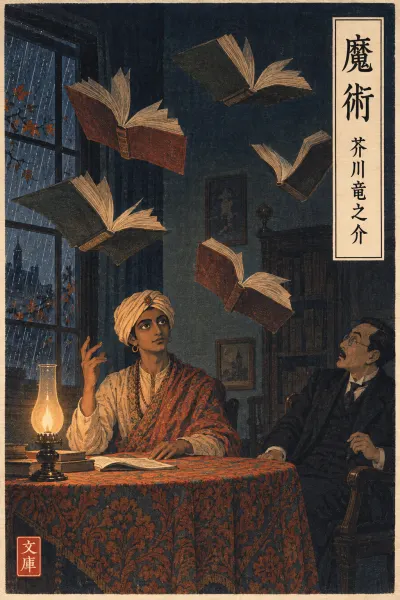
"Magic" is a short fantastic tale by Akutagawa Ryūnosuke, told in five brief parts. On a cold, rainy autumn night, the narrator takes a rickshaw to visit Matiram Misra, a young Indian patriot. Misra lives in a shabby Western-style house on the lonely outskirts of Ōmori and has learned the secret magic of the Brahmin Hassan Khan. After an evening of quiet, eerie wonders, Misra agrees to teach the narrator on one condition: the magic will not work for anyone who harbours greed. The story then moves to a club in Ginza, where that condition is put to the test. It works as a moral fable, but Akutagawa keeps the tone light, atmospheric and slightly wry, and the wonders themselves (a flower lifted out of a tablecloth, books flying like bats) are vivid and concrete. For learners, the steady desu/masu narration addressed to the reader is approachable, and the plot is easy to follow. The main challenges are the Taishō-era vocabulary, the old kanji spellings, and the shifts between speech styles: the servant's humble keigo, Misra's katakana Japanese, and the friends' casual male banter.
Contents
Easier versions
This story is also retold in simpler Japanese. Reading an easier version first makes the original much more approachable.
Before you read
- Learn the key words of the story's moral before you start: 魔術 (magic), 欲 (greed), 石炭 (coal) and 金貨 (gold coins). The turning points of Parts 3–5 all hinge on them.
- Misra's orders to his servant are written in katakana to suggest foreign-accented speech. Read them aloud slowly and convert them mentally into ordinary hiragana and kanji; they are simple, polite sentences once decoded.
- Expect three speech styles and use them to track who is talking. The old servant uses very humble keigo, Misra uses courteous polite Japanese, and the club friends speak casual educated male speech (僕, 君, and commands with 〜給え such as 見せ給え).
- Watch for the recurring patterns 〜さえ〜ば (the condition that greed must be given up), 〜に過ぎない (Misra calling his magic 'nothing more than' hypnotism), 〜に違いありません and 〜たまま. Recognising them will make the longer descriptive sentences much easier to parse.
- Don't be thrown by old kanji spellings of place names such as 印度 (India) and 仏蘭西 (France). Check the name list once, then read past them; they carry little difficulty after the first appearance.
Words to know
The most useful words from the notes across the story.
| Word | Meaning | JLPT |
|---|---|---|
| 見物みもの | a sight worth seeing, a spectacleRead けんぶつ, the same kanji mean 'sightseeing, watching'. | N4 |
| 大家たいか | great master, authority (in an art or field)Read おおや, the same kanji mean 'landlord'. | N3 |
| 評判ひょうばん | reputation; talk, rumour〜という評判だ = 'people say that…', as in the friend's words later on. | N3 |
| 俄ににわか | suddenly, all at oncedictionary form: 俄Literary; common in 俄雨 (にわかあめ, sudden shower). | N2 |
| もったいないもったいない | wasteful, a shame to waste | N2 |
| 骨牌かるた | playing cards; a card gameOld kanji spelling of カルタ, from Portuguese carta. | N2 |
| 肝腎かんじん | essential, the main thingAlso written 肝心. Here it marks the magic as the whole point of the friendship. | N1 |
| 露あらわ | exposed, showing openlyUsually written あらわ or 露わ; read つゆ, it means 'dew'. | N1 |
| 茫然とぼうぜん | dumbfounded, in a dazedictionary form: 茫然Also written 呆然. | N1 |
| 時雨しぐれ | cold, intermittent rain of late autumn or early winterA seasonal word often used in poetry; a special reading that does not follow the usual sounds of the kanji. | — |
| 人力車じんりきしゃ | rickshawLiterally 'human-power vehicle'. The runner is called 車夫 (しゃふ). | — |
| 梶棒かじぼう | the shafts of a rickshaw, held by the runnerLowering the shafts (梶棒を下ろす) means the rickshaw has stopped. | — |
| 界隈かいわい | neighbourhood, the area aroundFollows a place name: 大森界隈 'around Ōmori'. | — |
| 標札ひょうさつ | nameplate on a houseNow usually written 表札. | — |
| 覚束ないおぼつかない | unsteady, faint, unreliableDescribes the weak, flickering lantern light. | — |
Plot summary
Show the full summary (contains spoilers)
On a rainy autumn night the narrator visits Matiram Misra in Ōmori. Misra says his magic is only an advanced kind of hypnotism. He plucks a real-smelling flower from a tablecloth, spins a lamp like a top and makes books fly around the room. He agrees to teach the narrator Hassan Khan's magic, but only someone without greed can use it. About a month later, at a Ginza club, the narrator turns burning coals into gold coins and insists on throwing them back into the fire. His friends goad him into a card game. He keeps winning, and when a final hand for his rival's whole fortune is proposed, greed makes him secretly use magic. The king he draws speaks in Misra's voice, and he wakes in Ōmori. The whole month was a dream of two or three minutes, and it has shown he is unfit to learn the magic.
About the author
Akutagawa Ryūnosuke (1892–1927) was one of the most important writers of modern Japanese short fiction. Born in Tokyo, he studied English literature at Tokyo Imperial University, and his early story 鼻 (The Nose) won praise from Natsume Sōseki. Many of his works retell older Japanese and Chinese tales with modern psychological insight, including 羅生門 (Rashōmon) and 藪の中 (In a Grove), which later inspired Kurosawa Akira's film Rashomon. He died by suicide at the age of 35. The Akutagawa Prize was named in his honour by his friend Kikuchi Kan.