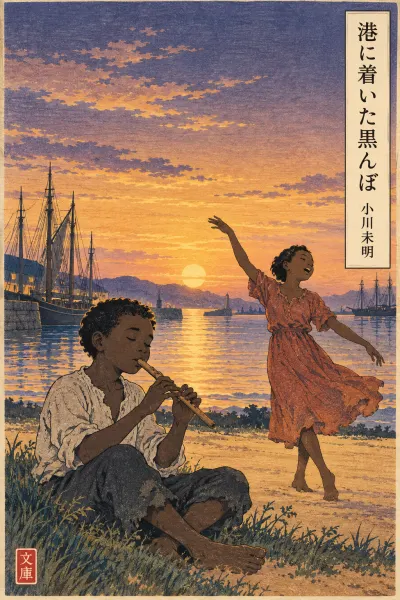
 N4 · easy
Simplified retelling · JLPT N4
港に着いた黒んぼ Minato ni Tsuita Kuronbo in easy Japanese (N4)
This is our own simplified retelling of The Stranger Who Came Ashore at the Harbour, written for N4 learners and checked word by word against the N4 vocabulary list. A few story words and grammar patterns go beyond N4; the notes below give each one's level. It keeps the characters, events and ending of the original. When it feels easy, move on to the original text.
The story in brief
A blind boy plays the flute in a harbour square while his gentle older sister sings and dances. One evening a rich man's messenger takes the sister away, promising it will not take long. While she is gone, a grieving swan turns the lonely boy into a swan and flies south with him. The sister searches the harbour town for him in vain. Later a short stranger from a southern island tells her he saw a girl just like her there with a blind boy, and she realises that another, kinder version of herself has taken her brother to a far-off island.
AI translation · independently checked
ある町のみなとの近くに、広い広場がありました。Near the harbour of a certain town, there was a wide open square.
そこで毎日、十さいぐらいの男の子がふえをふいていました。There, every day, a boy of about ten played the flute.
とても上手で、かなしい音でした。He played very well, and the sound was sad.
男の子は目が見えませんでした。The boy was blind.
男の子のそばでは、十六、七さいの姉が歌って、おどっていました。Beside the boy, his sister, who was sixteen or seventeen, sang and danced.
姉はうすい青の着物を着ていました。The sister wore a pale blue kimono.
かみは長くて、目はほしのようにきれいでした。Her hair was long, and her eyes were as lovely as the stars.
姉ははずかしそうに、小さい声で歌っていました。The sister sang shyly, in a small voice.
二人には親がいませんでした。The two of them had no parents.
弟には、姉しかいませんでした。The boy had no one but his sister.
姉は弟をとても大切に思っていました。The sister held her brother very dear.
二人はとてもなかのいい姉と弟でした。They were a sister and brother who were very fond of each other.
天気のいい日には、姉は弟の手をひいて広場に来ました。On fine days, the sister would lead her brother by the hand to the square.
弟がふえをふいて、姉が歌いました。The brother played his flute, and the sister sang.
人々はそれを聞いて、お金をくれました。People listened to them and gave them money.
ある夏の日も、二人のまわりに大ぜいの人が集まりました。On a certain summer day, too, a great many people gathered around the two.
「こんなにいいふえの音は聞いたことがない」と、ある男が言いました。"I have never heard such fine flute music," said one man.
「あのむすめは、きっと弟のためにはたらいているのです」と、ある女の人が言いました。"That girl must surely be working for her little brother's sake," said one woman.
夕方になって、人々は帰りました。Evening came, and the people went home.
二人も帰ろうとしたとき、知らない男が来ました。Just as the two of them were about to go home too, a man they did not know came up to them.
「この町の金持ちのお使いです。金持ちがあなたに会いたいと言っています。あの馬車にのってください」I am a messenger from a rich man of this town. He says he wishes to meet you. Please get into that carriage.
姉はこまりました。The sister did not know what to do.
「弟もいっしょに行ってもいいですか」「いいえ、あなた一人で来てください。時間はかかりません」姉はしばらく考えて、「では、一時間で帰してくださいね」と言いました。"May my brother come with me?" "No, please come by yourself. It will not take long." The sister thought for a while, and then said, "Very well, but please bring me back within an hour."
姉は弟のところへ行って、「すぐ帰ってくるから、ここで待っていてね」と言いました。The sister went over to her brother and said, "I'll be back very soon, so wait here for me."
弟は「姉さんは、もう帰ってこない気がする」と言いました。The brother said, "I feel as if you're never coming back, Sister."
姉はなきそうになって、「そんなかなしいことを言わないで。一時間で帰るよ」と言いました。Close to tears, the sister said, "Don't say such sad things. I'll be back in an hour."
弟は小さい声で「うん」と言いました。The brother said "All right" in a small voice.
姉は馬車にのって、行ってしまいました。The sister got into the carriage and was gone.
一時間たっても、二時間たっても、姉は帰ってきませんでした。An hour passed, then two hours, but still the sister did not come back.
夜になって、空にほしが出ました。Night fell, and the stars came out in the sky.
弟はさびしくて、なきました。The boy felt so lonely that he cried.
「ぼくのふえを聞いたら、姉さんはきっと帰ってくる」と思いました。He thought, "If Sister hears my flute, she will surely come back."
弟はいっしょうけんめい、ふえをふきました。The boy played his flute with all his might.
そのとき、一わの白鳥が空をとんでいました。Just then, a single swan was flying across the sky.
白鳥は北の海で子どもをなくして、南へ帰るところでした。The swan had lost her children in the northern sea and was on her way back to the south.
白鳥はかなしいふえの音を聞いて、広場におりてきました。Hearing the sad sound of the flute, the swan came down into the square.
「どうして一人でふえをふいているのですか」と白鳥は聞きました。"Why are you playing the flute all alone?" asked the swan.
弟は、姉がいなくなったことを話しました。The boy told her that his sister had gone away.
「かわいそうに。私も子どもをなくした白鳥です。私があなたのせわをしましょう。いっしょに南の国へ行きましょう」"You poor thing. I too am a swan who has lost her children. I will take care of you. Let us go together to the southern lands."
白鳥は、弟を白い鳥にしました。The swan turned the boy into a white bird.
二わの白鳥は、夜の空へとんで行って、見えなくなりました。The two swans flew off into the night sky and were lost from sight.
しばらくして、姉が帰ってきました。A little while later, the sister came back.
思ったより時間がかかったので、しんぱいしていました。It had taken longer than she had expected, so she had been worried.
でも、弟はどこにもいませんでした。But her brother was nowhere to be found.
足もとには、小さな花がさいていました。At her feet, little flowers were blooming.
姉の着物には、ほうせきがひかっていました。On the sister's kimono, jewels were sparkling.
つぎの日から、姉は毎日みなとの町を歩いて、弟をさがしました。From the next day on, the sister walked through the harbour town every day, searching for her brother.
でも、弟は見つかりませんでした。But her brother could not be found.
ある日、外国からふねが着きました。One day, a ship arrived from a foreign land.
その中に、南のしまから来た、せのひくい男がいました。Among those on board was a short man who had come from a southern island.
男は姉を見て言いました。The man looked at the sister and spoke.
「あなたは南のしまで歌っていたむすめさんではありませんか」姉は「いいえ、人ちがいです」と答えました。"Are you not the young lady who was singing on the southern island?" The sister answered, "No, you are mistaking me for someone else."
「いいえ、たしかにあなたです。うすい青の着物を着て、目の見えない男の子のふえで、おどっていました。しまのおうさまがむかえに来ましたが、弟がかわいそうだと言って、行きませんでした。その海には、白鳥がたくさんいます」"No, it was certainly you. You wore a pale blue kimono and danced to the flute of a blind boy. The king of the island came to fetch you, but you would not go, saying you felt too sorry for your brother. In that sea there are a great many swans."
姉はとてもおどろきました。The sister was greatly astonished.
「もう一人の私がいるのだ。その私は、私よりもやさしいのだろう。その私が、弟をつれて行ってしまったのだ」姉は、自分のしたことをとても悪かったと思いました。"So there is another me. That other me must be kinder than I am. And it was she who took my brother away." The sister felt that what she had done was very wrong.
「そのしまはどこですか。私も行きたいです」と姉は言いました。"Where is that island? I want to go there too," said the sister.
男はみなとの方をゆびさして答えました。The man pointed toward the harbour and answered.
「とても遠いところです。銀色の海をわたって、ゆきの高い山の向こうへ行きます。かんたんには行けません」"It is very far away. You must cross a silver sea and go beyond high, snowy mountains. It is not easy to get there."
夏の日がくれて、海の上の空は、昨日のように赤くなりました。The summer day drew to a close, and the sky above the sea turned red, just as it had the day before.
Vocabulary
| Word | Meaning | JLPT |
|---|---|---|
| 広場ひろば | open square, plaza広 'wide' + 場 'place'. The square by the harbour is the main setting of the story. | N2 |
| ふえふえ | flute (a simple wind instrument)dictionary form: 笛You 'blow' a flute in Japanese: ふえをふく (笛を吹く). | N3 |
| なかのいいなかがいい | close, on good terms, fond of each otherdictionary form: 仲がいいBefore a noun, が often changes to の: なかのいい姉と弟. | — |
| 手をひいててをひく | to lead someone by the handdictionary form: 手を引くOften used for guiding a child or someone who cannot see. | — |
| 大ぜいおおぜい | a great many people, a crowddictionary form: 大勢Used only for people, not for things. | N5 |
| お使いつかい | messenger; someone sent on an erranddictionary form: 使いWith お it can also mean a child's errand or shopping trip (おつかい). | N1 |
| 馬車ばしゃ | horse-drawn carriage馬 'horse' + 車 'vehicle'. | — |
| 白鳥はくちょう | swanBirds are counted with わ (羽): 一わ, 二わ. | — |
| せわせわ | care, looking afterdictionary form: 世話〜のせわをする = to look after someone. お世話になります is a common polite phrase. | N4 |
| ほうせきほうせき | jewel, gemdictionary form: 宝石宝 'treasure' + 石 'stone'. | N3 |
| せのひくいせがひくい | short (in height)dictionary form: 背が低いThis man is the stranger of the original title, which calls him 黒んぼ (くろんぼ), an old word for a dark-skinned or Black person. It is a racial slur today and should never be used; say 肌の色が黒い人 or name the person's origin instead. | — |
| 人ちがいひとちがい | mistaking someone for another persondictionary form: 人違い人ちがいです = 'You have the wrong person.' | — |
| むかえに来ましたむかえにくる | to come to fetch / pick someone updictionary form: 迎えに来るVerb stem + に来る shows the purpose of coming. | — |
| くれてくれる | (of a day) to draw to a close, grow darkdictionary form: 暮れる日がくれる = 'the sun sets / the day ends'. Different from くれる 'to give'. | N4 |
Grammar
〜たことがない N4 have never done ~
The past plain form of a verb + ことがない says the speaker has never had that experience. Here it praises the flute: the man has never heard anything so good.
こんなにいいふえの音は聞いたことがない
I have never heard such fine flute music.
〜ようとしたとき N3 just as (someone) was about to ~
The volitional form (帰ろう) + とする means 'try to / be about to do'. With とき, it marks the moment something interrupts the action.
二人も帰ろうとしたとき、知らない男が来ました。
Just as the two of them were about to go home too, a man they did not know came up to them.
〜気がする N3 to have a feeling that ~
A plain-form clause + 気がする expresses a vague feeling or hunch, not a certain fact. The boy senses his sister will not return.
姉さんは、もう帰ってこない気がする
I feel as if you're never coming back, Sister.
〜てしまう N4 to do ~ completely; (with regret) end up ~
Te-form + しまう stresses that an action is finished and cannot be undone, often with a sad feeling. Here the sister is gone, leaving her brother behind.
姉は馬車にのって、行ってしまいました。
The sister got into the carriage and was gone.
〜ところだ N4 to be about to ~ / on the way to ~
Dictionary form + ところだ means the action is just about to happen or is under way. The swan was in the middle of her journey home.
南へ帰るところでした。
...and was on her way back to the south.