 N5 · easy
Simplified retelling · JLPT N5
港に着いた黒んぼ Minato ni Tsuita Kuronbo in easy Japanese (N5)
This is our own simplified retelling of The Stranger Who Came Ashore at the Harbour, written for N5 learners and checked word by word against the N5 vocabulary list. A few story words and grammar patterns go beyond N5; the notes below give each one's level. It keeps the characters, events and ending of the original. When it feels easy, move on to the N4 version or the original text.
The story in brief
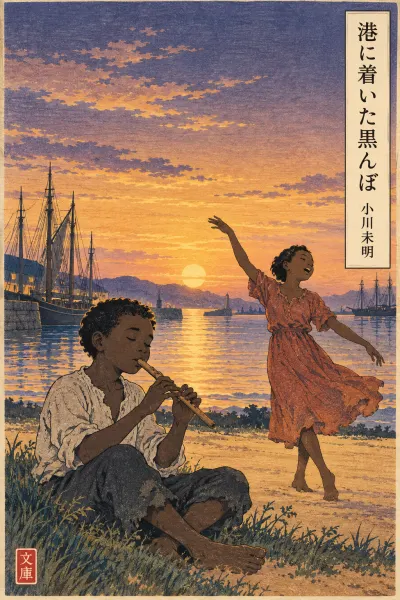
A blind boy and his older sister make music every day in a square by the harbour, until a stranger takes the sister away, saying a person from a big house in town wants to meet her. Left alone, the boy plays his flute in tears, and a swan that has lost her child turns him into a white bird and flies with him to the southern country. When the sister finally returns, she searches for him, and a dark-skinned man from a ship tells her he saw her dancing on a distant island of swans, which she takes to be another, kinder self.
AI translation · independently checked
みなとのちかくに、ひろいひろばがありました。Near the harbour, there was a wide open square.
そこに毎日、二人の子どもが来ました。Every day, two children came there.
男の子は十さいぐらいです。The boy was about ten years old.
めが見えません。He could not see.
でも、ふえがとてもじょうずです。But he played the flute very well.
女の子は、男の子のおねえさんです。The girl was the boy's older sister.
十六さいぐらいで、とてもきれいです。She was about sixteen, and very beautiful.
あおいふくをきています。She wore blue clothes.
おとうとのふえのおとで、うたって、おどります。To the sound of her little brother's flute, she sang and danced.
二人には、りょうしんがいません。The two of them had no parents.
おねえさんは、おとうとが大すきです。The sister loved her little brother dearly.
いつも、おとうとのてをひいて来ました。She always came leading him by the hand.
人がたくさん来て、二人のふえとうたを聞きました。Many people came and listened to the two children's flute and song.
そして、お金をあげました。And they gave them money.
あるなつのゆうがた、しらない男が来ました。One summer evening, a man they did not know came.
「まちの大きな家の人が、あなたにあいたいです。来てください。」"A person from a big house in town wants to see you. Please come."
「おとうとも、いっしょにいいですか。」"May my little brother come with me too?"
「いいえ、あなた一人です。でも、ながくはかかりません。」"No, only you. But it will not take long."
おねえさんは、おとうとにいいました。The sister spoke to her little brother.
「ちょっと出かけます。ここでまっていてね。一時間でかえります。」"I'm going out for a little while. Wait here for me, won't you? I'll be back in an hour."
「おねえさんは、もうかえってこない。」と、おとうとはいいました。"My sister isn't coming back anymore," said the little brother.
「大じょうぶよ。かえってきます。」"Don't worry. I will come back."
おねえさんは、男とばしゃにのって、行きました。The sister got into a carriage with the man and went away.
一時間まっても、二時間まっても、おねえさんはかえりません。He waited one hour, he waited two hours, but his sister did not come back.
よるになりました。Night came.
おとうとは、なきました。The little brother cried.
そして、ふえをふきました。And then he played his flute.
「おねえさん、このおとを聞いて、かえってきて。」"Sister, hear this sound and come back to me."
そこへ、一わのはくちょうが来ました。Just then, a swan came flying there.
はくちょうは、北のうみで子どもをなくしました。The swan had lost her young ones in the northern sea.
今、南の国へかえります。Now she was going home to the southern country.
かなしいふえのおとを聞いて、ひろばにおりました。She had heard the sad sound of the flute and come down into the square.
「どうして、一人でふえをふいていますか。」"Why are you playing your flute all alone?"
おとうとは、おねえさんの話をしました。The little brother told her about his sister.
「かわいそうに。わたしといっしょに、南の国へ行きましょう。あなたも白い鳥になります。」"You poor child. Come with me to the southern country. You will become a white bird too."
おとうとは、白い鳥になりました。The little brother became a white bird.
二わのはくちょうは、よるのそらを、とおい国へとんで行きました。The two swans flew away across the night sky to a faraway country.
おねえさんは、ずっと後でかえってきました。The sister came back much, much later.
でも、おとうとはいません。But her little brother was not there.
どこにもいません。He was nowhere to be found.
それから毎日、おねえさんは、みなとのまちをあるいて、おとうとをさがしました。From then on, every day, the sister walked through the harbour town searching for her little brother.
あるあさ、南の国から、ふねが来ました。One morning, a ship came from the southern country.
小さな、くろい男の人がおりてきました。A small, dark-skinned man came down from it.
その人は、おねえさんを見て、いいました。When he saw the sister, he spoke.
「あなたは、南のしまでうたっていた人ですね。」"You are the one who was singing on the southern island, aren't you?"
「いいえ。わたしは、しまにいませんでした。」"No. I was never on any island."
「でも、あおいふくをきていました。めの見えない男の子のふえで、おどっていました。そのしまには、はくちょうがたくさんいます。」"But you were wearing blue clothes. You were dancing to the flute of a boy who could not see. On that island there are many swans."
おねえさんは、とてもかなしくなりました。The sister grew very sad.
「もう一人のわたしが、おとうとといっしょに行きました。そのわたしは、わたしより、もっとやさしいわたしです。」"Another me went away with my brother. That me is a kinder me than I am."
「そのしまは、どこですか。わたしも行きたいです。」"Where is that island? I want to go there too."
男の人は、うみを見て、いいました。The man looked out at the sea and spoke.
「とてもとおい所です。ひろいうみをわたって、ゆきの白い、高い山にのぼって、行きます。」"It is a very faraway place. You cross the wide sea and climb high mountains white with snow to get there."
なつのゆうがたのそらは、まっかになっていました。The summer evening sky had turned a deep red.
Vocabulary
| Word | Meaning | JLPT |
|---|---|---|
| みなとみなと | harbour, portdictionary form: 港Usually written 港. The story's title begins with this word. | N4 |
| ひろばひろば | open square, plazadictionary form: 広場広 (wide) + 場 (place). | N2 |
| ふえふえ | flutedictionary form: 笛To play a flute is ふえをふく (literally 'blow the flute'). | N3 |
| じょうずじょうず | skilful, good atdictionary form: 上手Used with が: ふえがじょうずです 'is good at the flute'. | N5 |
| りょうしんりょうしん | parents (both)dictionary form: 両親Written 両親; 両 means 'both'. | N5 |
| ひいてひく | to pull; (てをひく) to lead someone by the handdictionary form: 引くてをひく is a set phrase for guiding a child or a blind person. | N5 |
| ばしゃばしゃ | horse-drawn carriagedictionary form: 馬車馬 (horse) + 車 (vehicle). | — |
| なきましたなく | to cry, to weepdictionary form: 泣く | N4 |
| ふきましたふく | to blow; to play (a wind instrument)dictionary form: 吹くDo not confuse with ふく 'clothes' (服) in the same story. | N5 |
| はくちょうはくちょう | swandictionary form: 白鳥Literally 'white bird'; birds are counted with 〜わ (羽): 一わ, 二わ. | — |
| なくしましたなくす | to lose (here: to lose a loved one to death)dictionary form: 無くす / 亡くすDifferent from なく 'to cry'. | — |
| さがしましたさがす | to look for, to search fordictionary form: 探す | N4 |
| くろいくろい | black; here, dark-skinneddictionary form: 黒いThe original title uses 黒んぼ, an old word for a dark-skinned or Black person. It is now considered offensive and is not used today; this edition says 'dark-skinned' instead. | N5 |
| まっかまっか | deep red, bright reddictionary form: 真っ赤真っ adds the meaning 'completely': 真っ白 'pure white', 真っ黒 'jet black'. | N3 |
Grammar
〜ている / 〜ていました N5 be doing; be in a state
The て-form plus いる shows an ongoing action or a continuing state. おどっていました describes her dancing as something that was going on, and きていました describes clothes she had on.
あおいふくをきていました。めの見えない男の子のふえで、おどっていました。
You were wearing blue clothes. You were dancing to the flute of a boy who could not see.
〜ても、〜ても N4 even if…, even if…; no matter how much…
The て-form plus も means 'even though'. Repeating it stresses that the result never changes: one hour, two hours, and still she does not return.
一時間まっても、二時間まっても、おねえさんはかえりません。
He waited one hour, he waited two hours, but his sister did not come back.
〜てくる (かえってくる) N4 come (back) toward the speaker
くる after a て-form shows movement toward the speaker. かえってきて is a soft, casual request: 'come back to me'.
おねえさん、このおとを聞いて、かえってきて。
Sister, hear this sound and come back to me.
〜になる N5 to become
A noun plus になる shows a change of state. With adjectives, い changes to く: かなしい → かなしくなる 'become sad'.
おとうとは、白い鳥になりました。
The little brother became a white bird.
〜ましょう N5 let's…
The ます-stem plus ましょう is a polite invitation to do something together. The swan uses it to invite the boy to fly away with her.
わたしといっしょに、南の国へ行きましょう。
Come with me to the southern country.
AはBより、もっと〜 N5 A is more … than B
より marks the thing being compared against, and もっと means 'more'. Here the sister compares herself with 'another me'.
そのわたしは、わたしより、もっとやさしいわたしです。
That me is a kinder me than I am.