Intermediate · JLPT N3
港に着いた黒んぼMinato ni Tsuita Kuronbo — The Stranger Who Came Ashore at the Harbour
- JLPT N3
- 6,856 characters
- 5 parts
- about 57 minutes
- 2 easier versions
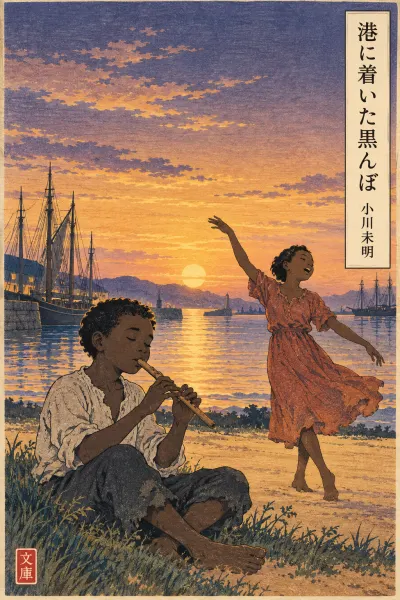
Ogawa Mimei's 港に着いた黒んぼ is a dōwa, a literary fairy tale written for children. Its mood is lyrical and melancholy rather than cheerful. In a harbour town one summer, a blind boy plays the flute in an open square while his older sister sings and dances barefoot on the sand. The two are orphans who earn their living from the crowds. One evening a messenger arrives and says a wealthy gentleman wishes to see the sister, and her brief absence sets the rest of the story in motion. Ordinary harbour life gives way to something closer to a dream, with a grieving swan, a jewel that appears from nowhere, and a southern island far beyond a silver sea. The narration is gentle and slightly old-fashioned, so it reads at a steady pace, but there are no character names to hold on to, and some of the plot turns are deliberately left unexplained. The title and text also use dated words that are offensive today, including 黒んぼ. This edition renders them in neutral English and explains them in the notes.
Contents
Easier versions
This story is also retold in simpler Japanese. Reading an easier version first makes the original much more approachable.
Before you read
- The narration is mostly polite past (〜ました) with the old storybook ending 〜のであります/〜のでありました, mixed with plain forms. Treat のであります as an emphatic, explanatory 'it was that…'. It does not change the meaning, so read past it once you recognise it.
- With no names in the text, speech style tells you who is talking. The messenger uses formal keigo such as 参りました and いらして. The sister speaks softly with feminine endings like 〜のよ. The boy calls himself 僕 and uses childish forms such as 〜んだもの.
- Learn a few patterns from the notes before you start: 〜ぬものはなかった (a double negative meaning 'there was no one who didn't…', i.e. everyone did), 〜もなければ〜もない ('neither… nor…'), 〜かと思うと ('no sooner… than…'), and 〜たものだ (habitual past, 'used to…').
- Some useful words for the opening parts are 笛 (flute), 姉 / 姉さん (older sister), 港 (harbour), 広場 (open square), and 使い (messenger). Later parts add 白鳥 (swan), 南の島 (the southern island), and 銀色の海 (silver sea).
- Expect dated and discriminatory vocabulary: 黒んぼ, 盲目, 乞食, 狂人 and 小人. These words reflect the period the story was written in, and you should not use them yourself. The notes give the neutral modern equivalents, for example 目の不自由な for 盲目.
Words to know
The most useful words from the notes across the story.
| Word | Meaning | JLPT |
|---|---|---|
| 盲目めくら | blindThe reading めくら is now considered discriminatory. Modern Japanese uses 盲目 (もうもく) in writing, or 目の見えない人. | — |
| 大尽だいじん | a very rich man, a magnateOld-fashioned word. Do not confuse it with 大臣 (だいじん, 'minister'). | — |
| 途中とちゅう | on the way, partway through a journey〜へ帰る途中 = on the way back to … | N4 |
| 笛ふえ | flute; pipeThe sound of a flute is 笛の音 (ふえのね). 音 is read ね for musical or pleasant sounds. | N3 |
| 哀れなあわれ | sad, mournful; pitifuldictionary form: 哀れA na-adjective that means both 'moving and sad' and 'pitiable'. The verb 憫れむ (あわれむ, to pity) appears later. | N3 |
| 頼るたよる | to depend on, rely on頼りなさ (13) is the noun form of 頼りない and means 'helplessness, a forlorn feeling'. | N3 |
| ほうぼうほうぼう | here and there, many placesdictionary form: 方々 | N3 |
| 手間てま | time and trouble手間を取らせる: to take up someone's time, to keep someone long. | N3 |
| 沖おき | the open sea, offshore | N3 |
| 翼つばさ | wing | N3 |
| 沈みしずむ | to sink; (悲しみに沈む) to be sunk in sorrowdictionary form: 沈むUsed literally for ships and the sun, and figuratively for deep feelings. | N3 |
| 陸おか | land, shore (as opposed to the sea)Usually read りく; the reading おか is older and used from the point of view of people at sea. | N3 |
| 評判ひょうばん | reputation; the talk of the townたいした評判 = 'everyone was talking about it'. | N3 |
| 容易ようい | easy, simpleA more formal word than 簡単; 容易に〜ない = 'cannot easily ~'. | N3 |
| しみじみとしみじみ | deeply, keenly, from the heartdictionary form: しみじみDescribes a feeling that soaks in slowly and deeply. | N2 |
Plot summary
Show the full summary (contains spoilers)
A blind boy and his older sister, both orphans, perform in a square by the harbour. He plays the flute while she sings and dances. One evening a messenger persuades the sister to visit a rich man's mansion and says it will not take long. She leaves her brother waiting on the grass, but night falls and she does not return. The frightened boy plays his flute with all his heart. A swan who has lost her own child hears him, offers to care for him, turns him into a white bird, and flies south with him. The sister comes back to find only evening primroses and a jewel shining on her collar. She searches the town in vain. Later a short, dark-skinned man from a southern ship tells her he saw her on a southern island, dancing to a blind boy's flute. Full of regret, she asks the way there, but the island lies thousands of leagues away beyond a silver sea and snowy mountains.
About the author
Ogawa Mimei was a Japanese writer from Niigata Prefecture. He is often called the father of modern Japanese children's literature, and he is sometimes described as 'the Japanese Andersen.' He studied at Tokyo Senmon Gakkō (now Waseda University), where his teacher Tsubouchi Shōyō is said to have given him the pen name Mimei. He wrote both fiction for adults and fairy tales, and he later devoted himself mainly to children's stories. His tales are known for their lyrical, often melancholy atmosphere and their concern for the weak and the lonely. Among his best-known works is 赤い蝋燭と人魚 (The Red Candles and the Mermaid).