Part 1 of 3 · JLPT N3
夏の葬列 Natsu no Sōretsu, part 1: Return to the Seaside Town
In this part
Ten-odd years after the war, a young office worker on his way home from a business trip stops at the seaside town where he was evacuated as a child. On a hot summer noon he walks out past the fields and suddenly sees a small funeral procession beyond a sweet-potato field, which pulls him straight back to a day in the last summer of the war. He remembers watching a funeral procession there with Hiroko, the older girl who looked after him, and racing her across the field because she said the mourners gave children sweet buns.
AI translation · independently checked
海岸の小さな町の駅に下りて、彼は、しばらくはものめずらしげにあたりを眺めていた。Stepping off the train at the station of the small seaside town, he stood for a while looking around him with curiosity.
駅前の風景はすっかり変っていた。The scene in front of the station had changed completely.
アーケードのついた明るいマーケットふうの通りができ、その道路も、固く鋪装されてしまっている。A bright, market-like street with an arcade had been built, and even the road itself had been paved hard.
はだしのまま、砂利の多いこの道を駈けて通学させられた小学生の頃の自分を、急になまなましく彼は思い出した。Suddenly, and vividly, he remembered himself as a schoolboy, made to run barefoot to school along this gravel-strewn road.
あれは、戦争の末期だった。That had been in the last days of the war.
彼はいわゆる疎開児童として、この町にまる三カ月ほど住んでいたのだった。He had lived in this town for a good three months as what was called an evacuee child.
――あれ以来、おれは一度もこの町をたずねたことがない。—Since then, I've never once come back to visit this town.
その自分が、いまは大学を出、就職をし、一人前の出張がえりのサラリーマンの一人として、この町に来ている……。And now that same boy has finished university, found a job, and come to this town as a fully fledged office worker on his way back from a business trip...
東京には、明日までに帰ればよかった。He only had to be back in Tokyo by tomorrow.
二、三時間は充分にぶらぶらできる時間がある。He had a good two or three hours to wander about as he pleased.
彼は駅の売店で煙草を買い、それに火を点けると、ゆっくりと歩きだした。He bought cigarettes at the station kiosk, lit one, and set off slowly on foot.
夏の真昼だった。It was high noon in summer.
小さな町の家並みはすぐに尽きて、昔のままの踏切りを越えると、線路に沿い、両側にやや起伏のある畑地がひろがる。The houses of the little town soon came to an end, and once he crossed the railway crossing, unchanged from the old days, fields of gently rolling land spread out on both sides along the tracks.
彼は目を細めながら歩いた。He walked with his eyes narrowed.
遠くに、かすかに海の音がしていた。Far off, the sea could be faintly heard.
なだらかな小丘の裾、ひょろ長い一本の松に見憶えのある丘の裾をまわりかけて、突然、彼は化石したように足をとめた。He was just rounding the foot of a gentle little hill, a hill he recognised by its single tall, spindly pine, when all at once he stopped dead, as if turned to stone.
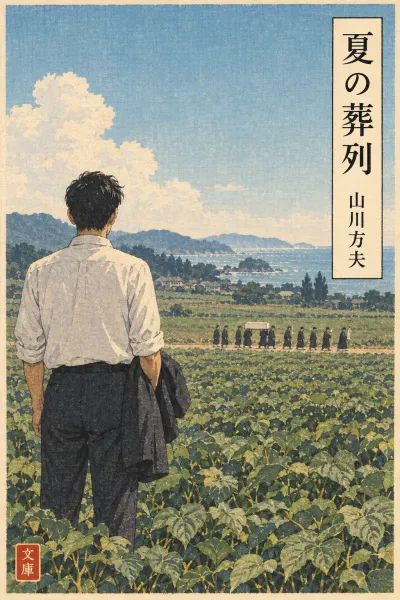
真昼の重い光を浴び、青々とした葉を波うたせたひろい芋畑の向うに、一列になって、喪服を着た人びとの小さな葬列が動いている。Beyond a broad sweet-potato field whose lush green leaves rippled under the heavy light of noon, a small funeral procession of people in mourning clothes was moving along in single file.
一瞬、彼は十数年の歳月が宙に消えて、自分がふたたびあのときの中にいる錯覚にとらえられた。For an instant he was seized by the illusion that the ten-odd years had vanished into thin air and that he was back inside that moment once more.
……呆然と口をあけて、彼は、しばらくは呼吸をすることを忘れていた。...Dumbfounded, his mouth hanging open, he forgot for a while even to breathe.
濃緑の葉を重ねた一面のひろい芋畑の向うに、一列になった小さな人かげが動いていた。Beyond the broad sweet-potato field, layered all over with deep green leaves, small figures were moving in single file.
線路わきの道に立って、彼は、真白なワンピースを着た同じ疎開児童のヒロ子さんと、ならんでそれを見ていた。Standing on the path beside the tracks, he was watching them side by side with Hiroko, a fellow evacuee in a pure white dress.
この海岸の町の小学校(当時は国民学校といったが)では、東京から来た子供は、彼とヒロ子さんの二人きりだった。At the elementary school in this seaside town (back then it was called a National People's School), he and Hiroko were the only two children who had come from Tokyo.
二年上級の五年生で、勉強もよくでき大柄なヒロ子さんは、いつも彼をかばってくれ、弱むしの彼をはなれなかった。Hiroko, two years ahead of him in the fifth grade, a big girl who did well at her studies, always stood up for him and never left his side, timid little thing that he was.
よく晴れた昼ちかくで、その日も、二人きりで海岸であそんできた帰りだった。It was close to noon on a clear, sunny day, and that day too they were on their way back from playing by the sea, just the two of them.
行列は、ひどくのろのろとしていた。The procession was moving terribly slowly.
先頭の人は、大昔の人のような白い着物に黒っぽい長い帽子をかぶり、顔のまえでなにかを振りながら歩いている。The person at its head wore a white robe like someone from ancient times and a tall, dark hat, and walked waving something in front of his face.
つづいて、竹筒のようなものをもった若い男。Next came a young man holding something like a bamboo tube.
そして、四角く細長い箱をかついだ四人の男たちと、その横をうつむいたまま歩いてくる黒い和服の女。And then four men carrying a long, narrow, square box on their shoulders, and beside them a woman in a black kimono, walking with her head bowed.
……...
「お葬式だわ」"It's a funeral."
と、ヒロ子さんがいった。said Hiroko.
彼は、口をとがらせて答えた。He pouted as he answered.
「へんなの。東京じゃあんなことしないよ」"That's weird. They don't do stuff like that in Tokyo."
「でも、こっちじゃああするのよ」ヒロ子さんは、姉さんぶっておしえた。"But that's how they do it here," Hiroko explained, playing the big sister.
「そしてね。子供が行くと、お饅頭をくれるの。お母さんがそういったわ」"And you know what? If children go, they give them a manjū bun. My mother told me so."
「お饅頭? ほんとうのアンコの?」"A manjū? With real bean paste?"
「そうよ。ものすごく甘いの。そして、とっても大きくって、赤ちゃんの頭ぐらいあるんだって」"That's right. Ever so sweet. And really big, too — they say it's as big as a baby's head."
彼は唾をのんだ。He swallowed hard.
「ね。……ぼくらにも、くれると思う?」"Hey... do you think they'd give us some too?"
「そうね」ヒロ子さんは、まじめな顔をして首をかしげた。"Let me see," said Hiroko, tilting her head with a serious look.
「くれる、かもしれない」"They might, maybe."
「ほんと?」"Really?"
「行ってみようか? じゃあ」"Shall we go and see, then?"
「よし」と彼は叫んだ。"Okay!" he shouted.
「競走だよ!」"Race you!"
芋畑は、真青な波を重ねた海みたいだった。The sweet-potato field was like a sea of deep green waves piled one upon another.
彼はその中におどりこんだ。He plunged into it.
近道をしてやるつもりだった。He meant to take a shortcut.
……ヒロ子さんは、畦道を大まわりしている。...Hiroko was going the long way round along the raised path between the fields.
ぼくのほうが早いにきまっている、もし早い者順でヒロ子さんの分がなくなっちゃったら、半分わけてやってもいい。I'm bound to get there first; and if it's first come, first served and there's none left for Hiroko, I don't mind giving her half of mine.
芋のつるが足にからむやわらかい緑の海のなかを、彼は、手を振りまわしながら夢中で駈けつづけた。Through the soft green sea, with potato vines tangling round his feet, he kept running for all he was worth, his arms flailing.
Vocabulary
| Word | Meaning | JLPT |
|---|---|---|
| ものめずらしげものめずらしげ | with curiosity; as if everything were newdictionary form: 物珍しげ〜げ added to an adjective stem means 'looking ~, with an air of ~'. | — |
| 末期まっき | final stage; last days (of a period)Read まつご, it means 'one's dying moment', so the reading changes the meaning. | N1 |
| 疎開そかい | wartime evacuation (of city children to the countryside)疎開児童 were schoolchildren sent away from cities to escape air raids in 1944–45. | — |
| 一人前いちにんまえ | fully fledged; a proper adultAlso 'one serving' of food; read いちにんまえ in both senses. | — |
| 尽きてつきる | to run out; to come to an enddictionary form: 尽きる | N1 |
| 葬列そうれつ | funeral processionKey word of the title: 葬 'burial' + 列 'line'. | — |
| 喪服もふく | mourning clothes | — |
| 錯覚さっかく | illusion; false impression錯覚にとらえられる: to be gripped by an illusion. | N1 |
| 呆然ぼうぜん | dumbfounded; stunnedUsually used as an adverb: 呆然と. | N1 |
| 国民学校こくみんがっこう | National People's SchoolThe wartime name (1941–47) for elementary schools in Japan. | — |
| かばってかばう | to protect; to stick up fordictionary form: 庇うUsually written in kana. | — |
| 弱むしよわむし | weakling; crybabydictionary form: 弱虫Literally 'weak bug'; a common childish insult. | — |
| 口をとがらせてくちをとがらせる | to poutdictionary form: 口を尖らせるLiterally 'to sharpen one's mouth'; it shows sulking or displeasure. | — |
| 畦道あぜみち | raised footpath between fields | — |
Grammar
〜させられる N3 be made to do (causative-passive)
The causative 駈けさせる 'make (someone) run' becomes passive, so the subject is forced to do the action. Here the boy had no choice about running barefoot to school.
はだしのまま、砂利の多いこの道を駈けて通学させられた
made to go to school barefoot, running along this gravelly road
〜ばよかった N4 it was enough to ~; only had to ~
〜ばいい means 'it's fine if ~', and in the past tense it describes what was required at the time. Here it shows that he had no need to hurry back.
東京には、明日までに帰ればよかった。
He only had to be back in Tokyo by tomorrow.
〜かける N3 to be about to ~; to start ~
Attached to the verb stem, かける marks an action that has begun but is not finished. He was in the middle of rounding the hill when he stopped.
丘の裾をまわりかけて、突然、彼は化石したように足をとめた
just as he was rounding the foot of the hill, he suddenly stopped as if turned to stone
〜ぶる N2 to act like ~; to put on airs of ~
Added to a noun, ぶる means behaving as if one were that thing, often with a hint of pretence. Hiroko takes on the role of a knowing older sister.
ヒロ子さんは、姉さんぶっておしえた
Hiroko explained, playing the big sister
〜んだって N4 I heard that ~; they say ~
って is a casual quotative, and with んだ it reports hearsay. Hiroko is passing on what her mother told her.
赤ちゃんの頭ぐらいあるんだって
they say it's as big as a baby's head
〜にきまっている N3 it's certain that ~; bound to ~
It expresses the speaker's strong conviction, often a subjective one. Here it shows the boy's childish confidence that he will win.
ぼくのほうが早いにきまっている
I'm bound to be faster