Part 3 of 3 · JLPT N3
夏の葬列 Natsu no Sōretsu, part 3: The Photograph on the Coffin
In this part
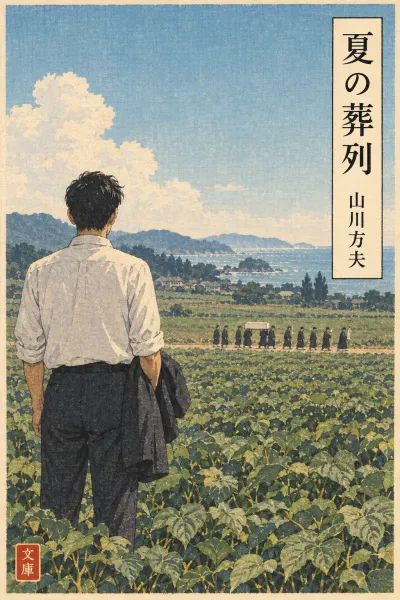
A funeral procession passes, and on the coffin he sees a photograph he takes for Hiroko grown up, and he is overjoyed to think he is not a murderer after all. The village children tell him the dead woman was an old madwoman who drowned herself; the photo was old, and she lost her mind after her only daughter was machine-gunned in that very field. He realises he now carries two deaths, Hiroko's and her mother's, and walks back to the station knowing he can never escape them.
AI translation · independently checked
芋の葉を、白く裏返して風が渡って行く。The wind sweeps across the potato leaves, turning them over to show their white undersides.
葬列は彼のほうに向かってきた。The funeral procession was coming toward him.
中央に、写真の置かれている粗末な柩がある。In the middle was a plain coffin with a photograph set upon it.
写真の顔は女だ。The face in the photograph was a woman's.
それもまだ若い女のように見える。And she looked young, too.
……不意に、ある予感が彼をとらえた。…Suddenly a premonition took hold of him.
彼は歩きはじめた。He began to walk.
彼は、片足を畦道の土にのせて立ちどまった。He stopped, one foot resting on the earth of the narrow path between the fields.
あまり人数の多くはない葬式の人の列が、ゆっくりとその彼のまえを過ぎる。The line of mourners, not very many of them, slowly passed in front of him.
彼はすこし頭を下げ、しかし目は熱心に柩の上の写真をみつめていた。He bowed his head slightly, but his eyes stayed intently fixed on the photograph on top of the coffin.
もし、あのとき死んでいなかったら、彼女はたしか二十八か、九だ。If she had not died back then, she would be twenty-eight, or twenty-nine, if he remembered right.
突然、彼は奇妙な歓びで胸がしぼられるような気がした。All at once he felt his chest wrung by a strange joy.
その写真には、ありありと昔の彼女の面かげが残っている。The photograph clearly kept the look of her face as it once had been.
それは、三十歳近くなったヒロ子さんの写真だった。It was a photograph of Hiroko at nearly thirty.
まちがいはなかった。There was no mistake.
彼は、自分が叫びださなかったのが、むしろ不思議なくらいだった。If anything, it seemed a wonder to him that he had not cried out.
――おれは、人殺しではなかったのだ。So I was not a murderer after all.
彼は、胸に湧きあがるものを、けんめいに冷静におさえつけながら思った。He thought this while struggling to calmly hold down what was welling up in his chest.
たとえなんで死んだにせよ、とにかくこの十数年間を生きつづけたのなら、もはや彼女の死はおれの責任とはいえない。Whatever she died of, if she had gone on living through these ten-odd years, then her death could no longer be called my responsibility.
すくなくとも、おれに直接の責任がないのはたしかなのだ。At the very least, it is certain that I bear no direct responsibility.
「……この人、ビッコだった?」"…Was this lady lame?"
彼は、群れながら列のあとにつづく子供たちの一人にたずねた。He asked one of the children who were trailing in a cluster behind the procession.
あのとき、彼女は太腿をやられたのだ、と思いかえしながら。As he asked, he recalled that she had been hit in the thigh that day.
「ううん。ビッコなんかじゃない。からだはぜんぜん丈夫だったよ」"Nuh-uh. She wasn't a cripple or nothing. She was totally healthy."
一人が、首をふって答えた。One of them answered, shaking his head.
では、癒ったのだ!Then it had healed!
おれはまったくの無罪なのだ!I am completely innocent!
彼は、長い呼吸を吐いた。He let out a long breath.
苦笑が頬にのぼってきた。A wry smile rose to his cheeks.
おれの殺人は、幻影にすぎなかった。My murder had been nothing but an illusion.
あれからの年月、重くるしくおれをとりまきつづけていた一つの夏の記憶、それはおれの妄想、おれの悪夢でしかなかったのだ。The memory of one summer, which had kept pressing in on me so heavily all the years since, had been nothing more than my delusion, my nightmare.
葬列は確実に一人の人間の死を意味していた。The procession surely meant that a human being had died.
それをまえに、いささか彼は不謹慎だったかもしれない。In the face of that, he may have been somewhat irreverent.
しかし十数年間もの悪夢から解き放たれ、彼は、青空のような一つの幸福に化してしまっていた。But set free from a nightmare that had lasted more than ten years, he had become one pure happiness, like a blue sky.
……もしかしたら、その有頂天さが、彼にそんなよけいな質問を口に出させたのかもしれない。…Perhaps it was that elation that made him blurt out such an unnecessary question.
「なんの病気で死んだの? この人」"What illness did she die of, this lady?"
うきうきした、むしろ軽薄な口調で彼はたずねた。He asked in a cheerful, even flippant tone.
「この小母さんねえ、気違いだったんだよ」"This lady, see, she was crazy."
ませた目をした男の子が答えた。A boy with knowing, grown-up eyes answered.
「一昨日ねえ、川にとびこんで自殺しちゃったのさ」"Day before yesterday, see, she jumped in the river and killed herself."
「へえ。失恋でもしたの?」"Really? Was she crossed in love or something?"
「バカだなあ小父さん」運動靴の子供たちは、口々にさもおかしそうに笑った。"You're so dumb, mister!" The children in their sneakers all laughed together, as if it were the funniest thing.
「だってさ、この小母さん、もうお婆さんだったんだよ」"'Cause, see, this lady was already an old woman."
「お婆さん? どうして。あの写真だったら、せいぜい三十くらいじゃないか」"An old woman? How? From that photo she'd be thirty at most, wouldn't she?"
「ああ、あの写真か。……あれねえ、うんと昔のしかなかったんだってよ」"Oh, that photo. …They say that was the only one they had, from way back."
洟をたらした子があとをいった。A boy with a runny nose took up the story.
「だってさ、あの小母さん、なにしろ戦争でね、一人きりの女の子がこの畑で機銃で撃たれて死んじゃってね、それからずっと気が違っちゃってたんだもんさ」"'Cause, see, that lady, what with the war and all, her one and only girl got shot by a machine gun in this field and died, and ever since then she'd been out of her mind."
葬列は、松の木の立つ丘へとのぼりはじめていた。The procession had begun to climb toward the hill where the pine trees stood.
遠くなったその葬列との距離を縮めようというのか、子供たちは芋畑の中におどりこむと、歓声をあげながら駈けはじめた。As if to close the gap between themselves and the procession, now far off, the children leapt into the potato field and began running, whooping as they went.
立ちどまったまま、彼は写真をのせた柩がかるく左右に揺れ、彼女の母の葬列が丘を上って行くのを見ていた。Standing still where he was, he watched the coffin with the photograph on it sway gently from side to side as her mother's funeral procession climbed the hill.
一つの夏といっしょに、その柩の抱きしめている沈黙。The silence the coffin held in its embrace, together with one summer.
彼は、いまはその二つになった沈黙、二つの死が、もはや自分のなかで永遠につづくだろうこと、永遠につづくほかはないことがわかっていた。He knew that those silences, which had now become two, those two deaths, would go on forever inside him, that they could do nothing but go on forever.
彼は、葬列のあとは追わなかった。He did not follow the procession.
追う必要がなかった。There was no need to follow it.
この二つの死は、結局、おれのなかに埋葬されるほかはないのだ。In the end, these two deaths can only be buried inside me.
――でも、なんという皮肉だろう、と彼は口の中でいった。And yet, what an irony, he said under his breath.
あれから、おれはこの傷にさわりたくない一心で海岸のこの町を避けつづけてきたというのに。And yet, ever since then, I have kept away from this seaside town, wanting only to avoid touching this wound.
そうして今日、せっかく十数年後のこの町、現在のあの芋畑をながめて、はっきりと敗戦の夏のあの記憶を自分の現在から追放し、過去の中に封印してしまって、自分の身をかるくするためにだけおれはこの町に下りてみたというのに。And yet today, ten-odd years later, I went to the trouble of coming down to this town for one reason only: to look at that potato field as it is now, to banish the memory of that summer of defeat from my present once and for all, to seal it away in the past, and so to lighten my burden.
……まったく、なんという偶然の皮肉だろう。…Truly, what an irony of chance.
やがて、彼はゆっくりと駅の方角に足を向けた。Before long, he slowly turned his steps toward the station.
風がさわぎ、芋の葉の匂いがする。The wind stirs, and there is the smell of potato leaves.
よく晴れた空が青く、太陽はあいかわらず眩しかった。The clear sky was blue, and the sun was as dazzling as ever.
海の音が耳にもどってくる。The sound of the sea comes back to his ears.
汽車が、単調な車輪の響きを立て、線路を走って行く。A train runs along the tracks, its wheels sounding out a monotonous rhythm.
彼は、ふと、いまとはちがう時間、たぶん未来のなかの別な夏に、自分はまた今とおなじ風景をながめ、今とおなじ音を聞くのだろうという気がした。Suddenly he felt that at some other time, perhaps in another summer in the future, he would once again gaze at this same scene and hear these same sounds.
そして時をへだて、おれはきっと自分の中の夏のいくつかの瞬間を、一つの痛みとしてよみがえらすのだろう……。And across the distance of time, I will surely bring back to life certain moments of summer within me, as a single pain…
思いながら、彼はアーケードの下の道を歩いていた。With these thoughts, he walked along the street beneath the arcade.
もはや逃げ場所はないのだという意識が、彼の足どりをひどく確実なものにしていた。The knowledge that there was no longer anywhere to run made his steps remarkably steady.
Vocabulary
| Word | Meaning | JLPT |
|---|---|---|
| 葬列そうれつ | funeral procession葬 (burial, funeral) + 列 (line). A key word of the story and its title. | — |
| 柩ひつぎ | coffinAlso written 棺. 棺桶 (かんおけ) is the everyday word. | — |
| 予感よかん | premonition, foreboding予 (beforehand) + 感 (feel). Common in the phrase 予感がする. | N1 |
| 畦道あぜみち | narrow raised path between fields | — |
| 面かげおもかげ | look, traces of a face as it once wasdictionary form: 面影Usually written 面影. Here 面 is read おも, not めん. | — |
| ビッコびっこ | lame, crippled (offensive)dictionary form: びっこA dated slur for someone with a limp, normal in children's speech of the period. Avoid it today; say 足が不自由. | — |
| 無罪むざい | innocent, not guiltyA legal term. The opposite is 有罪 (ゆうざい). | — |
| 幻影げんえい | illusion, phantom | — |
| 不謹慎ふきんしん | irreverent, inappropriate for a solemn occasionOften used for joking or cheerfulness at funerals and disasters. | — |
| 有頂天うちょうてん | elation, being in rapturesOriginally a Buddhist term for the highest heaven. Here it takes the noun suffix 〜さ. | — |
| 気違いきちがい | crazy, a madwoman (offensive)A strong slur for mental illness, now treated as a banned word. Sentence 47 uses the related verb 気が違う, 'to lose one's mind'. | — |
| ませたませる | precocious, grown-up beyond one's yearsdictionary form: ませるUsed of children. ませた子 means a precocious kid. | — |
| 洟はな | snot, nasal mucus洟をたらす means to have a runny nose, a stock image of a village child. | — |
| 皮肉ひにく | ironyAlso means sarcasm. なんという皮肉だろう means 'what an irony'. | N2 |
Grammar
たとえ〜にせよ N2 whatever / even if …
にせよ is a written form of にしても. With a question word (なんで), it means 'no matter what'. たとえ strengthens the concession.
たとえなんで死んだにせよ
whatever she died of
〜にすぎない N2 nothing more than …
This pattern downplays something as merely X. Here he tells himself his 'murder' was only an illusion.
おれの殺人は、幻影にすぎなかった。
My murder had been nothing but an illusion.
Causative 〜させる (inanimate cause) N4 to make someone do
The causer here is an emotion, その有頂天さ, not a person. This is a common literary way of saying a feeling drove someone to act.
その有頂天さが、彼にそんなよけいな質問を口に出させたのかもしれない
perhaps it was that elation that made him blurt out such an unnecessary question
〜ほかはない N2 there is no choice but to …
This attaches to the dictionary form, here the passive 埋葬される. It shows the only possible outcome; the same pattern appears in sentence 52 with つづくほかはない.
この二つの死は、結局、おれのなかに埋葬されるほかはないのだ。
In the end, these two deaths can only be buried inside me.
〜一心で N1 with the single desire to …, wanting only …
一心 means 'one heart, single-mindedness'. Placed after a verb clause, it gives one overriding motive for an action.
おれはこの傷にさわりたくない一心で海岸のこの町を避けつづけてきた
wanting only to avoid touching this wound, I have kept away from this seaside town
〜というのに N2 even though …, and yet …
This is an emphatic form of のに that conveys frustration or bitter irony. Ending the sentence on it leaves the disappointed 'and yet look what happened' unspoken.
あれから、おれはこの傷にさわりたくない一心で海岸のこの町を避けつづけてきたというのに。
And yet ever since then I have kept away from this seaside town, wanting only to avoid touching this wound.