Part 2 of 3 · JLPT N3
夏の葬列 Natsu no Sōretsu, part 2: Strafed in the Potato Field
In this part
During the war, a boy lying in a potato field is strafed by two carrier-based fighter planes. When Hiroko, in her white clothes, runs to help him, he panics and shoves her away with all his strength, and a blast hurls her into the air. Years later, a funeral procession winding through the same potato fields brings that wartime summer back to him; he recalls that she was gravely wounded and that he left the town without ever learning what became of her.
AI translation · independently checked
正面の丘のかげから、大きな石が飛び出したような気がしたのはその途中でだった。It was partway there that he felt as if a large stone had come flying out from behind the hill straight ahead.
石はこちらを向き、急速な爆音といっしょに、不意に、なにかを引きはがすような烈しい連続音がきこえた。The stone turned toward them, and together with a rapidly swelling roar there suddenly came a fierce, continuous noise like something being ripped away.
叫びごえがあがった。A shout went up.
「カンサイキだあ」と、その声はどなった。"Fighter planes!" the voice bellowed.
艦載機だ。Carrier planes.
彼は恐怖に喉がつまり、とたんに芋畑の中に倒れこんだ。His throat closed up with fear, and in that instant he threw himself down in the potato field.
炸裂音が空中にすさまじい響きを立てて頭上を過ぎ、女の泣きわめく声がきこえた。The bursts of gunfire passed overhead with a tremendous din that filled the air, and he heard a woman wailing and sobbing.
ヒロ子さんじゃない、と彼は思った。That isn't Hiroko, he thought.
あれは、もっと大人の女のひとの声だ。That's the voice of a woman, someone more grown-up.
「二機だ、かくれろ! またやってくるぞう」奇妙に間のびしたその声の間に、べつの男の声が叫んだ。"It's two planes—take cover! They're coming back!" In the gaps of that strangely drawling voice, another man's voice shouted.
「おーい、ひっこんでろその女の子、だめ、走っちゃだめ! 白い服はぜっこうの目標になるんだ、……おい!」"Hey, you there, girl—get back! No, don't run, don't run! White clothes make a perfect target... Hey!"
白い服――ヒロ子さんだ。White clothes—that's Hiroko.
きっと、ヒロ子さんは撃たれて死んじゃうんだ。Hiroko's going to get shot and die, for sure.
そのとき第二撃がきた。Just then the second attack came.
男が絶叫した。A man screamed.
彼は、動くことができなかった。He could not move.
頬っぺたを畑の土に押しつけ、目をつぶって、けんめいに呼吸をころしていた。He pressed his cheek into the soil of the field, shut his eyes, and desperately held his breath.
頭が痺れているみたいで、でも、無意識のうちに身体を覆おうとするみたいに、手で必死に芋の葉を引っぱりつづけていた。His head felt numb, and yet, as though he were unconsciously trying to cover his body, his hands kept frantically pulling at the potato leaves.
あたりが急にしーんとして、旋回する小型機の爆音だけが不気味につづいていた。All around, everything suddenly went silent, and only the drone of the small planes circling overhead went on, eerily.
突然、視野に大きく白いものが入ってきて、やわらかい重いものが彼をおさえつけた。All at once something big and white filled his view, and something soft and heavy pressed down on him.
「さ、早く逃げるの。いっしょに、さ、早く。だいじょうぶ?」"Come on, we have to run, quickly. Together—come on, quickly. Are you all right?"
目を吊りあげ、別人のような真青なヒロ子さんが、熱い呼吸でいった。Her eyes wide and fierce, her face deathly pale, like a different person, Hiroko spoke with hot, panting breath.
彼は、口がきけなかった。He could not speak.
全身が硬直して、目にはヒロ子さんの服の白さだけがあざやかに映っていた。His whole body had gone rigid, and all that registered in his eyes was the vivid whiteness of Hiroko's clothes.
「いまのうちに、逃げるの、……なにしてるの? さ、早く!」"We have to run while we can... What are you doing? Come on, quickly!"
ヒロ子さんは、怒ったようなこわい顔をしていた。Hiroko's face was frightening, almost angry.
ああ、ぼくはヒロ子さんといっしょに殺されちゃう。Oh no, I'm going to get killed along with Hiroko.
ぼくは死んじゃうんだ、と彼は思った。I'm going to die, he thought.
声の出たのは、その途端だった。It was at that very moment that his voice came back.
ふいに、彼は狂ったような声で叫んだ。Suddenly he screamed in a voice like a madman's.
「よせ! 向うへ行け! 目立っちゃうじゃないかよ!」"Stop it! Go away! You'll make us stand out!"
「たすけにきたのよ!」ヒロ子さんもどなった。"I came to help you!" Hiroko shouted back.
「早く、道の防空壕に……」"Quick, to the shelter by the road..."
「いやだったら! ヒロ子さんとなんて、いっしょに行くのいやだよ!」夢中で、彼は全身の力でヒロ子さんを突きとばした。"I said no! I don't want to go anywhere with you!" Beside himself, he shoved Hiroko away with all the strength in his body.
「……むこうへ行け!」"...Go away!"
悲鳴を、彼は聞かなかった。He did not hear a scream.
そのとき強烈な衝撃と轟音が地べたをたたきつけて、芋の葉が空に舞いあがった。At that moment a violent shock and a thunderous roar slammed into the ground, and potato leaves went flying up into the sky.
あたりに砂埃のような幕が立って、彼は彼の手で仰向けに突きとばされたヒロ子さんがまるでゴムマリのようにはずんで空中に浮くのを見た。A curtain like a cloud of dust rose all around, and he saw Hiroko, whom his own hands had shoved over onto her back, bounce up like a rubber ball and hang in the air.
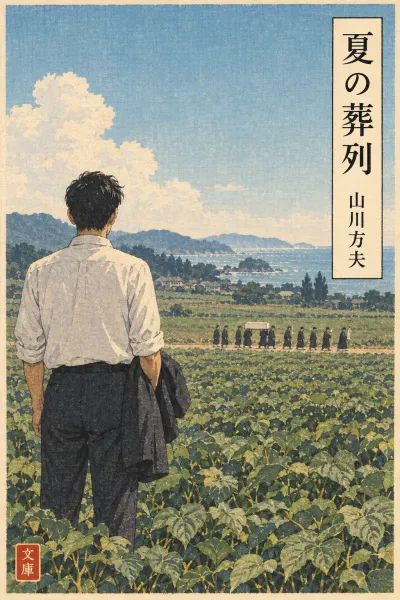
葬列は、芋畑のあいだを縫って進んでいた。The funeral procession was threading its way between the potato fields.
それはあまりにも記憶の中のあの日の光景に似ていた。It looked all too much like the scene from that day in his memory.
これは、ただの偶然なのだろうか。Could this be mere coincidence?
真夏の太陽がじかに首すじに照りつけ、眩暈に似たものをおぼえながら、彼は、ふと、自分には夏以外の季節がなかったような気がしていた。The midsummer sun beat straight down on the back of his neck, and, feeling something close to dizziness, he suddenly felt as though there had never been any season for him but summer.
……それも、助けにきてくれた少女を、わざわざ銃撃のしたに突きとばしたあの夏、殺人をおかした、戦時中の、あのただ一つの夏の季節だけが、いまだに自分をとりまきつづけているような気がしていた。...And more than that, he felt as though only that one summer still surrounded him even now: that single wartime summer when he had committed murder, when he had deliberately shoved the girl who came to rescue him out into the gunfire.
彼女は重傷だった。She was badly wounded.
下半身を真赤に染めたヒロ子さんはもはや意識がなく、男たちが即席の担架で彼女の家へはこんだ。Hiroko, the lower half of her body soaked in red, was already unconscious, and the men carried her home on a makeshift stretcher.
そして、彼は彼女のその後を聞かずにこの町を去った。And he left the town without hearing what became of her.
あの翌日、戦争は終ったのだ。The very next day, the war ended.
Vocabulary
| Word | Meaning | JLPT |
|---|---|---|
| 艦載機かんさいき | carrier-based aircraftWartime term for planes launched from aircraft carriers; here American fighters strafing civilians. 艦 = warship, 載 = carry on board, 機 = machine/aircraft. | — |
| 芋畑いもばたけ | potato field (sweet potatoes)畑 becomes ばたけ through rendaku. | — |
| 炸裂音さくれつおん | sound of bursting shells or gunfire炸裂 means 'to explode, burst'. | — |
| 間のびまのび | drawn-out, slow, drawlingdictionary form: 間延びUsually written 間延び. Literally 'the gap (間) stretches'. | — |
| 目標もくひょう | targetAlso means 'goal' in everyday use. Here it is a military target. | N3 |
| 呼吸をころしてこきゅうをころす | to hold one's breath, breathe silentlydictionary form: 呼吸を殺すLike 息を殺す. ころす (kill) is used figuratively for suppressing a sound or breath. | — |
| 旋回せんかい | circling, wheeling (of aircraft) | — |
| 不気味ぶきみ | eerie, ominous, creepy | — |
| 防空壕ぼうくうごう | air-raid shelterLiterally 'air-defence trench'. These were dug everywhere in wartime Japan. | — |
| 突きとばしたつきとばす | to shove away violently, knock someone flyingdictionary form: 突き飛ばす突く (thrust) + 飛ばす (send flying). | — |
| 葬列そうれつ | funeral processionThe key word of the title: 葬 (funeral) + 列 (line). | — |
| 眩暈めまい | dizziness, vertigoDifficult kanji. It is usually written in kana or as 目眩. | N2 |
| 銃撃じゅうげき | gunfire, shooting | — |
| 担架たんか | stretcher | N1 |
Grammar
〜のは…だった N3 it was … that ~ (cleft sentence)
の turns the first clause into a noun, and the part after は is put in focus. Here the emphasis falls on the time, 'partway there'. The same structure appears with 声の出たのは、その途端だった.
大きな石が飛び出したような気がしたのはその途中でだった。
It was partway there that he felt as if a large stone had come flying out.
〜ような気がする N4 to feel as if ~, to have a feeling that ~
This expresses a vague impression rather than a certain fact. The story uses it repeatedly to show the boy's perceptions and the man's memories.
自分には夏以外の季節がなかったような気がしていた。
He felt as though there had never been any season for him but summer.
〜ちゃう N4 casual contraction of 〜てしまう (completion, regret)
〜てしまう becomes 〜ちゃう in speech, and 〜でしまう becomes 〜じゃう. It conveys something unwanted and irreversible. Here it carries the child's dread of death.
きっと、ヒロ子さんは撃たれて死んじゃうんだ。
Hiroko's going to get shot and die, for sure.
〜ちゃだめ N4 you mustn't ~
This is a colloquial contraction of 〜てはだめ, a strong prohibition. The man shouts it at Hiroko because running in white makes her a target.
だめ、走っちゃだめ!
No, don't run, don't run!
〜じゃないか(よ) N3 but ~!, can't you see ~! (reproachful emphasis)
Attached to a plain form, this blames the listener for an obvious bad result. The added よ makes it rougher and more childish.
目立っちゃうじゃないかよ!
You'll make us stand out!
〜ずに N3 without doing ~
This is a written equivalent of 〜ないで, attached to the negative stem of a verb. 聞かずに means 'without hearing' what happened to her.
彼は彼女のその後を聞かずにこの町を去った。
He left the town without hearing what became of her.