Intermediate · JLPT N3
夏の葬列Natsu no Sōretsu — A Procession in Midsummer
- JLPT N3
- 4,744 characters
- 3 parts
- about 40 minutes
- 2 easier versions
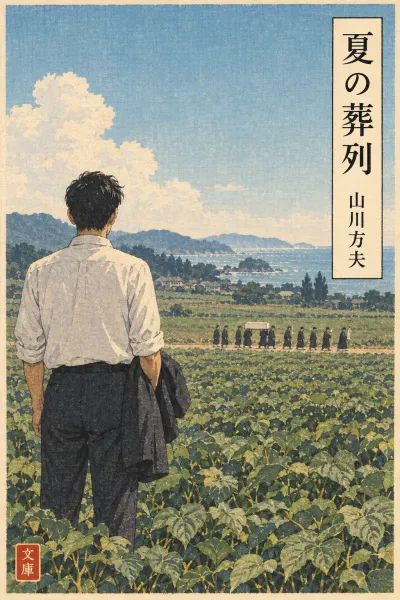
夏の葬列 is a short literary story about guilt and memory. A young office worker, returning to Tokyo from a business trip, gets off the train at the small seaside town where he was evacuated as a child during the war. Walking out past the sweet-potato fields on a hot summer noon, he sees a small funeral procession, and the sight pulls him back to the last summer of the war and to Hiroko, the older girl who looked after him there. The story turns on a single act he has never been able to face, and on what the procession in front of him might mean. The tone is quiet and tightly controlled, with sudden shifts between present and past. For a learner, the text is short and its vocabulary is concrete: fields, heat, planes, the coffin, the photograph. The main challenge is the narration, which moves without warning from third-person past tense into the man's own anguished inner voice and breaks off in dashes and ellipses. The children's dialogue also includes wartime vocabulary and some harsh period slurs.
Contents
Easier versions
This story is also retold in simpler Japanese. Reading an easier version first makes the original much more approachable.
Before you read
- Track the shifts in voice and time. The narration usually refers to the man as 彼 in plain past tense, but it slips into his inner voice with おれ, often after a dash (――) or an ellipsis (……). When you see those marks, ask whether you are in the present scene, in memory, or inside his head.
- Learn the wartime vocabulary before you start: 疎開 (evacuation), 国民学校 (wartime elementary school), 艦載機 (carrier-based plane), 防空壕 (air-raid shelter), and 機銃 (machine gun). Also learn the scene words that recur throughout: 葬列, 棺, 写真, and 芋畑.
- Watch how grammar carries his guilt and self-justification. 〜ばよかった expresses regret, 〜にきまっている shows his forced certainty, and 〜ような気がする marks his uncertain memory. 〜のは…だった is used for emphatic recollection.
- Compare the speech styles. Hiroko speaks gently with 〜わ and 〜の, and the young boy uses ぼく and 〜ちゃだめ. The village children speak bluntly, using 〜んだって for hearsay and 〜ちゃう. Their hearsay is how the truth reaches him.
- The children use period slurs such as ビッコ (a derogatory word for a lame person) and 気違い (a derogatory word for a mentally ill person). They are offensive today and should not be used, but here they show how casually cruel the village talk is.
Words to know
The most useful words from the notes across the story.
| Word | Meaning | JLPT |
|---|---|---|
| 葬列そうれつ | funeral processionKey word of the title: 葬 'burial' + 列 'line'. | — |
| 畦道あぜみち | raised footpath between fields | — |
| 目標もくひょう | targetAlso means 'goal' in everyday use. Here it is a military target. | N3 |
| 眩暈めまい | dizziness, vertigoDifficult kanji. It is usually written in kana or as 目眩. | N2 |
| 皮肉ひにく | ironyAlso means sarcasm. なんという皮肉だろう means 'what an irony'. | N2 |
| 末期まっき | final stage; last days (of a period)Read まつご, it means 'one's dying moment', so the reading changes the meaning. | N1 |
| 尽きてつきる | to run out; to come to an enddictionary form: 尽きる | N1 |
| 錯覚さっかく | illusion; false impression錯覚にとらえられる: to be gripped by an illusion. | N1 |
| 呆然ぼうぜん | dumbfounded; stunnedUsually used as an adverb: 呆然と. | N1 |
| 担架たんか | stretcher | N1 |
| 予感よかん | premonition, foreboding予 (beforehand) + 感 (feel). Common in the phrase 予感がする. | N1 |
| ものめずらしげものめずらしげ | with curiosity; as if everything were newdictionary form: 物珍しげ〜げ added to an adjective stem means 'looking ~, with an air of ~'. | — |
| 疎開そかい | wartime evacuation (of city children to the countryside)疎開児童 were schoolchildren sent away from cities to escape air raids in 1944–45. | — |
| 一人前いちにんまえ | fully fledged; a proper adultAlso 'one serving' of food; read いちにんまえ in both senses. | — |
| 喪服もふく | mourning clothes | — |
Plot summary
Show the full summary (contains spoilers)
Ten-odd years after the war, a young office worker stops at the seaside town where he was evacuated as a child. Beyond a sweet-potato field he sees a funeral procession, and he remembers watching one there with Hiroko, the older girl who protected him. She told him the mourners gave children sweet buns, and he raced her across the field. He also remembers carrier-based fighters strafing the field. When Hiroko, in her white clothes, ran to help him, he shoved her away in panic, and a blast threw her into the air. He left the town without learning her fate. Now he sees a photograph on the coffin and takes it for Hiroko grown up. Overjoyed, he thinks he is not a murderer after all. The village children tell him the dead woman was an old madwoman who drowned herself. The photograph was an old one, and she had lost her mind after her only daughter was machine-gunned in that very field. Realising he now carries two deaths, Hiroko's and her mother's, he walks back to the station knowing he can never escape them.
About the author
Yamakawa Masao (山川方夫) was a Tokyo-born writer and the son of the nihonga painter Yamakawa Shūhō. His own fiction was nominated several times for the Akutagawa Prize. He died at the age of thirty-four from injuries suffered in a traffic accident.