 N4 · easy
Simplified retelling · JLPT N4
夏の葬列 Natsu no Sōretsu in easy Japanese (N4)
This is our own simplified retelling of A Procession in Midsummer, written for N4 learners and checked word by word against the N4 vocabulary list. A few story words and grammar patterns go beyond N4; the notes below give each one's level. It keeps the characters, events and ending of the original. When it feels easy, move on to the original text.
The story in brief
Some fifteen years after the war, a young office worker returns to the seaside town where he was evacuated as a child. He sees a funeral procession like the one he and Hiroko went to watch the day before the war ended, when, during an air attack, he pushed her away and she was hit. At first he is relieved to think she survived, but he learns that the funeral is for her mother, who had lost her mind after her only daughter was killed. He understands that he can never forget or escape that summer.
AI translation · independently checked
彼は、海の近くの小さな町の駅で、電車を降りました。He got off the train at the station of a small town near the sea.
駅の前は、すっかりかわっていました。The area in front of the station had changed completely.
十五年ぐらい前、せんそうの夏に、彼は東京からこの町に来ました。About fifteen years earlier, in a summer during the war, he had come to this town from Tokyo.
小学生で、この町に住んでいました。He had been a schoolboy then, living in this town.
今は大学を出て、会社で働いています。Now he had graduated from university and was working for a company.
今日は仕事の帰りに、この町に寄りました。Today, on his way home from work, he had stopped off in this town.
暑い夏の昼でした。It was a hot summer afternoon.
彼はゆっくり歩きました。He walked slowly.
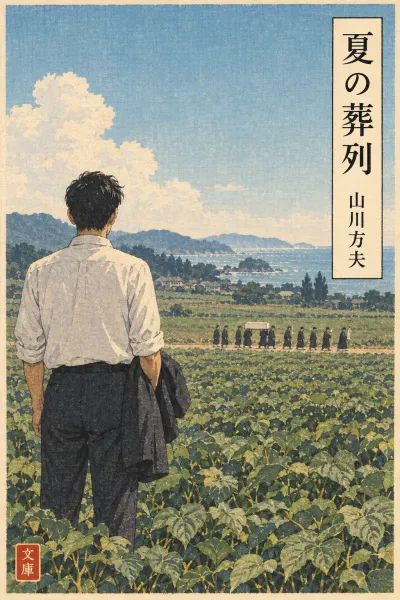
道のそばに、広いいもばたけがあります。Beside the road lay a wide field of sweet potatoes.
遠くで、海の音が聞こえました。In the distance he could hear the sound of the sea.
彼は、急に止まりました。Suddenly he stopped.
はたけの向こうを、黒い服の人たちが行列で歩いています。On the far side of the field, people dressed in black were walking in a procession.
そうしきです。It was a funeral.
あの日と同じでした。It was just like that day.
あの日、彼はヒロ子さんと二人で、そうしきを見ていました。On that day he and Hiroko had watched a funeral together, just the two of them.
ヒロ子さんも東京から来た子で、五年生でした。Hiroko had also come from Tokyo, and she was in fifth grade.
勉強がよくできて、いつも弱い彼のそばにいてくれました。She did well at her studies, and she always stayed by his side, weak as he was.
その日、ヒロ子さんは白い服を着ていました。That day Hiroko was wearing a white dress.
「おそうしきよ。子どもが行くと、まんじゅうがもらえるの。とても大きくて、あまいのよ」"It's a funeral. If children go, they get a sweet bun. They're really big, and sweet too."
「ぼくたちも、もらえるかな」"I wonder if we can get one too."
「行ってみようか」"Shall we go and see?"
「うん。きょうそうだよ!」"Yeah. Race you!"
彼は、いもばたけの中に走って入りました。He ran straight into the potato field.
ヒロ子さんは、道を回って行きました。Hiroko went the long way round by the road.
すると、山の向こうから、小さなひこうきが来ました。Just then a small plane came over the hill.
大きな音がして、ひこうきが上からうってきました。There was a loud noise, and the plane opened fire from above.
彼はこわくて、はたけの中にたおれました。He was terrified and threw himself down in the field.
「その女の子、走ってはだめだ!白い服はよく見えるぞ!」と、男の人のこえがしました。A man's voice shouted, "You, girl, don't run! That white dress stands out a mile!"
彼は動けませんでした。He could not move.
そこへ、ヒロ子さんが走って来ました。Then Hiroko came running up to him.
「早くにげよう。いっしょに、早く!」"Let's get away, quick. Together. Hurry!"
白い服のヒロ子さんといっしょにいたら、ぼくも死んでしまう。If I stay with Hiroko in her white dress, I'll be killed too.
彼はそう思いました。That was what he thought.
「いやだ!向こうへ行け!」"No! Go away!"
彼は、ヒロ子さんを強くおしました。He shoved Hiroko hard.
そのすぐ後、大きな音がしました。A moment later there was a loud explosion.
いものはが、空に飛びました。Potato leaves flew up into the air.
ヒロ子さんの体も、高く飛ぶのが見えました。He saw Hiroko's body fly high into the air as well.
ヒロ子さんの足から、ちがたくさん出ていました。Blood was pouring from Hiroko's legs.
男の人たちが、ヒロ子さんを家に運びました。Some men carried Hiroko to a house.
次の日、せんそうは終りました。The next day the war ended.
彼は、ヒロ子さんがどうなったか聞かずに、東京へ帰りました。He went back to Tokyo without asking what had happened to Hiroko.
そして長い間、ヒロ子さんが死んだのは自分が悪いと思っていました。And for a long time he believed that Hiroko's death was his fault.
今、行列が彼の前に来ました。Now the procession came up in front of him.
ひつぎの上に、写真があります。On top of the coffin there was a photograph.
三十さいぐらいの女の人です。It was of a woman of about thirty.
それは、ヒロ子さんでした。It was Hiroko.
彼はうれしくなりました。A wave of happiness came over him.
ヒロ子さんは、あの日に死にませんでした。Hiroko had not died that day.
大人になるまで、生きていたのです。She had lived until she was a grown woman.
彼は、行列の後ろの子どもに聞きました。He asked a child at the back of the procession,
「この人は、足が悪かった?」"Did this lady have a bad leg?"
「いいえ。とてもじょうぶだったよ」"No. She was really healthy."
彼は安心しました。He felt relieved.
そして、また聞きました。Then he asked again,
「何の病気で死んだの?」"What illness did she die of?"
「このおばさんは、心の病気だったんだよ。おととい、川に入って死んだんだ」"This lady was sick in her mind. The day before yesterday she walked into the river and drowned."
「でも、写真の人は三十さいぐらいでしょう?」"But the woman in the photo is only about thirty, isn't she?"
「写真は、むかしのしかなかったんだって。おばさんは、もうおばあさんだったよ。せんそうで、一人だけの女の子が、このはたけでうたれて死んだんだ。それから、心の病気になったんだよ」"They say they only had an old photo of her. She was already an old woman. In the war her only daughter was shot and killed in this field. After that she went out of her mind."
彼は、何も言えませんでした。He could not say a word.
これは、ヒロ子さんのお母さんのそうしきでした。This was the funeral of Hiroko's mother.
行列は、山の方へのぼって行きました。The procession climbed on toward the hills.
彼は、長い間この町に来ませんでした。For a long time he had not come to this town.
今日は、あの夏をわすれるために来ました。He had come today in order to forget that summer.
でも、そうはなりませんでした。But it had not turned out that way.
ヒロ子さんとお母さん、二人が死んだことを、これからもわすれることはできません。Hiroko and her mother, the two of them, had died, and he would never be able to forget it.
彼にはそれが分かりました。He understood that now.
彼は、ゆっくり駅の方へ歩きました。He walked slowly back toward the station.
空は青く、海の音が聞こえます。The sky was blue, and he could hear the sound of the sea.
もうにげることはできない、と彼は思いました。I can't run away anymore, he thought.
Vocabulary
| Word | Meaning | JLPT |
|---|---|---|
| 行列ぎょうれつ | procession; line of peopleAlso the everyday word for a queue, e.g. outside a popular shop. | N2 |
| そうしきそうしき | funeraldictionary form: 葬式お葬式 (おそうしき) in sentence 19 is the polite form, typical of a girl's speech. | N2 |
| すっかりすっかり | completely, totallyOften used with change: すっかりかわる, "to change completely". | N4 |
| 寄りましたよる | to stop off at, drop bydictionary form: 寄るOften in the pattern 〜の帰りに〜に寄る, "stop off at ~ on the way back". | N4 |
| いもばたけいもばたけ | sweet-potato fielddictionary form: 芋畑いも + はたけ; は becomes ば when the words join (rendaku). During the war, sweet potatoes were an important food. | — |
| まんじゅうまんじゅう | manju, a steamed bun with sweet bean fillingdictionary form: 饅頭Sweets like this were sometimes given out at funerals, a rare treat for children in wartime. | — |
| きょうそうきょうそう | race, competitiondictionary form: 競争Here a child's shout: "It's a race!" | N4 |
| うってうつ | to shoot, fire (a gun)dictionary form: 撃つPassive うたれる (sentence 59) means "to be shot". Do not confuse it with 打つ, "to hit". | N3 |
| にげようにげる | to run away, escapedictionary form: 逃げるThe story ends with にげることはできない. The word means fleeing danger here, and fleeing memory at the end. | N4 |
| おしましたおす | to push, shovedictionary form: 押す | N5 |
| ひつぎひつぎ | coffindictionary form: 棺 | — |
| じょうぶじょうぶ | healthy, strongdictionary form: 丈夫Also used for sturdy objects (じょうぶなかばん). Not to be confused with 大丈夫, "all right". | N5 |
| 安心しましたあんしんする | to feel relieved, be reassureddictionary form: 安心する | — |
| 心の病気こころのびょうき | mental illnessA gentle, indirect expression. The original story uses the blunt period word 気違い ("madwoman"), which is now offensive. | — |
Grammar
〜てくれる N4 someone does something for me / for the person in focus
くれる shows that Hiroko's action benefited him, and it adds a sense of gratitude. Because the narration follows him closely, his debt to her is felt even in plain description.
いつも弱い彼のそばにいてくれました
she always stayed by his side, because he was weak
〜たら N4 if / when (condition)
The た-form + ら sets up a condition: "if I am with her". The result is the feared outcome, ぼくも死んでしまう.
白い服のヒロ子さんといっしょにいたら、ぼくも死んでしまう。
If I stay with Hiroko in her white dress, I'll be killed too.
〜てしまう N4 to end up doing; something regrettable happens
しまう marks an outcome as complete and unwanted. Here it expresses the boy's panic about being killed.
ぼくも死んでしまう
I'll be killed too
〜ずに N3 without doing ~
ず is a written negative form attached to the ない-stem (聞か-). 〜ずに means the same as 〜ないで: he left without asking.
ヒロ子さんがどうなったか聞かずに、東京へ帰りました
He went back to Tokyo without asking what had happened to Hiroko.
〜んだって N3 I heard that ~ / they say ~
って is casual quotation, and here it marks hearsay. The child is passing on what adults said about the photo.
写真は、むかしのしかなかったんだって。
They say they only had an old photo of her.
〜ことはできない N4 cannot do ~
This is the negative of 〜ことができる, with は adding emphasis: there is no way he can forget. The same pattern closes the story with にげることはできない.
これからもわすれることはできません
he would never be able to forget it