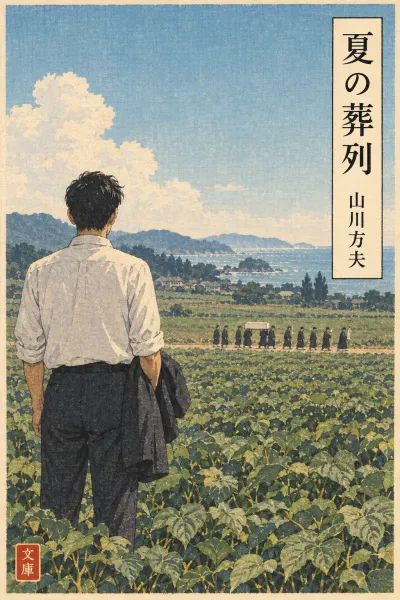
 N5 · easy
Simplified retelling · JLPT N5
夏の葬列 Natsu no Sōretsu in easy Japanese (N5)
This is our own simplified retelling of A Procession in Midsummer, written for N5 learners and checked word by word against the N5 vocabulary list. A few story words and grammar patterns go beyond N5; the notes below give each one's level. It keeps the characters, events and ending of the original. When it feels easy, move on to the N4 version or the original text.
The story in brief
A man goes back to the seaside town where he was evacuated as a child and sees a funeral procession, just like one he saw with Hiroko fifteen years earlier, when a plane attacked and he pushed her away. He learns that Hiroko died that summer and that this is her mother's funeral. He came to forget that summer, but now he knows he never will.
AI translation · independently checked
なつの昼です。It was a summer afternoon.
一人の男の人が、うみの近くの小さなまちで、でんしゃをおりました。A man got off the train in a small town near the sea.
かれは、かいしゃではたらいています。He works for a company.
十五年前、せんそうがありました。Fifteen years earlier, there had been a war.
そのなつ、子どものかれは、とうきょうからこのまちに来て、住んでいました。That summer, when he was a child, he had come to this town from Tokyo and lived here.
それから、このまちには来ませんでした。He had never come back to this town since.
かれは、ゆっくりみちをあるきました。He walked slowly along the road.
はたけの向こうに、くろいふくの人たちが、ならんであるいています。Beyond the fields, people dressed in black were walking in a line.
そうしきです。It was a funeral.
かれは、とまりました。He stopped.
十五年前と、おなじです。It was just like fifteen years ago.
十五年前のなつの昼、かれはヒロ子さんと二人で、そうしきを見ていました。On a summer afternoon fifteen years ago, he and Hiroko had watched a funeral together, just the two of them.
ヒロ子さんも、とうきょうから来た子どもです。Hiroko was also a child who had come from Tokyo.
かれより二つ大きい女の子で、白いふくを着ていました。She was a girl two years older than him, and she was wearing white clothes.
ヒロ子さんは、いつもよわいかれといっしょにいました。Hiroko was always together with him, the weak boy.
「そうしきでは、子どもに大きなまんじゅうをあげるのよ。」"At funerals, they give the children big sweet buns, you know."
「ほんとう?行こう!」"Really? Let's go!"
かれは、はたけの中を走りました。He ran through the fields.
そのあと、ひこうきが来て、人をうちました。After that, a plane came and fired on the people.
かれは、かおを土につけて、目をつけて、何もできませんでした。He pressed his face, his eyes, into the dirt, and could do nothing at all.
「白いふくはあぶないぞ!」と、男の人が大きなこえでいいました。"White clothes are dangerous!" a man shouted.
ヒロ子さんが、かれのそばに来ました。Hiroko came up beside him.
「早く!いっしょに行こう!」"Quick! Let's go together!"
「いやだ!向こうへ行け!」"No! Get away from me!"
かれは、ヒロ子さんをつよくおしました。He pushed Hiroko hard.
すぐに、ひこうきがまたうちました。At once, the plane fired again.
ヒロ子さんの白い体が、上にとびました。Hiroko's white body flew up into the air.
ヒロ子さんは、足をうたれました。Hiroko was shot in the leg.
つぎの朝、かれはまちを出ました。The next morning, he left the town.
そして、せんそうがおわりました。And then the war ended.
かれは、長い間「ぼくがわるい」とおもっていました。For a long time, he had thought, "It's my fault."
今、そうしきのしゃしんを見ました。Now he looked at the funeral photograph.
三十さいぐらいの女の人です。It was a woman of about thirty.
ヒロ子さんのかおです。It was Hiroko's face.
「ヒロ子さんは、あのなつの後も、生きていたんだ。」"So Hiroko lived on after that summer."
かれは、そうしきの後ろの子どもに聞きました。He asked a child at the back of the procession.
「この人は、足がわるかったの?」"Did this lady have a bad leg?"
「いいえ。体はじょうぶだったよ。」"No. She was perfectly healthy."
かれは、そらのように、あかるくなりました。He became bright, like the sky.
「何のびょうきで、しんだの?」"What illness did she die of?"
「このおばさんは、頭のびょうきだったよ。おととい、川に入ってしんだんだ。もう、おばあさんだったよ。あのしゃしんは、とてもふるいんだ。」"This lady was sick in the head. The day before yesterday she walked into the river and died. She was already an old woman. That photo is really old."
「せんそうのなつ、一人の女の子が、このはたけでうたれて、しんだんだ。それから、おばさんは長い間、びょうきだったんだよ。」"In the summer of the war, a girl got shot in this field and died. After that, the lady was sick for a long time."
かれは、わかりました。He understood.
ヒロ子さんは、あのなつにしにました。Hiroko had died that summer.
これは、ヒロ子さんのお母さんのそうしきです。This was the funeral of Hiroko's mother.
かれは、そうしきについて行きませんでした。He did not follow the funeral procession.
二人のしは、これからいつも、かれの中にあります。From now on, the two deaths would always be inside him.
かれは、あのなつをわすれに、このまちに来ました。He had come to this town to forget that summer.
でも、わすれられません。But he could not forget it.
そらは青く、かぜがふいています。The sky was blue, and the wind was blowing.
かれは、ゆっくりえきへあるきました。He walked slowly toward the station.
あのなつは、これからもいつも、かれといっしょです。That summer would always be with him, from now on as well.
Vocabulary
| Word | Meaning | JLPT |
|---|---|---|
| そうしきそうしき | funeraldictionary form: 葬式Key word of the story. A funeral procession is 葬列 (そうれつ), as in the title. | N2 |
| はたけはたけ | field (for vegetables or crops)dictionary form: 畑A dry field. A rice paddy is 田 (た). | N3 |
| せんそうせんそう | wardictionary form: 戦争Here it means the Pacific War, which ended in 1945. | N4 |
| ならんでならぶ | to line up; to walk in a linedictionary form: 並ぶThe て-form describes how the people walk: in a line. | N5 |
| まんじゅうまんじゅう | manjū, a steamed bun filled with sweet bean pastedictionary form: 饅頭Sweets like this were sometimes handed out at funerals. In wartime they were a rare treat for hungry children. | — |
| ひこうきひこうき | airplanedictionary form: 飛行機Here it means an enemy fighter plane. | N5 |
| うちましたうつ | to shoot; to fire (a gun)dictionary form: 撃つWritten 撃つ when it means shooting. Do not confuse it with 打つ (to hit), which has the same reading. | N3 |
| あぶないあぶない | dangerousdictionary form: 危ないWhite clothes could easily be seen from the air. | N5 |
| おしましたおす | to pushdictionary form: 押すThe opposite is 引く (ひく), to pull. | N5 |
| よわいよわい | weakdictionary form: 弱いThe opposite is つよい. つよく in sentence 25 is its adverb form. | N5 |
| じょうぶじょうぶ | healthy; strong; sturdydictionary form: 丈夫A な-adjective. It is used for people's bodies and for things that do not break easily. | N5 |
| おとといおととい | the day before yesterdaydictionary form: 一昨日 | N5 |
| 頭のびょうきあたまのびょうき | an illness of the mind (literally 'an illness of the head')dictionary form: 頭の病気A child's blunt way to describe mental illness. The original story uses a harsher period slur here. | — |
| わすれられませんわすれる | to forgetdictionary form: 忘れるThis is the negative potential form: 'cannot forget'. | N5 |
Grammar
〜ていました N5 was doing (an ongoing action in the past)
The て-form + いました shows an action that was in progress at a time in the past. It sets the scene of the memory.
十五年前のなつの昼、かれはヒロ子さんと二人で、そうしきを見ていました。
On a summer afternoon fifteen years ago, he and Hiroko had watched a funeral together.
AよりB N5 B compared to A; more B than A
より marks the thing being compared against. A number before the adjective tells how big the difference is, here two years.
かれより二つ大きい女の子
a girl two years older than him
Volitional form (〜う/〜よう) N4 let's ~
行く becomes 行こう. In casual speech this form invites someone to do something together.
「ほんとう?行こう!」
"Really? Let's go!"
Passive (〜れる/〜られる) N4 to be ~ed; to have ~ done to one
うつ becomes うたれる. The person who is affected is the subject, and the body part that was hit is marked with を.
ヒロ子さんは、足をうたれました。
Hiroko was shot in the leg.
Verb stem + に + 来る/行く N5 to come or go in order to do ~
The ます-stem (わすれ) + に gives the purpose of the movement. He came to the town in order to forget.
かれは、あのなつをわすれに、このまちに来ました。
He had come to this town to forget that summer.
〜んだ N4 explanatory ending: it's that ~ / you see
の or ん + だ after a plain form gives an explanation or the background to something. The child uses it to explain the woman's death to the man.
おととい、川に入ってしんだんだ。
The day before yesterday she walked into the river and died.