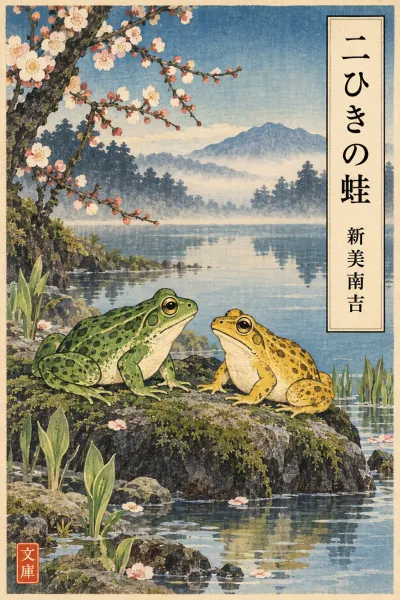
 N3 · easy
Simplified retelling · JLPT N3
二ひきの蛙 Nihiki no Kaeru in easy Japanese (N3)
This is our own simplified retelling of The Green Frog and the Yellow Frog, written for N3 learners and checked word by word against the N3 vocabulary list. A few story words and grammar patterns go beyond N3; the notes below give each one's level. It keeps the characters, events and ending of the original. When it feels easy, move on to the original text.
The story in brief
A green frog and a yellow frog meet in a field, insult each other's colours and start to fight. Winter is coming, so they agree to settle the fight in spring and dig into the ground to sleep. When they wake in spring and wash in the clear pond, each finds the other's colour beautiful, and they decide to stop quarrelling.
AI translation · independently checked
みどり色のかえると、きいろのかえるが、はたけの真ん中でばったり会いました。A green frog and a yellow frog happened to bump into each other in the middle of a field.
「やあ、きみはきいろだね。きたない色だ。」"Well, you're yellow, aren't you. What a dirty colour."
と、みどりのかえるが言いました。So said the green frog.
「きみはみどりだね。きみは自分のことを美しいと思っているのかい。」"And you're green, aren't you. Do you think you're beautiful, then?"
と、きいろのかえるが言いました。So said the yellow frog.
こんなふうに話していると、良いことは起こりません。When folk talk to each other like this, nothing good comes of it.
二ひきのかえるは、とうとうけんかを始めました。At last the two frogs began to fight.
みどりのかえるは、きいろのかえるの上に飛びかかりました。The green frog leapt on top of the yellow frog.
このかえるは、飛びかかるのがとても得意でした。This frog was very good at leaping on others.
きいろのかえるは、後ろの足ですなをけりました。The yellow frog kicked up sand with its back legs.
すなは、みどりのかえるの顔に飛んでいきました。The sand flew into the green frog's face.
それで、みどりのかえるは、何度も目からすなを払わなければなりませんでした。So the green frog had to brush the sand out of its eyes again and again.
そのとき、寒い風が吹いてきました。Just then, a cold wind began to blow.
二ひきのかえるは、もうすぐ冬が来ることを思い出しました。The two frogs remembered that winter would soon be here.
かえるたちは、土の中にもぐって、寒い冬をこさなければならないのです。Frogs, you see, must burrow into the ground and wait out the cold winter there.
「春になったら、このけんかの勝負をつけよう。」"When spring comes, we'll settle this fight once and for all."
と言って、みどりのかえるは土にもぐりました。With that, the green frog burrowed into the ground.
「今言ったことを忘れるなよ。」"Don't you forget what you just said!"
と言って、きいろのかえるも土にもぐりました。With that, the yellow frog burrowed into the ground too.
寒い冬が来ました。The cold winter came.
かえるたちがねむっている土の上に、冷たい北風がびゅうびゅうと吹きました。Over the ground where the frogs lay sleeping, the icy north wind blew and howled.
しもばしらも立ちました。Frost columns even rose up out of the soil.
それから、また春がやってきました。And then spring came round once more.
土の中でねむっていたかえるたちは、背中の上の土があたたかくなってきたので、春が来たことが分かりました。The frogs sleeping underground felt the earth above their backs growing warm, and so they knew that spring had come.
最初に目を覚ましたのは、みどりのかえるでした。The first to wake up was the green frog.
みどりのかえるは、土の上に出てみました。The green frog climbed out onto the ground to have a look.
ほかのかえるは、まだだれも出ていません。None of the other frogs had come out yet.
「おいおい、起きなさい。もう春だよ。」"Hey, hey, wake up! It's spring already!"
と、みどりのかえるは土の中に向かって呼びました。So the green frog called down into the ground.
すると、きいろのかえるが、Then the yellow frog,
「やれやれ、春になったか。」"Well, well, so it's spring, is it?"
と言って、土から出てきました。said, and came up out of the ground.
「去年のけんか、忘れたか。」"Have you forgotten last year's fight?"
と、みどりのかえるが言いました。said the green frog.
「待て待て。体の土を洗ってからにしよう。」"Wait, wait. Let's wash the dirt off ourselves first."
と、きいろのかえるが言いました。said the yellow frog.
二ひきのかえるは、体についたどろを落とすために、いけの方へ行きました。The two frogs went over to the pond to get rid of the mud stuck to their bodies.
いけには、新しい水がいっぱいありました。The pond was full of fresh new water.
ラムネのように、すっきりとしたきれいな水でした。It was clean water, as clear and crisp as ramune soda.
かえるたちは、その水の中へ、とぶん、とぶんと飛び込みました。Into that water the frogs jumped—plop, plop!
体を洗ってから、みどりのかえるは目をぱちぱちさせて言いました。When it had washed, the green frog blinked its eyes and said,
「やあ、きみのきいろは美しいね。」"Why, your yellow is beautiful!"
「そういえば、きみのみどりだって、すばらしいよ。」"Now that you mention it, your green is splendid too."
と、きいろのかえるが言いました。said the yellow frog.
そこで、二ひきのかえるは、And so the two frogs
「もうけんかはやめよう。」"Let's not fight any more."
と言い合いました。said to each other.
よくねむった後は、人間でもかえるでも、きげんが良くなるものなのです。After a good long sleep, you see, people and frogs alike are bound to be in a better mood.
Vocabulary
| Word | Meaning | JLPT |
|---|---|---|
| ばったりばったり | by chance, unexpectedly (meeting someone)Very often used with 会う: ばったり会う = run into someone. | N3 |
| 飛びかかるとびかかる | to leap at, to pounce on飛ぶ (jump) + かかる (attack, set upon). | — |
| 得意とくい | good at, skilled at〜が得意 = be good at ~; the opposite is 苦手 (にがて). | N3 |
| 払わはらう | to brush away, to wipe offdictionary form: 払うUsually means 'to pay', but here it means to brush something off. | N4 |
| もぐってもぐる | to burrow into, to dive underdictionary form: もぐるKanji: 潜る. Used for going under water, soil or blankets. | N2 |
| こさこす | to get through, to pass (a season)dictionary form: 越す冬を越す = to survive the winter, a set phrase. | N3 |
| 勝負をつけしょうぶをつける | to settle a contest, to decide who winsdictionary form: 勝負をつける勝負 = victory or defeat; a contest. | — |
| しもばしらしもばしら | frost columns (needle ice pushing up from the soil)dictionary form: 霜柱Thin columns of ice that lift the soil on cold winter mornings; 霜 (frost) + 柱 (pillar). | — |
| 目を覚ましめをさます | to wake updictionary form: 目を覚ますA little more formal than 起きる, which also means 'to get up'. | — |
| すっきりすっきり | clear, refreshing, cleanAlso used for feeling refreshed: 気分がすっきりする. | N2 |
| ぱちぱちぱちぱち | blinking (sound/look of eyes opening and closing)目をぱちぱちさせる = to blink one's eyes. It is also the sound of clapping. | — |
| 言い合いいいあう | to say to each otherdictionary form: 言い合うVerb stem + 合う = do something to each other. | — |
| きげんきげん | mood, temperdictionary form: 機嫌きげんが良い = in a good mood; きげんが悪い = in a bad mood. | N3 |
Grammar
〜なければならない N4 must, have to
The ない-form with the ない changed to なければ, followed by ならない, means something is necessary. Here it is polite past: 払わなければなりませんでした = had to brush off.
みどりのかえるは、何度も目からすなを払わなければなりませんでした。
The green frog had to brush the sand out of its eyes again and again.
〜たら N4 when / once (something happens)
The た-form + ら shows that the main action happens after the condition is met. 春になったら = once spring has come.
春になったら、このけんかの勝負をつけよう。
When spring comes, we'll settle this fight once and for all.
Verb dictionary form + な N3 don't ~ (strong command)
Adding な after the dictionary form makes a blunt prohibition, used in rough or casual male speech. よ at the end adds emphasis.
今言ったことを忘れるなよ。
Don't you forget what you just said!
〜ために N4 in order to
Dictionary form + ために shows the purpose of an action. The frogs went to the pond so that they could get the mud off.
体についたどろを落とすために、いけの方へ行きました。
They went over to the pond to get rid of the mud stuck to their bodies.
〜のように N3 like ~, as ~ as
Noun + のように compares one thing to another. Here the water is compared to ramune, a clear fizzy drink.
ラムネのように、すっきりとしたきれいな水でした。
It was clean water, as clear and crisp as lemonade.
〜ものだ N3 it is natural that ~, things are bound to ~
ものだ (here ものなのです) states a general truth about how things usually are. The narrator uses it for the story's closing lesson.
よくねむった後は、人間でもかえるでも、きげんが良くなるものなのです。
After a good long sleep, people and frogs alike are bound to be in a better mood.